Qiu Feng, Wang Kunyu, Li Tingting, Song Dandan, Wang Zhiwei, Zhang Hailing, Liu Jianguo, Ren Ming, Qi Xiaokun
Department of Neurology, Sixth Medical Center of Chinese PLA General Hospital, Beijing, 100048, People's Republic of China.
Department of Gastroenterology, Second Medical Center of Chinese PLA General Hospital, Beijing, 100853, People's Republic of China.
Neuropsychiatr Dis Treat. 2019 Nov 5;15:3061-3067. doi: 10.2147/NDT.S218073. eCollection 2019.
The differential diagnosis of Parkinson's disease (PD) with multiple-system atrophy (MSA) is difficult because of their similarity in symptoms and signs. The objective of this study was to investigate the value of external anal-sphincter electromyography (EAS-EMG) and urethral-sphincter electromyography (US-EMG) in differentiating MSA from PD.
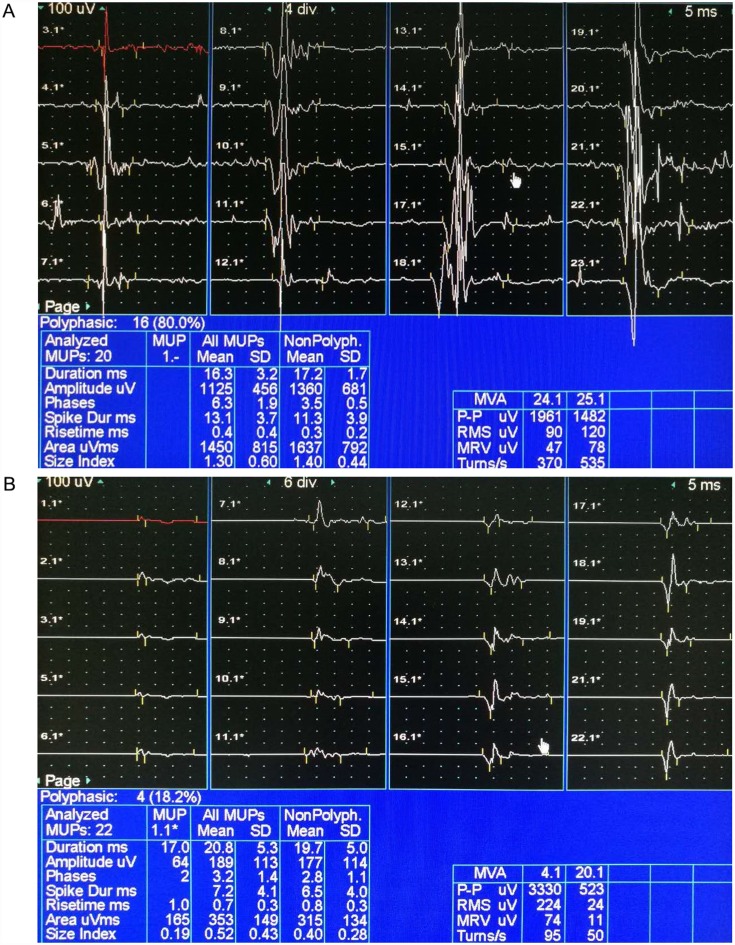
A total of 201 patients, - 101 MSA and 100 PD - were recruited in this study. Average duration and amplitude of motor unit potentials (MUPs), percentage of polyphasic MUPs, amplitude during strong contractions, and recruitment patterns during maximal voluntary contractions were recorded and analyzed to assess diagnostic efficiency of EAS-EMG and US-EMG for MSA.
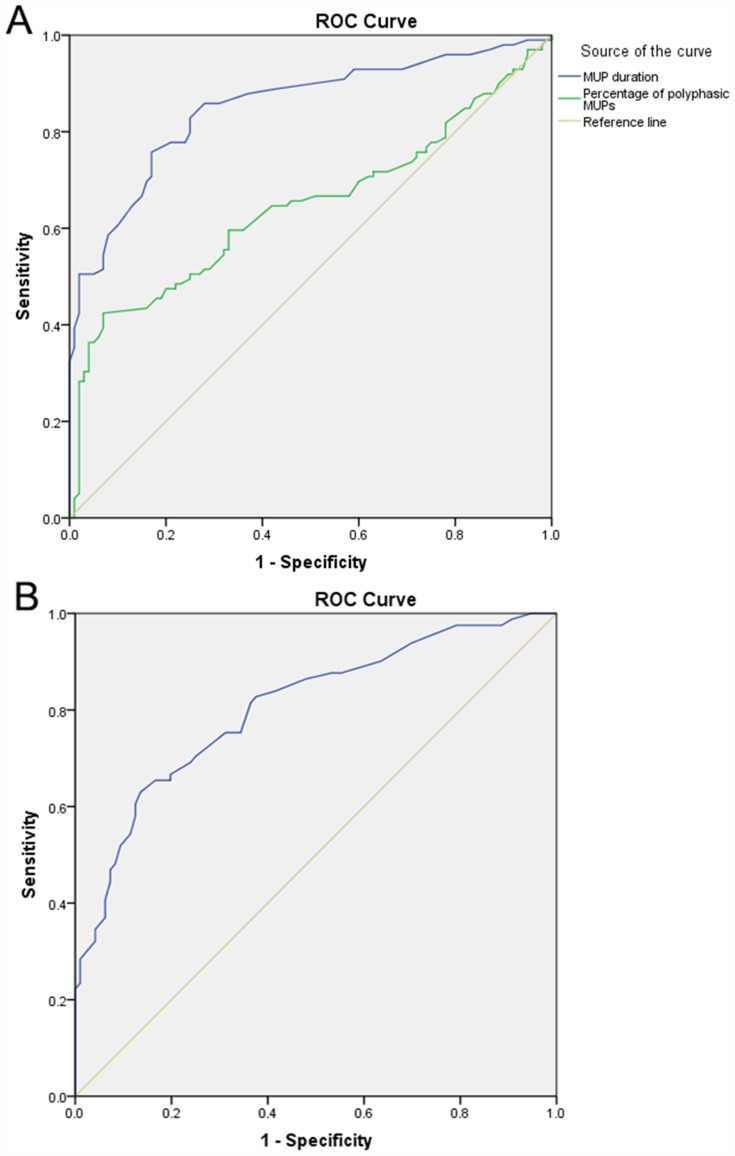
Significant differences in average MUP duration and recruitment patterns during maximal voluntary contractions were found between patients with MSA and patients with PD using both EAS-EMG (<0.001, <0.001) and US-EMG (<0.001, <0.001). The percentage of polyphasic MUPs and amplitude during strong contractions showed significant differences in MSA and PD using only EAS-EMG (<0.001, =0.005). Cutoff points for average MUP duration in EAS-EMG and US-EMG for differential diagnosis of MSA with PD were 10.9 and 11.1 milliseconds, respectively. With average MUP duration of EAS-EMG and US-EMG being applied jointly, sensitivity and specificity in distinguishing MSA from PD were 83.2% and 71.8%, respectively.
EAS-EMG and US-EMG were sensitive and specific methods for the diagnosis and differential diagnosis of MSA, and the combination of both would improve the diagnostic rate of MSA compared to only one method being used.
帕金森病(PD)与多系统萎缩(MSA)的鉴别诊断较为困难,因为它们在症状和体征上存在相似性。本研究的目的是探讨肛门外括约肌肌电图(EAS-EMG)和尿道括约肌肌电图(US-EMG)在鉴别MSA与PD中的价值。
本研究共纳入201例患者,其中101例为MSA患者,100例为PD患者。记录并分析运动单位电位(MUPs)的平均时限和波幅、多相MUPs的百分比、强力收缩时的波幅以及最大自主收缩时的募集模式,以评估EAS-EMG和US-EMG对MSA的诊断效能。
使用EAS-EMG(<0.001,<0.001)和US-EMG(<0.001,<0.001)时,MSA患者与PD患者在最大自主收缩时的MUP平均时限和募集模式上均存在显著差异。仅使用EAS-EMG时,多相MUPs的百分比和强力收缩时的波幅在MSA和PD中显示出显著差异(<0.001,=0.005)。EAS-EMG和US-EMG中用于鉴别MSA与PD的MUP平均时限的截断点分别为10.9毫秒和11.1毫秒。联合应用EAS-EMG和US-EMG的MUP平均时限时,鉴别MSA与PD的敏感性和特异性分别为83.2%和71.8%。
EAS-EMG和US-EMG是诊断和鉴别诊断MSA的敏感且特异的方法,与仅使用一种方法相比,两者联合应用可提高MSA的诊断率。