McGill Group for Suicide Studies, Douglas Mental Health University Institute, Department of Psychiatry, McGill University, Montreal, Quebec, Canada.
McMaster University and St Joseph's Healthcare Hamilton, Hamilton, Ontario, Canada.
Int J Neuropsychopharmacol. 2020 Feb 1;23(2):88-95. doi: 10.1093/ijnp/pyz066.
Antidepressant drugs are effective therapies for major depressive disorder; however, they are frequently associated with side effects. Although there is some evidence for a relationship between genetic variation and side effects, little is known regarding the role of dynamic molecular factors as moderators of side effects. The aim of this study was to assess microRNA (miRNA) changes associated with side effects during escitalopram treatment and their downstream effects on target gene expression.
A total 160 patients with major depressive disorder from the CAN-BIND-1 cohort were included. Side effects were assessed with the Toronto Side Effect Scale after 2 weeks of treatment with escitalopram. We assessed the relationship between side effects and changes in peripheral expression of miRNAs between baseline and week 2. For miRNA whose expression changed, we used target prediction algorithms to identify putative messenger RNA (mRNA) targets and assessed their expression.
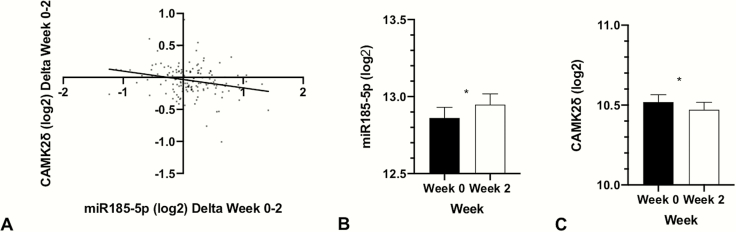
Nausea was experienced by 42.5% of patients. We identified 45 miRNAs whose expression changed on initiation of escitalopram treatment, of which 10 displayed a negative association with intensity of nausea (miR15b-5p, miR17-5p, miR20a-5p, miR20b-5p, miR103a-3p, miR103b, miR106a-5p, miR182-5p, miR185-5p, and miR660-5p). Additionally, we found negative associations between 4 microRNAs (miR20a-5p, miR106a-5p, miR185-5p, miR660-5p) and mRNA targets. The expression of the miR185-5p target, CAMK2δ was significantly decreased [log 2 mean = -0.048 (0.233)] between weeks 0 and 2 (P = .01)].
We identified an overexpression of miR185-5p during escitalopram treatment of major depressive disorder, which was negatively associated with intensity of nausea, and identified a potential mRNA target that may mediate this effect.
抗抑郁药是治疗重度抑郁症的有效疗法;然而,它们经常与副作用相关。虽然有一些证据表明遗传变异与副作用之间存在关系,但对于作为副作用调节剂的动态分子因素的作用知之甚少。本研究旨在评估与依地普仑治疗期间副作用相关的微小 RNA(miRNA)变化及其对靶基因表达的下游影响。
共纳入来自 CAN-BIND-1 队列的 160 例重度抑郁症患者。在依地普仑治疗 2 周后,使用多伦多副作用量表评估副作用。我们评估了副作用与基线至第 2 周外周 miRNA 表达变化之间的关系。对于表达发生变化的 miRNA,我们使用靶预测算法识别可能的信使 RNA(mRNA)靶标,并评估其表达。
42.5%的患者出现恶心。我们在依地普仑治疗开始时鉴定出 45 个表达发生变化的 miRNA,其中 10 个 miRNA 的表达与恶心强度呈负相关(miR15b-5p、miR17-5p、miR20a-5p、miR20b-5p、miR103a-3p、miR103b、miR106a-5p、miR182-5p、miR185-5p 和 miR660-5p)。此外,我们还发现 4 个 miRNA(miR20a-5p、miR106a-5p、miR185-5p、miR660-5p)与 mRNA 靶标之间存在负相关。miR185-5p 靶标 CAMK2δ 的表达在第 0 周至第 2 周之间显著降低[log2均值=-0.048(0.233)](P=0.01)。
我们在依地普仑治疗重度抑郁症期间发现 miR185-5p 的过度表达,其与恶心强度呈负相关,并鉴定出可能介导这种作用的潜在 mRNA 靶标。