Yu Qi, Huang Tianci, Liu Chao, Zhao Menglong, Xie Mingjuan, Li Guo, Liu Shujuan, Huang Wei, Zhao Qiang
Key Laboratory for Organic Electronics and Information Displays , Jiangsu Key Laboratory for Biosensors , Institute of Advanced Materials (IAM) , Nanjing University of Posts and Telecommunications (NUPT) , Nanjing 210023 , P. R. China . Email:
Shaanxi Institute of Flexible Electronics (SIFE) , Northwestern Polytechnical University (NPU) , Xi'an 710072 , Shaanxi , P. R. China . Email:
Chem Sci. 2019 Aug 8;10(39):9091-9098. doi: 10.1039/c9sc03161h. eCollection 2019 Oct 21.
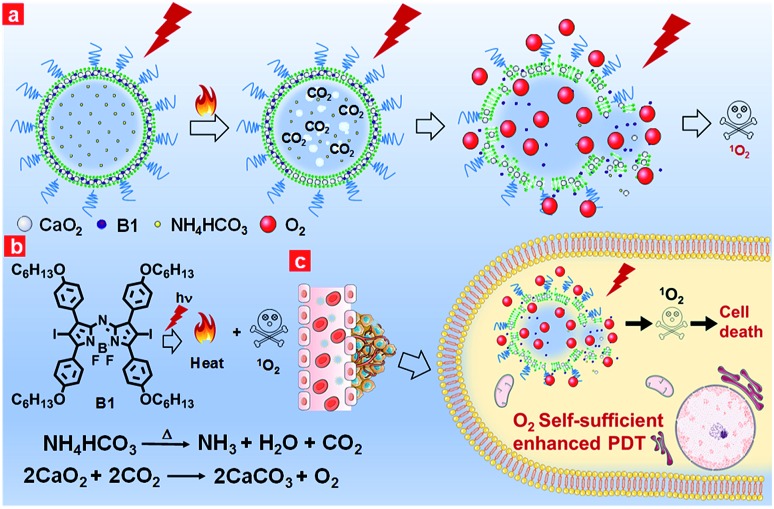
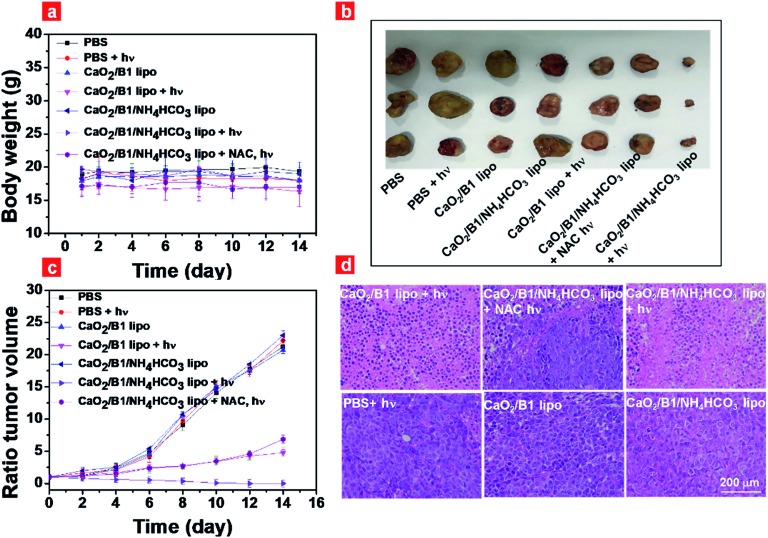
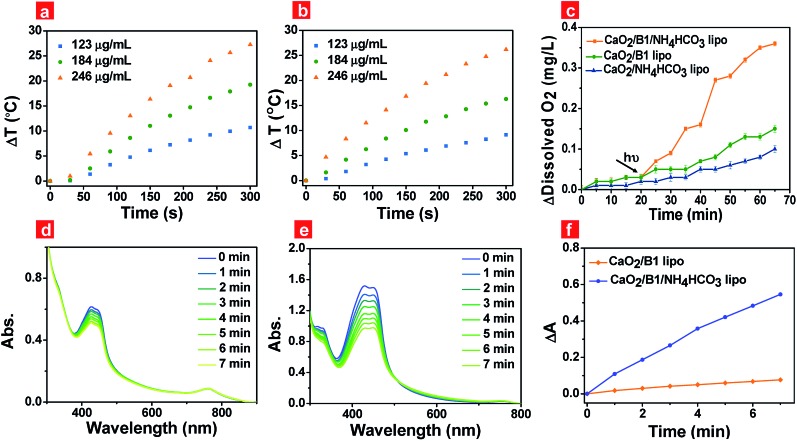
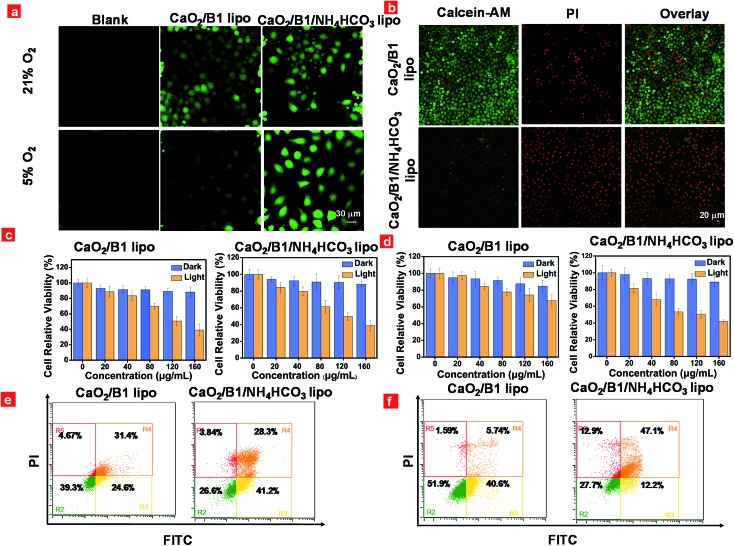
The inherent hypoxic environment in tumors severely resists the efficacy of photodynamic therapy. To address this problem, herein, the strategy of using oxygen self-sufficient liposomes (denoted as CaO//NHHCO lipo), which contained aza-BODIPY dye () and CaO nanoparticles in the hydrophobic layer and NHHCO in the hydrophilic cavity, was presented to overcome hypoxia-associated photodynamic resistance. Under near-infrared (NIR) irradiation, NIR-absorbable was activated to induce hyperthermia and further triggered the decomposition of NHHCO. Subsequently, with the aid of NHHCO and CaO nanoparticles, oxygen was rapidly and self-sufficiently generated, during which clean by-products were produced. Furthermore, the increased amount of oxygen promoted the singlet oxygen production in the presence of , which served as a photosensitizer because of the heavy atom effect. The oxygen self-sufficient system improved the anticancer efficiency and alleviated the hypoxic environment , which demonstrated a valuable attempt to regulate intratumoral hypoxia and overcome the limitation of current photodynamic therapy systems. To our knowledge, this highlights the first example of using NIR light to activate CaO nanoparticle-containing liposomes for the modulation of the hypoxic environment in tumors.
肿瘤内固有的缺氧环境严重阻碍了光动力疗法的疗效。为了解决这一问题,本文提出了使用氧自给自足脂质体(表示为CaO//NHHCO lipo)的策略,该脂质体在疏水层中含有氮杂-BODIPY染料()和CaO纳米颗粒,在亲水腔内含有NHHCO,以克服与缺氧相关的光动力抗性。在近红外(NIR)照射下,可吸收近红外的被激活以诱导热疗,并进一步触发NHHCO的分解。随后,借助NHHCO和CaO纳米颗粒,迅速且自给自足地产生了氧气,在此过程中产生了清洁的副产物。此外,在作为光敏剂的存在下,由于重原子效应,增加的氧气量促进了单线态氧的产生。氧自给自足系统提高了抗癌效率并缓解了缺氧环境,这是调节肿瘤内缺氧并克服当前光动力治疗系统局限性的一次有价值的尝试。据我们所知,这突出了利用近红外光激活含CaO纳米颗粒的脂质体来调节肿瘤缺氧环境的首个实例。