Corepal Rekesh, Best Paul, O'Neill Roisin, Kee Frank, Badham Jennifer, Dunne Laura, Miller Sarah, Connolly Paul, Cupples Margaret E, van Sluijs Esther M F, Tully Mark A, Hunter Ruth F
UKCRC Centre of Excellence for Public Health/Centre for Public Health, Queen's University Belfast, Institute of Clinical Science B, Royal Victoria Hospital, Grosvenor Road, Belfast, BT12 6BA Northern Ireland.
2Centre for Evidence and Social Innovation, School of Social Sciences, Education and Social Work, Queen's University Belfast, 6 College Park, 69-71 University Street, BT7 1NN Belfast, Northern Ireland.
Pilot Feasibility Stud. 2019 Nov 17;5:132. doi: 10.1186/s40814-019-0523-5. eCollection 2019.
Inactive lifestyles are becoming the norm and creative approaches to encourage adolescents to be more physically active are needed. Little is known about how gamification techniques can be used in physical activity interventions for young people. Such approaches may stimulate interest and encourage physical activity behaviour. The study investigated the feasibility of implementing and evaluating a physical activity intervention for adolescents which included gamification techniques within schools. We tested recruitment and retention strategies for schools and participants, the use of proposed outcome measures, and explored intervention acceptability.
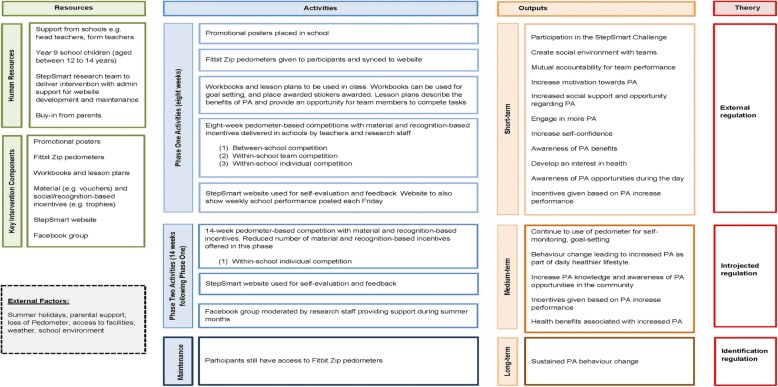
This school-based feasibility study of a randomised cluster trial recruited adolescents aged 12-14 years ( = 224) from five schools (three intervention; two control) in Belfast, Northern Ireland. The 22-week intervention (The StepSmart Challenge) informed by self-determination theory and incorporating gamification strategies involved a school-based pedometer competition. Outcomes, measured at baseline, and post-intervention (at 22 weeks post-baseline and 52 weeks post-baseline) included daily minutes of moderate to vigorous physical activity (MVPA) (measured using ActiGraph accelerometer), mental wellbeing (Warwick-Edinburgh Mental Wellbeing Scale), social support for physical activity, time preference (for delayed and larger rewards or immediate and smaller rewards), pro-social behaviour (Strengths and Difficulties Questionnaire (SDQ)) and the influence of social networks. The intervention's acceptability was explored in focus groups.
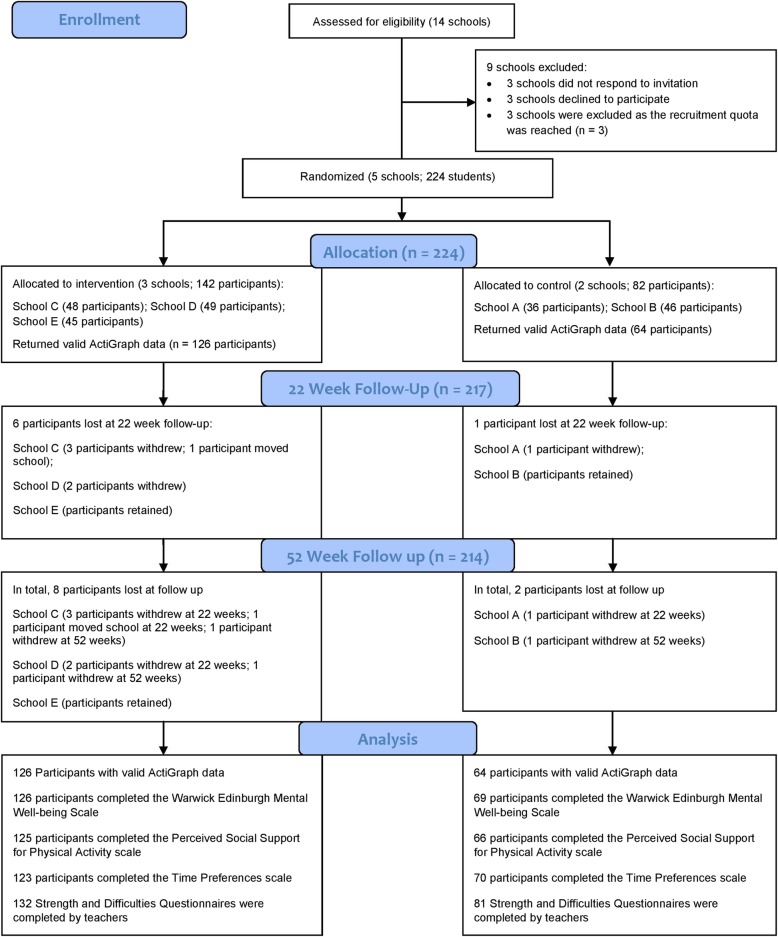
We invited 14 schools to participate; eight showed interest in participating. We recruited the first five who responded; all five completed the trial. Of the 236 pupils invited, 224 participated (94.9%): 84.8% (190/224) provided valid MVPA (minutes/day) at baseline and 57.2% (123/215) at 52 weeks. All other outcomes were well completed apart from the SDQ (65% at baseline). Qualitative data highlighted that participants and teachers found The StepSmart Challenge to be an acceptable intervention.
The level of interest and high recruitment and retention rates provide support for the feasibility of this trial. The intervention, incorporating gamification strategies and the recruitment methods, using parental opt-out procedures, were acceptable to participants and teachers. Teachers also suggested that the implementation of The StepSmart Challenge could be embedded in a lifelong learning approach to health within the school curriculum. As young people's lives become more intertwined with technology, the use of innovative gamified interventions could be one approach to engage and motivate health behavioural change in this population.
NCT02455986 (date of registration: 28 May 2015).
久坐不动的生活方式正变得越来越普遍,因此需要采用创新方法来鼓励青少年更多地进行体育活动。对于如何将游戏化技术应用于青少年体育活动干预措施,我们知之甚少。此类方法可能会激发兴趣并鼓励体育活动行为。本研究调查了在学校实施和评估一项针对青少年的体育活动干预措施(其中包括游戏化技术)的可行性。我们测试了针对学校和参与者的招募及留存策略、所提议的结果测量指标的使用情况,并探讨了干预措施的可接受性。
这项基于学校的随机整群试验可行性研究,从北爱尔兰贝尔法斯特的五所学校(三所干预学校;两所对照学校)招募了12至14岁的青少年(n = 224)。这项为期22周的干预措施(“步步为赢挑战”)以自我决定理论为依据,并纳入了游戏化策略,包括一场基于学校的计步器竞赛。在基线、干预后(基线后22周和基线后52周)测量的结果包括每日中等至剧烈身体活动(MVPA)的分钟数(使用ActiGraph加速度计测量)、心理健康(沃里克 - 爱丁堡心理健康量表)、对体育活动的社会支持、时间偏好(对于延迟和更大奖励或即时和较小奖励)、亲社会行为(长处与困难问卷(SDQ))以及社交网络的影响。通过焦点小组探讨了干预措施的可接受性。
我们邀请了14所学校参与;8所表示有兴趣参与。我们招募了最先回复的5所学校;这5所学校均完成了试验。在邀请的236名学生中,224名参与了(94.9%):84.8%(190/224)在基线时提供了有效的MVPA(分钟/天)数据,52周时为57.2%(123/215)。除SDQ外(基线时为65%),所有其他结果的完成情况都很好。定性数据表明,参与者和教师认为“步步为赢挑战”是一项可接受的干预措施。
兴趣程度以及高招募率和留存率为该试验的可行性提供了支持。纳入游戏化策略的干预措施以及采用家长默认程序的招募方法,得到了参与者和教师的认可。教师们还建议,“步步为赢挑战”的实施可以融入学校课程中关于健康的终身学习方法。随着年轻人的生活与技术联系日益紧密,采用创新的游戏化干预措施可能是促使这一人群参与并激发健康行为改变的一种方法。
NCT02455986(注册日期:2015年5月28日)。