Jawaid Masood, Bakhtiar Nighat, Masood Zubia, Mehar Abdul-Khaliq
Surgery, Darul Sehat Hospital, Karachi, PAK.
General Surgery, Dow University of Health Sciences, Karachi, PAK.
Cureus. 2019 Nov 4;11(11):e6071. doi: 10.7759/cureus.6071.
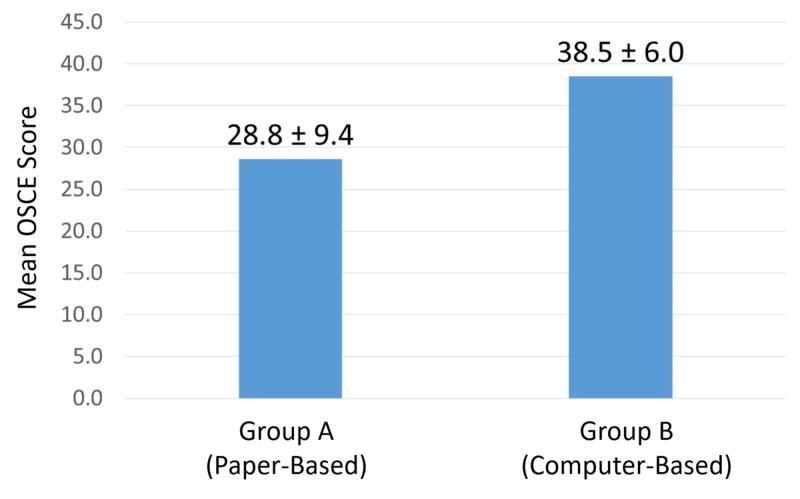
Background and objectives Skilled clinical reasoning is a critical tool for physicians. Educators agree that this skill should be formally taught and assessed. Objectives related to the mastery of clinical reasoning skills appear in the documentation of most medical schools and licensing bodies. We conducted this study to assess the differences in clinical reasoning skills in medical students following paper- and computer-based simulated instructions. Materials and methods A total of 52 sixth semester medical students of the Dow University of Health Sciences were included in this study. A tutorial was delivered to all students on clinical reasoning and its importance in clinical practice. Students were divided randomly into two groups: group A received paper-based instructions while group B received computer-based instructions (as Flash-based scenarios developed with Articulate Storyline software [https://articulate.com/p/storyline-3]) focused on clinical reasoning skills in history-taking of acute and chronic upper abdominal pain. After one week, both groups were tested at two objective structured clinical examination (OSCE) stations to assess acute and chronic pain history-taking skills in relation to clinical reasoning. Results There were 27 students in group A and 25 students in group B. The mean OSCE score for group A (paper-based) was 28.6 ± 9.4 and that for group B (computer-based) was 38.5 ± 6.0. Group B's mean score was statistically significantly greater (p < 0.001) than group A's mean score for clinical reasoning skills. Conclusion A computer simulation program can enhance clinical reasoning skills. This technology could be used to acquaint students with real-life experiences and identify potential areas for more training before facing real patients.
背景与目的 熟练的临床推理是医生的一项关键技能。教育工作者一致认为,这项技能应该得到正式的教授和评估。大多数医学院校和执照颁发机构的文件中都出现了与掌握临床推理技能相关的目标。我们开展这项研究是为了评估医学生在接受纸质和基于计算机的模拟指导后临床推理技能的差异。
材料与方法 本研究纳入了道健康科学大学的52名第六学期医学生。为所有学生提供了一次关于临床推理及其在临床实践中的重要性的辅导课。学生被随机分为两组:A组接受纸质指导,而B组接受基于计算机的指导(以使用Articulate Storyline软件[https://articulate.com/p/storyline-3]开发的基于Flash的情景模拟),重点是急性和慢性上腹部疼痛病史采集的临床推理技能。一周后,两组学生在两个客观结构化临床考试(OSCE)站点接受测试,以评估与临床推理相关的急性和慢性疼痛病史采集技能。
结果 A组有27名学生,B组有25名学生。A组(纸质)的OSCE平均成绩为28.6±9.4,B组(基于计算机)的OSCE平均成绩为38.5±6.0。B组的平均成绩在统计学上显著高于A组的临床推理技能平均成绩(p<0.001)。
结论 计算机模拟程序可以提高临床推理技能。这项技术可用于让学生熟悉实际临床情景,并在面对真实患者之前识别出需要更多训练的潜在领域。