Division of Medical Education Research and Curriculum Development, Study Deanery of University Medical Centre Göttingen, Göttingen, Germany.
Department of Legal Medicine, University Medical Centre Hamburg-Eppendorf, Hamburg, Germany.
PLoS One. 2018 Sep 11;13(9):e0203851. doi: 10.1371/journal.pone.0203851. eCollection 2018.
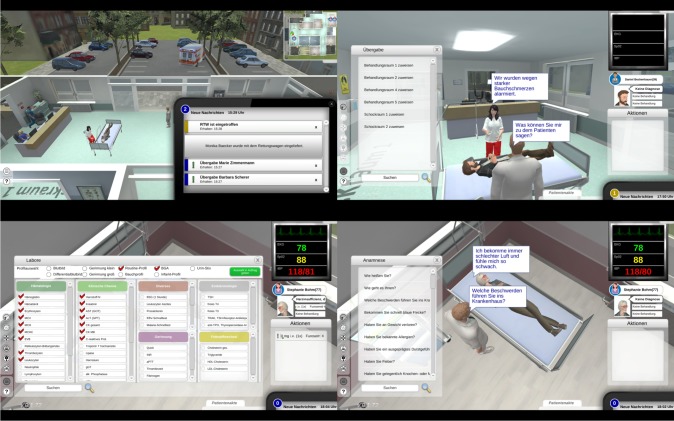
Serious Games are increasingly being used in undergraduate medical education. They are usually intended to enhance learning with a focus on knowledge acquisition and skills development. According to the current literature, few studies have assessed their effectiveness regarding clinical reasoning (CR). The aim of this prospective study was to compare a Serious Game, the virtual Accident & Emergency department 'EMERGE' to small-group problem-based learning (PBL) regarding student learning outcome on clinical reasoning in the short term.
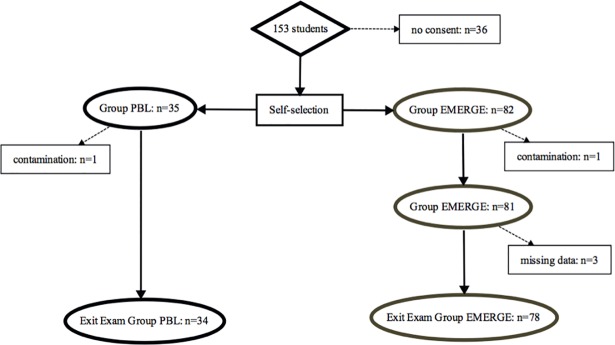
A total of 112 final-year medical students self-selected to participate in ten 90-minute sessions of either small-group PBL or playing EMERGE. CR was assessed in a formative examination consisting of six key feature cases and a final 45-minute EMERGE session.
Overall, the EMERGE group (n = 78) scored significantly higher than the PBL group (n = 34) in the key feature examination (62.5 (IQR: 17.7)% vs. 54.2 (IQR: 21.9)%; p = 0.015). There was no significant difference in performance levels between groups regarding those cases which had been discussed in both instructional formats during the training phase. In the final EMERGE session, the EMERGE group achieved significantly better results than the PBL group in all four cases regarding the total score as well as in three of four cases regarding the final diagnosis and the correct therapeutic interventions.
EMERGE can be used effectively for CR training in undergraduate medical education. The difference in key feature exam scores was driven by additional exposure to more cases in EMERGE compared to PBL despite identical learning time in both instructional formats. EMERGE is a potential alternative to intensive small-group teaching. Further work is needed to establish how Serious Games enhance CR most effectively.
严肃游戏越来越多地应用于本科医学教育。它们通常旨在通过关注知识获取和技能发展来增强学习。根据目前的文献,很少有研究评估它们在临床推理(CR)方面的有效性。本前瞻性研究的目的是比较严肃游戏,即虚拟急症科“EMERGE”与小组以问题为基础的学习(PBL),以评估短期学生在临床推理方面的学习成果。
共有 112 名即将毕业的医学生自愿参加了十次 90 分钟的小组 PBL 或 EMERGE 游戏。CR 通过形成性考试进行评估,该考试由六个关键特征病例和最后 45 分钟的 EMERGE 会议组成。
总体而言,EMERGE 组(n = 78)在关键特征考试中的得分明显高于 PBL 组(n = 34)(62.5(IQR:17.7)%对 54.2(IQR:21.9)%;p = 0.015)。在培训阶段讨论过两种教学模式的病例中,两组的表现水平没有显著差异。在最后的 EMERGE 会议中,与 PBL 组相比,EMERGE 组在所有四个病例中的总分以及在最终诊断和正确治疗干预的四个病例中的三个病例中均取得了更好的成绩。
EMERGE 可有效地用于本科医学教育中的 CR 培训。尽管两种教学模式的学习时间相同,但与 PBL 相比,EMERGE 中额外接触更多病例导致了关键特征考试成绩的差异。EMERGE 是强化小组教学的一种潜在替代方法。需要进一步的工作来确定严肃游戏如何最有效地增强 CR。