Ahn Seong Hee, Park So Young, Yoo Jun-Il, Chung Youn-Jee, Jeon Yun Kyung, Yoon Byung-Ho, Kim Ha Young, Lee Seung Hun, Lee Jehoon, Hong Seongbin
Division of Endocrinology and Metabolism, Department of Internal Medicine, Inha University Hospital, Inha University School of Medicine, Incheon, Korea.
Division of Endocrinology and Metabolism, Department of Internal Medicine, Kyung Hee University Hospital, Seoul, Korea.
J Bone Metab. 2019 Nov;26(4):271-277. doi: 10.11005/jbm.2019.26.4.271. Epub 2019 Nov 30.
There has been interest in the clinical potential of bone turnover markers (BTMs) as tools both for assessing fracture risk and for monitoring treatment. However, the practical use of BTMs has been limited by their biological variability and difficulties in the interpretation of results. We investigated the current situation of application of BTMs by clinicians in Korea for the management of osteoporosis through a survey asking the patterns of BTMs prescription in clinical practice.
The survey was conducted online using the "google survey" by the BTM committee authorized by the Korean Society for Bone and Mineral Research.
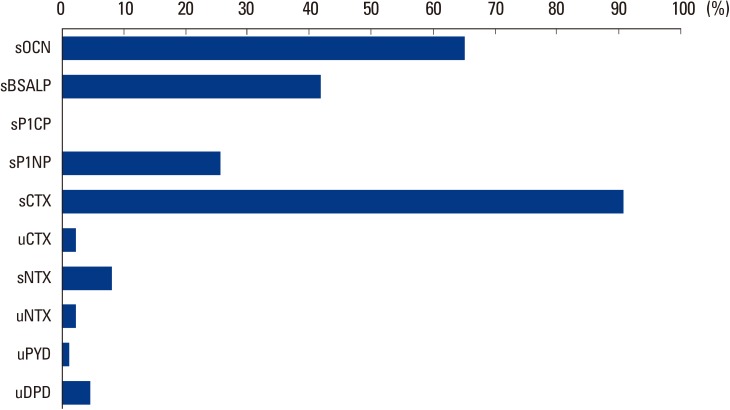
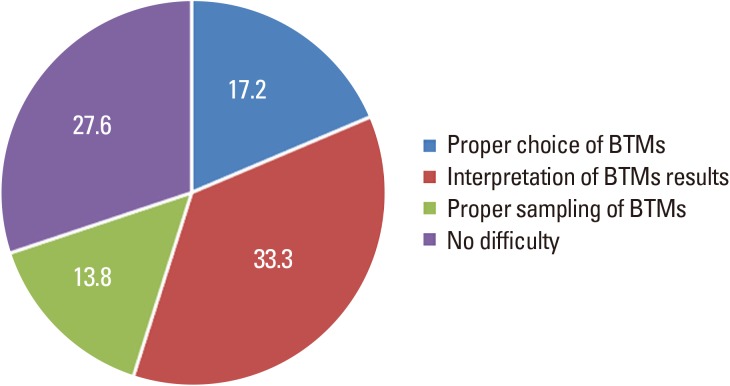
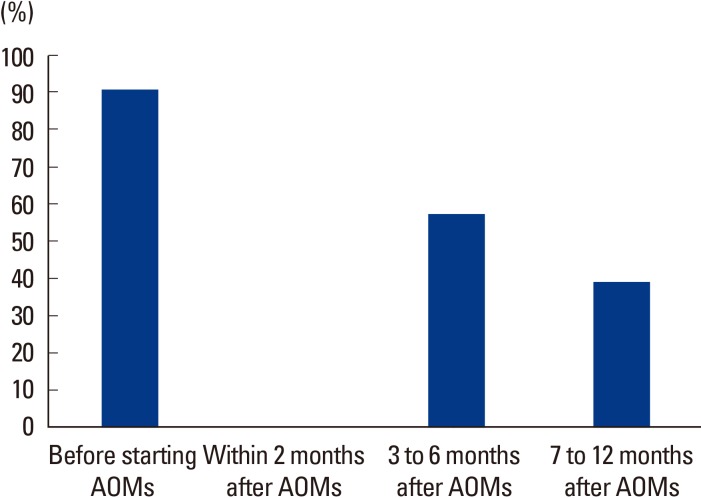
Total 108 clinicians responded the survey. Most of the respondents prescribed BTMs (80.6%) when they prescribed anti-osteoporotic medications (AOMs). The most frequently prescribed bone resorption and formation markers were serum C-terminal telopeptide of type I collagen (90.7%) and osteocalcin (65.1%), respectively. BTMs were mostly prescribed before starting AOMs (90.8%) and used for the purpose of evaluating treatment response (74.4%). Treatment response and compliance to AOMs were evaluated according to the change of absolute value of BTMs (55.1%). The respondents complained difficulties in the interpretation of BTMs (33.3%), the choice of proper BTMs (17.2%), and the proper sample preparation and handling (13.8%).
In Korea, most of clinicians recognized the benefit of BTMs in the management of osteoporosis. However, there are limitations in the broad use of these markers in clinical practice. Therefore, a clear recommendation for BTM in Korea enhances their use in clinical practice.
骨转换标志物(BTMs)作为评估骨折风险和监测治疗的工具,其临床潜力一直备受关注。然而,BTMs的实际应用受到其生物学变异性以及结果解读困难的限制。我们通过一项关于临床实践中BTMs处方模式的调查,研究了韩国临床医生应用BTMs管理骨质疏松症的现状。
该调查由韩国骨与矿物质研究学会授权的BTM委员会通过“谷歌调查”在线进行。
共有108名临床医生回复了调查。大多数受访者(80.6%)在开具抗骨质疏松药物(AOMs)时会开具BTMs。最常开具的骨吸收和骨形成标志物分别是血清I型胶原C端肽(90.7%)和骨钙素(65.1%)。BTMs大多在开始使用AOMs之前开具(90.8%),并用于评估治疗反应(74.4%)。根据BTMs绝对值的变化评估治疗反应和对AOMs的依从性(55.1%)。受访者抱怨在BTMs结果解读(33.3%)、选择合适的BTMs(17.2%)以及合适的样本制备和处理(13.8%)方面存在困难。
在韩国,大多数临床医生认识到BTMs在骨质疏松症管理中的益处。然而,这些标志物在临床实践中的广泛应用存在局限性。因此,在韩国对BTMs给出明确建议可促进其在临床实践中的应用。