Bekić Marina, Tomić Sergej, Rudolf Rebeka, Milanović Marijana, Vučević Dragana, Anžel Ivan, Čolić Miodrag
Institute for Application of Nuclear Energy, University of Belgrade, 11000 Belgrade, Serbia.
Faculty for Mechanical Engineering, University of Maribor, 2000 Maribor, Slovenia.
Materials (Basel). 2019 Dec 9;12(24):4121. doi: 10.3390/ma12244121.
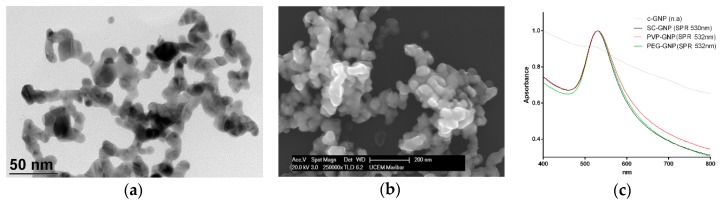
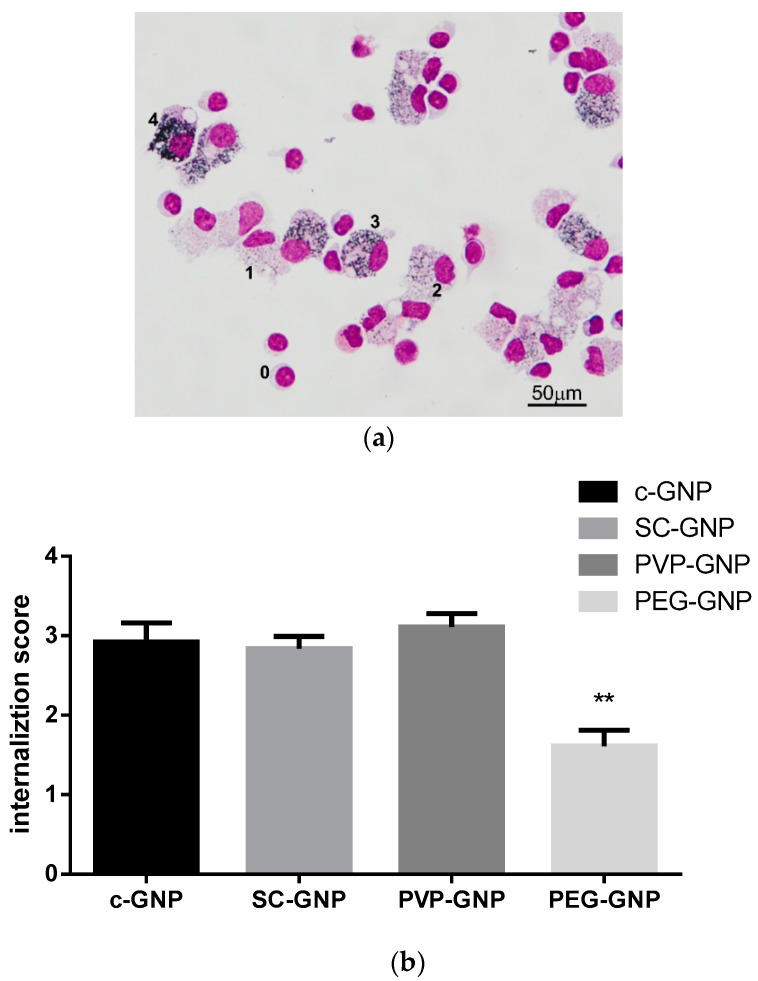
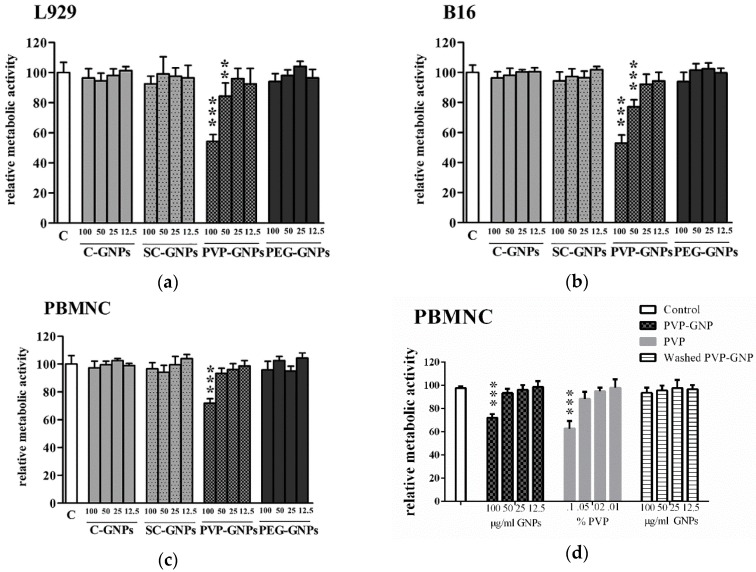
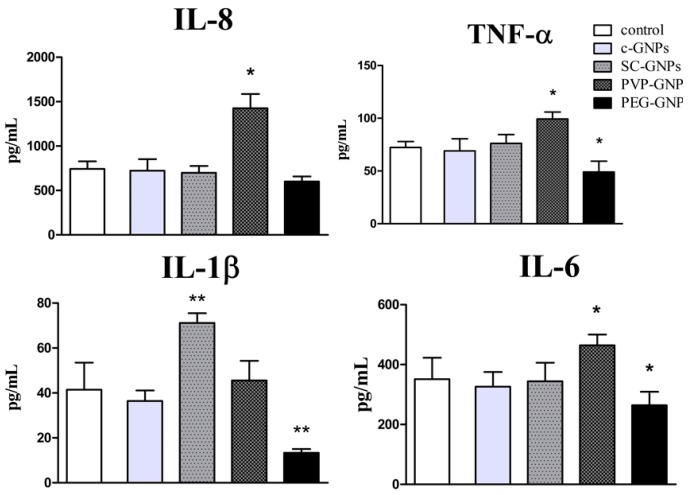
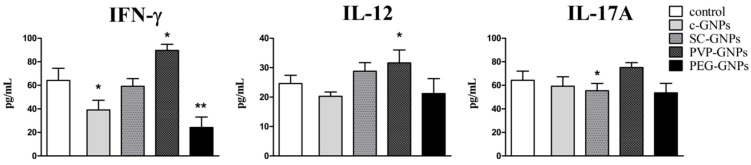
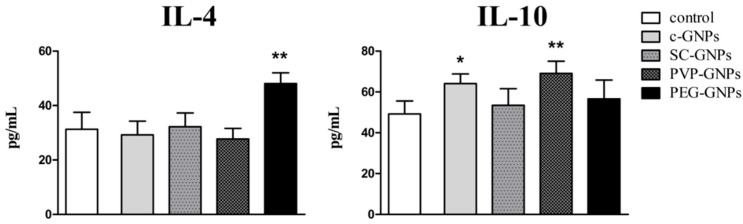
Gold nanoparticles (GNPs) have been investigated extensively as drug carriers in tumour immunotherapy in combination with photothermal therapy. For this purpose, GNPs should be stabilised in biological fluids. The goal of this study was to examine how stabilisation agents influence cytotoxicity and immune response in vitro. Spherical GNPs, 20 nm in size, were prepared by ultrasonic spray pyrolysis (USP). Three types of stabilising agents were used: sodium citrate (SC), polyvinyl-pyrrolidone (PVP), and poly-ethylene glycol (PEG). Pristine, non-stabilised GNPs were used as a control. The culture models were mouse L929 cells, B16F10 melanoma cells and human peripheral blood mononuclear cells (PBMNCs), obtained from healthy donors. Control SC- and PEG-GNPs were non-cytotoxic at concentrations (range 1-100 µg/mL), in contrast to PVP-GNPs, which were cytotoxic at higher concentrations. Control GNPs inhibited the production of IFN-ϒ slightly, and augmented the production of IL-10 by PHA-stimulated PBMNC cultures. PEG-GNPs inhibited the production of pro-inflammatory cytokines (IL-1, IL-6, IL-8, TNF-α) and Th1-related cytokines (IFN-ϒ and IL-12p70), and increased the production of Th2 cytokines (IL-4 and IL-5). SC-PEG inhibited the production of IL-8 and IL-17A. In contrast, PVP-GNPs stimulated the production of pro-inflammatory cytokines, Th1 cytokines, and IL-17A, but also IL-10. When uptake of GNPs by monocytes/macrophages in PBMNC cultures was analysed, the ingestion of PEG- GNPs was significantly lower compared to SC- and PVP-GNPs. In conclusion, stabilisation agents modulate biocompatibility and immune response significantly, so their adequate choice for preparation of GNPs is an important factor when considering the use of GNPs for application in vivo.
金纳米颗粒(GNPs)作为药物载体已被广泛研究,用于结合光热疗法的肿瘤免疫治疗。为此,GNPs应在生物流体中保持稳定。本研究的目的是考察稳定剂如何在体外影响细胞毒性和免疫反应。通过超声喷雾热解(USP)制备了尺寸为20nm的球形GNPs。使用了三种类型的稳定剂:柠檬酸钠(SC)、聚乙烯吡咯烷酮(PVP)和聚乙二醇(PEG)。未加稳定剂的原始GNPs用作对照。培养模型为小鼠L929细胞、B16F10黑色素瘤细胞和从健康供体获得的人外周血单核细胞(PBMNCs)。对照SC-GNPs和PEG-GNPs在浓度范围为1-100μg/mL时无细胞毒性,而PVP-GNPs在较高浓度时具有细胞毒性。对照GNPs对PHA刺激的PBMNC培养物中IFN-ϒ的产生有轻微抑制作用,并增加了IL-10的产生。PEG-GNPs抑制促炎细胞因子(IL-1、IL-6、IL-8、TNF-α)和Th1相关细胞因子(IFN-ϒ和IL-12p70)的产生,并增加Th2细胞因子(IL-4和IL-5)的产生。SC-PEG抑制IL-8和IL-17A的产生。相反,PVP-GNPs刺激促炎细胞因子、Th1细胞因子和IL-17A的产生,但也刺激IL-10的产生。当分析PBMNC培养物中单核细胞/巨噬细胞对GNPs的摄取时,与SC-GNPs和PVP-GNPs相比,PEG-GNPs的摄取显著降低。总之,稳定剂显著调节生物相容性和免疫反应,因此在考虑将GNPs用于体内应用时,为制备GNPs选择合适的稳定剂是一个重要因素。