Brain-Machine Interface Systems Lab, Miguel Hernández University of Elche, Avda. de la Universidad S/N, Ed. Innova, Elche, 03202 Alicante, Spain.
Sensors (Basel). 2019 Dec 10;19(24):5444. doi: 10.3390/s19245444.
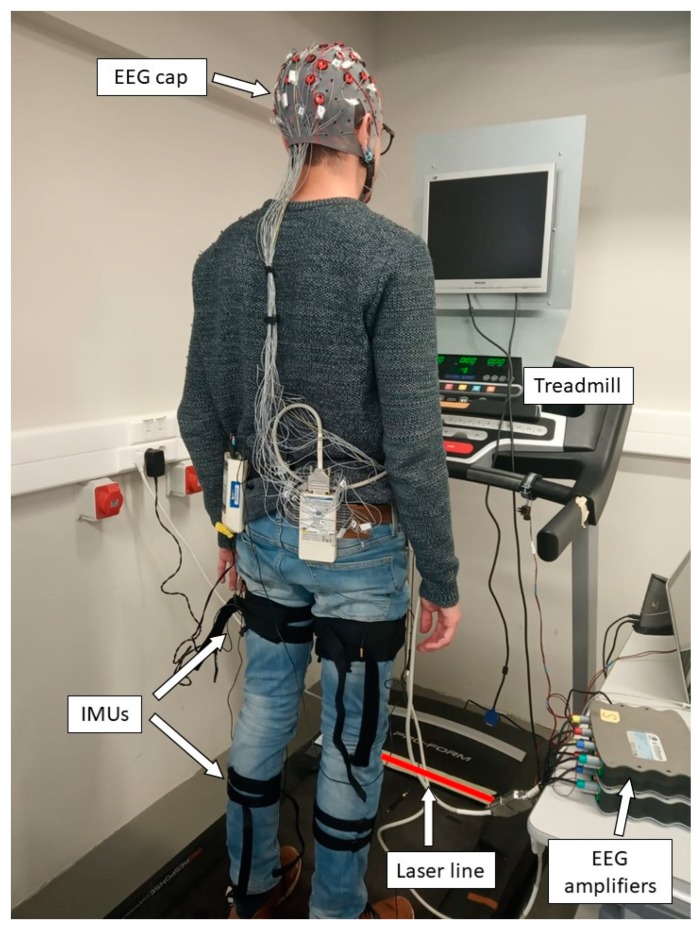
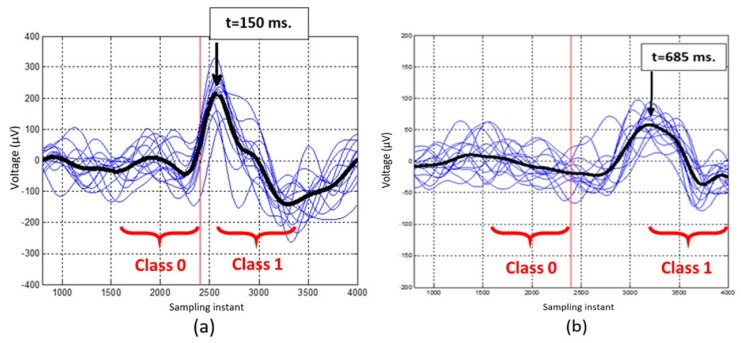
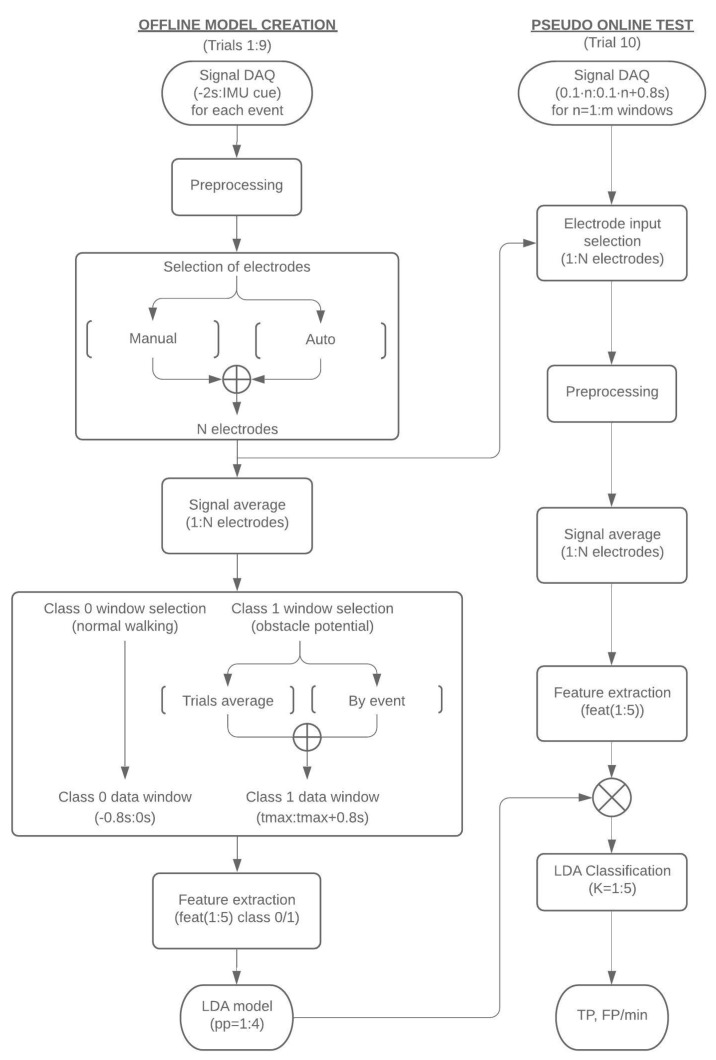
The aim of this paper is to describe new methods for detecting the appearance of unexpected obstacles during normal gait from EEG signals, improving the accuracy and reducing the false positive rate obtained in previous studies. This way, an exoskeleton for rehabilitation or assistance of people with motor limitations commanded by a Brain-Machine Interface (BMI) could be stopped in case that an obstacle suddenly appears during walking. The EEG data of nine healthy subjects were collected during their normal gait while an obstacle appearance was simulated by the projection of a laser line in a random pattern. Different approaches were considered for selecting the parameters of the BMI: subsets of electrodes, time windows and classifier probabilities, which were based on a linear discriminant analysis (LDA). The pseudo-online results of the BMI for detecting the appearance of obstacles, with an average percentage of 63.9% of accuracy and 2.6 false positives per minute, showed a significant improvement over previous studies.
本文旨在描述从 EEG 信号中检测正常步态中意外障碍物出现的新方法,以提高先前研究中获得的准确性并降低误报率。这样,当行走过程中突然出现障碍物时,由脑机接口(BMI)控制的康复或辅助运动受限者的外骨骼就可以停止运动。在模拟出现障碍物的情况下,收集了九名健康受试者在正常行走时的 EEG 数据,方法是通过激光线以随机模式投射。为了选择 BMI 的参数,考虑了不同的方法:电极子集、时间窗口和分类器概率,这些方法基于线性判别分析(LDA)。用于检测障碍物出现的 BMI 的伪在线结果显示,平均准确率为 63.9%,每分钟误报率为 2.6,与先前的研究相比有显著提高。