• 文献检索
  • 文档翻译
  • 深度研究
  • 学术资讯
  • Suppr Zotero 插件Zotero 插件
  • 邀请有礼
  • 套餐&价格
  • 历史记录
应用&插件
Suppr Zotero 插件Zotero 插件浏览器插件Mac 客户端Windows 客户端微信小程序
定价
高级版会员购买积分包购买API积分包
服务
文献检索文档翻译深度研究API 文档MCP 服务
关于我们
关于 Suppr公司介绍联系我们用户协议隐私条款
关注我们

Suppr 超能文献

核心技术专利:CN118964589B侵权必究
粤ICP备2023148730 号-1Suppr @ 2026

文献检索

告别复杂PubMed语法,用中文像聊天一样搜索,搜遍4000万医学文献。AI智能推荐,让科研检索更轻松。

立即免费搜索

文件翻译

保留排版,准确专业,支持PDF/Word/PPT等文件格式,支持 12+语言互译。

免费翻译文档

深度研究

AI帮你快速写综述,25分钟生成高质量综述,智能提取关键信息,辅助科研写作。

立即免费体验

基于混合脑电图-功能近红外光谱的脑机接口系统对人类步态的分析:综述

Analysis of Human Gait Using Hybrid EEG-fNIRS-Based BCI System: A Review.

作者信息

Khan Haroon, Naseer Noman, Yazidi Anis, Eide Per Kristian, Hassan Hafiz Wajahat, Mirtaheri Peyman

机构信息

Department of Mechanical, Electronics and Chemical Engineering, OsloMet-Oslo Metropolitan University, Oslo, Norway.

Department of Mechatronics and Biomedical Engineering, Air University, Islamabad, Pakistan.

出版信息

Front Hum Neurosci. 2021 Jan 25;14:613254. doi: 10.3389/fnhum.2020.613254. eCollection 2020.

DOI:10.3389/fnhum.2020.613254
PMID:33568979
原文链接:https://pmc.ncbi.nlm.nih.gov/articles/PMC7868344/
Abstract

Human gait is a complex activity that requires high coordination between the central nervous system, the limb, and the musculoskeletal system. More research is needed to understand the latter coordination's complexity in designing better and more effective rehabilitation strategies for gait disorders. Electroencephalogram (EEG) and functional near-infrared spectroscopy (fNIRS) are among the most used technologies for monitoring brain activities due to portability, non-invasiveness, and relatively low cost compared to others. Fusing EEG and fNIRS is a well-known and established methodology proven to enhance brain-computer interface (BCI) performance in terms of classification accuracy, number of control commands, and response time. Although there has been significant research exploring hybrid BCI (hBCI) involving both EEG and fNIRS for different types of tasks and human activities, human gait remains still underinvestigated. In this article, we aim to shed light on the recent development in the analysis of human gait using a hybrid EEG-fNIRS-based BCI system. The current review has followed guidelines of preferred reporting items for systematic reviews and meta-Analyses (PRISMA) during the data collection and selection phase. In this review, we put a particular focus on the commonly used signal processing and machine learning algorithms, as well as survey the potential applications of gait analysis. We distill some of the critical findings of this survey as follows. First, hardware specifications and experimental paradigms should be carefully considered because of their direct impact on the quality of gait assessment. Second, since both modalities, EEG and fNIRS, are sensitive to motion artifacts, instrumental, and physiological noises, there is a quest for more robust and sophisticated signal processing algorithms. Third, hybrid temporal and spatial features, obtained by virtue of fusing EEG and fNIRS and associated with cortical activation, can help better identify the correlation between brain activation and gait. In conclusion, hBCI (EEG + fNIRS) system is not yet much explored for the lower limb due to its complexity compared to the higher limb. Existing BCI systems for gait monitoring tend to only focus on one modality. We foresee a vast potential in adopting hBCI in gait analysis. Imminent technical breakthroughs are expected using hybrid EEG-fNIRS-based BCI for gait to control assistive devices and Monitor neuro-plasticity in neuro-rehabilitation. However, although those hybrid systems perform well in a controlled experimental environment when it comes to adopting them as a certified medical device in real-life clinical applications, there is still a long way to go.

摘要

人类步态是一项复杂的活动,需要中枢神经系统、肢体和肌肉骨骼系统之间高度协调。为了设计出更好、更有效的步态障碍康复策略,还需要更多研究来了解后一种协调的复杂性。脑电图(EEG)和功能近红外光谱(fNIRS)是最常用的监测大脑活动的技术,因为它们具有便携性、非侵入性,且与其他技术相比成本相对较低。融合EEG和fNIRS是一种公认的成熟方法,已被证明在分类准确率、控制命令数量和响应时间方面能够提高脑机接口(BCI)的性能。尽管已经有大量研究探索涉及EEG和fNIRS的混合BCI(hBCI)在不同类型任务和人类活动中的应用,但人类步态仍未得到充分研究。在本文中,我们旨在阐明基于EEG-fNIRS混合BCI系统的人类步态分析的最新进展。本次综述在数据收集和筛选阶段遵循了系统评价和Meta分析的首选报告项目(PRISMA)指南。在本综述中,我们特别关注常用的信号处理和机器学习算法,并调查步态分析的潜在应用。我们总结了本次调查的一些关键发现如下。首先,由于硬件规格和实验范式对步态评估质量有直接影响,因此应仔细考虑。其次,由于EEG和fNIRS这两种模式都对运动伪影、仪器和生理噪声敏感,因此需要更强大、更复杂的信号处理算法。第三,通过融合EEG和fNIRS获得的、与皮层激活相关的混合时空特征,有助于更好地识别大脑激活与步态之间的相关性。总之,由于与上肢相比其复杂性,hBCI(EEG + fNIRS)系统在下肢方面尚未得到充分探索。现有的用于步态监测的BCI系统往往只关注一种模式。我们预见在步态分析中采用hBCI具有巨大潜力。预计基于EEG-fNIRS混合BCI的步态在控制辅助设备和监测神经康复中的神经可塑性方面将取得重大技术突破。然而,尽管这些混合系统在受控实验环境中表现良好,但在将其作为认证医疗设备应用于实际临床应用时,仍有很长的路要走。
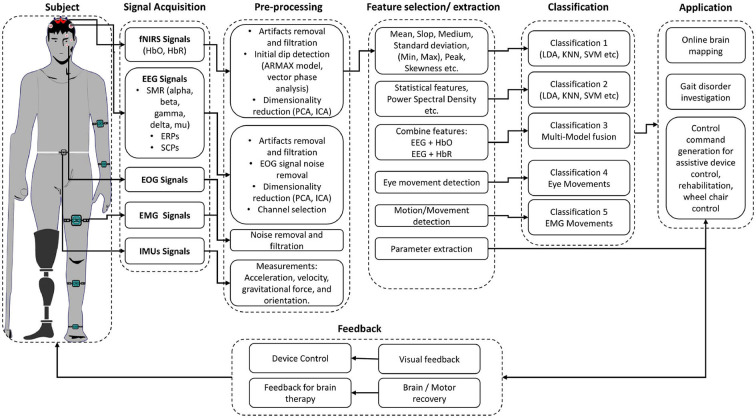
https://cdn.ncbi.nlm.nih.gov/pmc/blobs/64ac/7868344/208887bf02d4/fnhum-14-613254-g0007.jpg
https://cdn.ncbi.nlm.nih.gov/pmc/blobs/64ac/7868344/6c307df53368/fnhum-14-613254-g0001.jpg
https://cdn.ncbi.nlm.nih.gov/pmc/blobs/64ac/7868344/f7f09aab0fab/fnhum-14-613254-g0002.jpg
https://cdn.ncbi.nlm.nih.gov/pmc/blobs/64ac/7868344/0cc40415718d/fnhum-14-613254-g0003.jpg
https://cdn.ncbi.nlm.nih.gov/pmc/blobs/64ac/7868344/dab437b53ab0/fnhum-14-613254-g0004.jpg
https://cdn.ncbi.nlm.nih.gov/pmc/blobs/64ac/7868344/e0af665c0f2a/fnhum-14-613254-g0005.jpg
https://cdn.ncbi.nlm.nih.gov/pmc/blobs/64ac/7868344/d9ec8d086953/fnhum-14-613254-g0006.jpg
https://cdn.ncbi.nlm.nih.gov/pmc/blobs/64ac/7868344/208887bf02d4/fnhum-14-613254-g0007.jpg
https://cdn.ncbi.nlm.nih.gov/pmc/blobs/64ac/7868344/6c307df53368/fnhum-14-613254-g0001.jpg
https://cdn.ncbi.nlm.nih.gov/pmc/blobs/64ac/7868344/f7f09aab0fab/fnhum-14-613254-g0002.jpg
https://cdn.ncbi.nlm.nih.gov/pmc/blobs/64ac/7868344/0cc40415718d/fnhum-14-613254-g0003.jpg
https://cdn.ncbi.nlm.nih.gov/pmc/blobs/64ac/7868344/dab437b53ab0/fnhum-14-613254-g0004.jpg
https://cdn.ncbi.nlm.nih.gov/pmc/blobs/64ac/7868344/e0af665c0f2a/fnhum-14-613254-g0005.jpg
https://cdn.ncbi.nlm.nih.gov/pmc/blobs/64ac/7868344/d9ec8d086953/fnhum-14-613254-g0006.jpg
https://cdn.ncbi.nlm.nih.gov/pmc/blobs/64ac/7868344/208887bf02d4/fnhum-14-613254-g0007.jpg

相似文献

1
Analysis of Human Gait Using Hybrid EEG-fNIRS-Based BCI System: A Review.基于混合脑电图-功能近红外光谱的脑机接口系统对人类步态的分析:综述
Front Hum Neurosci. 2021 Jan 25;14:613254. doi: 10.3389/fnhum.2020.613254. eCollection 2020.
2
EEG-fNIRS-based hybrid image construction and classification using CNN-LSTM.基于脑电图-近红外光谱的混合图像构建与卷积神经网络-长短期记忆网络分类
Front Neurorobot. 2022 Aug 31;16:873239. doi: 10.3389/fnbot.2022.873239. eCollection 2022.
3
Enhancing Performance of a Hybrid EEG-fNIRS System Using Channel Selection and Early Temporal Features.利用通道选择和早期时间特征提高混合脑电图-功能近红外光谱系统的性能
Front Hum Neurosci. 2017 Sep 15;11:462. doi: 10.3389/fnhum.2017.00462. eCollection 2017.
4
A Ternary Hybrid EEG-NIRS Brain-Computer Interface for the Classification of Brain Activation Patterns during Mental Arithmetic, Motor Imagery, and Idle State.一种用于在心算、运动想象和空闲状态期间对大脑激活模式进行分类的三元混合脑电-近红外光谱脑机接口。
Front Neuroinform. 2018 Feb 23;12:5. doi: 10.3389/fninf.2018.00005. eCollection 2018.
5
Toward a compact hybrid brain-computer interface (BCI): Performance evaluation of multi-class hybrid EEG-fNIRS BCIs with limited number of channels.迈向紧凑型混合脑机接口 (BCI):使用有限数量通道的多类混合 EEG-fNIRS BCI 的性能评估。
PLoS One. 2020 Mar 18;15(3):e0230491. doi: 10.1371/journal.pone.0230491. eCollection 2020.
6
fNIRS-based brain-computer interfaces: a review.基于功能近红外光谱技术的脑机接口:综述
Front Hum Neurosci. 2015 Jan 28;9:3. doi: 10.3389/fnhum.2015.00003. eCollection 2015.
7
Design of an fNIRS-EEG hybrid terminal for wearable BCI systems.用于可穿戴脑机接口系统的 fNIRS-EEG 混合终端设计。
Rev Sci Instrum. 2024 Aug 1;95(8). doi: 10.1063/5.0187070.
8
Feature Extraction and Classification Methods for Hybrid fNIRS-EEG Brain-Computer Interfaces.用于混合功能近红外光谱-脑电图脑机接口的特征提取与分类方法
Front Hum Neurosci. 2018 Jun 28;12:246. doi: 10.3389/fnhum.2018.00246. eCollection 2018.
9
Hybrid Brain-Computer Interface Techniques for Improved Classification Accuracy and Increased Number of Commands: A Review.用于提高分类准确率和增加命令数量的混合脑机接口技术:综述
Front Neurorobot. 2017 Jul 24;11:35. doi: 10.3389/fnbot.2017.00035. eCollection 2017.
10
A hybrid BCI based on EEG and fNIRS signals improves the performance of decoding motor imagery of both force and speed of hand clenching.一种基于脑电图(EEG)和功能近红外光谱(fNIRS)信号的混合脑机接口(BCI)提高了对手部紧握力和速度的运动想象解码性能。
J Neural Eng. 2015 Jun;12(3):036004. doi: 10.1088/1741-2560/12/3/036004. Epub 2015 Apr 2.

引用本文的文献

1
The Potential of Near-Infrared Spectroscopy as a Therapeutic Tool Following a Stroke (Review).近红外光谱作为中风后治疗工具的潜力(综述)。
Sovrem Tekhnologii Med. 2025;17(2):73-83. doi: 10.17691/stm2025.17.2.07. Epub 2025 Apr 30.
2
Improved performance of fNIRS-BCI by stacking of deep learning-derived frequency domain features.通过堆叠深度学习衍生的频域特征提高功能近红外光谱脑机接口的性能。
PLoS One. 2025 Apr 17;20(4):e0314447. doi: 10.1371/journal.pone.0314447. eCollection 2025.
3
Recent progress on smart lower prosthetic limbs: a comprehensive review on using EEG and fNIRS devices in rehabilitation.

本文引用的文献

1
The NIRS Brain AnalyzIR Toolbox.近红外光谱脑分析仪工具箱
Algorithms. 2018 May;11(5). doi: 10.3390/a11050073. Epub 2018 May 16.
2
Random Subspace Ensemble Learning for Functional Near-Infrared Spectroscopy Brain-Computer Interfaces.用于功能性近红外光谱脑机接口的随机子空间集成学习
Front Hum Neurosci. 2020 Jul 17;14:236. doi: 10.3389/fnhum.2020.00236. eCollection 2020.
3
Temporal Combination Pattern Optimization Based on Feature Selection Method for Motor Imagery BCIs.基于特征选择方法的运动想象脑机接口时间组合模式优化
智能下肢假肢的最新进展:关于在康复中使用脑电图(EEG)和功能近红外光谱(fNIRS)设备的综合综述
Front Bioeng Biotechnol. 2024 Aug 26;12:1454262. doi: 10.3389/fbioe.2024.1454262. eCollection 2024.
4
Real-time motion artifact suppression using convolution neural networks with penalty in fNIRS.在功能近红外光谱技术中使用带惩罚项的卷积神经网络进行实时运动伪影抑制
Front Neurosci. 2024 Aug 6;18:1432138. doi: 10.3389/fnins.2024.1432138. eCollection 2024.
5
Hybrid Integrated Wearable Patch for Brain EEG-fNIRS Monitoring.脑电-近红外光谱混合集成可穿戴贴片监测系统
Sensors (Basel). 2024 Jul 25;24(15):4847. doi: 10.3390/s24154847.
6
Applications of Functional Near-Infrared Spectroscopy (fNIRS) Neuroimaging During Rehabilitation Following Stroke: A Review.功能性近红外光谱 (fNIRS) 神经影像学在脑卒中康复中的应用:综述。
Med Sci Monit. 2024 Jun 16;30:e943785. doi: 10.12659/MSM.943785.
7
Unleashing the potential of fNIRS with machine learning: classification of fine anatomical movements to empower future brain-computer interface.利用机器学习释放功能近红外光谱技术的潜力:精细解剖运动分类以助力未来脑机接口
Front Hum Neurosci. 2024 Feb 16;18:1354143. doi: 10.3389/fnhum.2024.1354143. eCollection 2024.
8
A feasibility study investigating cortical hemodynamic changes during infinity walk with fNIRS.一项使用功能近红外光谱技术(fNIRS)研究无限行走过程中皮质血流动力学变化的可行性研究。
IBRO Neurosci Rep. 2024 Jan 29;16:309-316. doi: 10.1016/j.ibneur.2024.01.003. eCollection 2024 Jun.
9
fNIRS-EEG BCIs for Motor Rehabilitation: A Review.用于运动康复的功能近红外光谱-脑电图脑机接口:综述
Bioengineering (Basel). 2023 Dec 6;10(12):1393. doi: 10.3390/bioengineering10121393.
10
A global bibliometric and visualized analysis of gait analysis and artificial intelligence research from 1992 to 2022.1992年至2022年步态分析与人工智能研究的全球文献计量与可视化分析
Front Robot AI. 2023 Nov 17;10:1265543. doi: 10.3389/frobt.2023.1265543. eCollection 2023.
Front Hum Neurosci. 2020 Jun 30;14:231. doi: 10.3389/fnhum.2020.00231. eCollection 2020.
4
Independent Low-Rank Matrix Analysis-Based Automatic Artifact Reduction Technique Applied to Three BCI Paradigms.基于独立低秩矩阵分析的自动伪迹减少技术应用于三种脑机接口范式。
Front Hum Neurosci. 2020 Jun 9;14:173. doi: 10.3389/fnhum.2020.00173. eCollection 2020.
5
Deep learning-based BCI for gait decoding from EEG with LSTM recurrent neural network.基于深度学习的 EEG 脑机接口的 LSTM 递归神经网络步态解码
J Neural Eng. 2020 Jul 13;17(4):046011. doi: 10.1088/1741-2552/ab9842.
6
A Review of Robot-Assisted Lower-Limb Stroke Therapy: Unexplored Paths and Future Directions in Gait Rehabilitation.机器人辅助下肢中风治疗综述:步态康复中未探索的路径与未来方向
Front Neurorobot. 2020 Apr 15;14:19. doi: 10.3389/fnbot.2020.00019. eCollection 2020.
7
Merging fNIRS-EEG Brain Monitoring and Body Motion Capture to Distinguish Parkinsons Disease.融合 fNIRS-EEG 脑监测和身体运动捕捉技术以区分帕金森病。
IEEE Trans Neural Syst Rehabil Eng. 2020 Jun;28(6):1246-1253. doi: 10.1109/TNSRE.2020.2987888. Epub 2020 Apr 14.
8
Toward a compact hybrid brain-computer interface (BCI): Performance evaluation of multi-class hybrid EEG-fNIRS BCIs with limited number of channels.迈向紧凑型混合脑机接口 (BCI):使用有限数量通道的多类混合 EEG-fNIRS BCI 的性能评估。
PLoS One. 2020 Mar 18;15(3):e0230491. doi: 10.1371/journal.pone.0230491. eCollection 2020.
9
Detecting self-paced walking intention based on fNIRS technology for the development of BCI.基于 fNIRS 技术的自我调节步行意图检测,用于脑机接口的开发。
Med Biol Eng Comput. 2020 May;58(5):933-941. doi: 10.1007/s11517-020-02140-w. Epub 2020 Feb 21.
10
An EEG-fNIRS hybridization technique in the four-class classification of alzheimer's disease.一种用于阿尔茨海默病四类分类的脑电图-功能近红外光谱杂交技术。
J Neurosci Methods. 2020 Apr 15;336:108618. doi: 10.1016/j.jneumeth.2020.108618. Epub 2020 Feb 8.