Wei Jie, Zhou Zhiyang, Xu Zhijie, Zeng Shuangshuang, Chen Xi, Wang Xiang, Liu Wanli, Liu Min, Gong Zhicheng, Yan Yuanliang
Department of Pharmacy, Xiangya Hospital, Central South University, Changsha, Hunan, China.
Institute for Rational and Safe Medication Practices, National Clinical Research Center for Geriatric Disorders, Xiangya Hospital, Central South University, Changsha, Hunan, China.
PeerJ. 2019 Dec 10;7:e8188. doi: 10.7717/peerj.8188. eCollection 2019.
Renin-angiotensin system blockers (RASBs), which include angiotensin-converting enzyme inhibitors (ACEIs) and angiotensin-2 receptor 1 blockers (ARBs), have been reported to be associated with lung cancer metastasis, radiotherapy and chemotherapy. Until now, very limited clinical data for RASBs' diagnostic and prognostic effects has existed for lung cancer chemotherapy in Chinese patients.
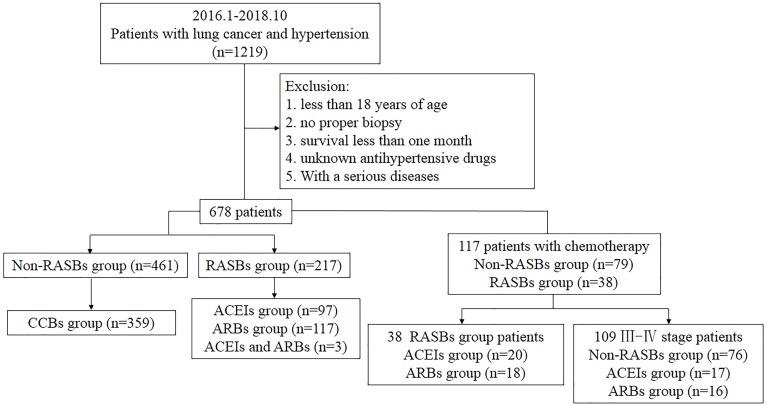
There were a total of 678 lung cancer patients with hypertension, of which 461 (68%) were in the non-RASBs group and 217 (32%) were in the RASBs group. Patients' gender, age, smoking status, histologic differentiation, tumor size, pathological grade, lymph node metastasis, pathological stage and progression-free survival (PFS) were retrospectively analyzed between these two groups. The clinical effects of ACEIs and ARBs in lung cancer patients were compared via t tests, and test, and potential prognostic factors for progression-free survival (PFS) were evaluated by Kaplan-Meier analysis.
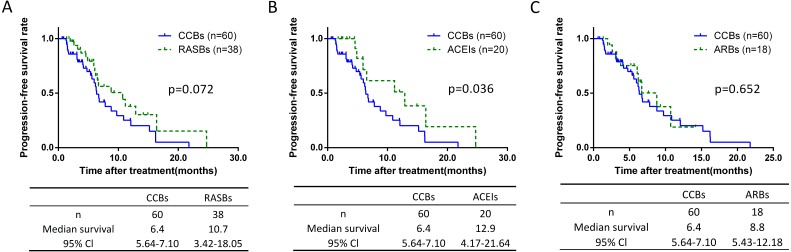
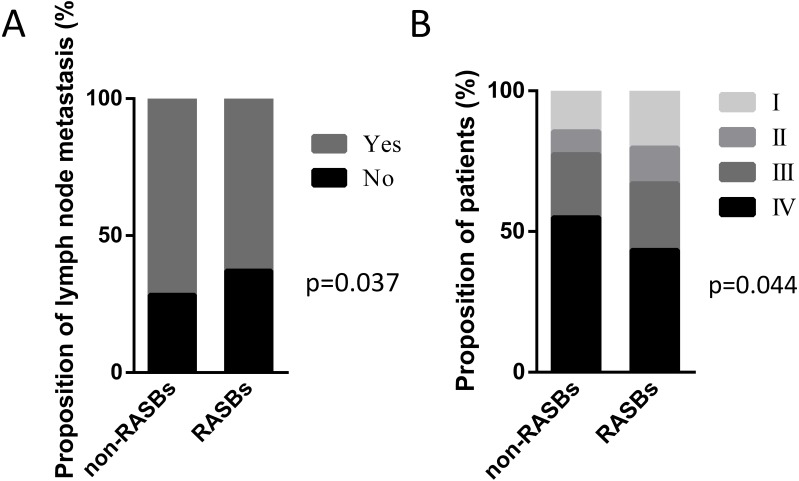
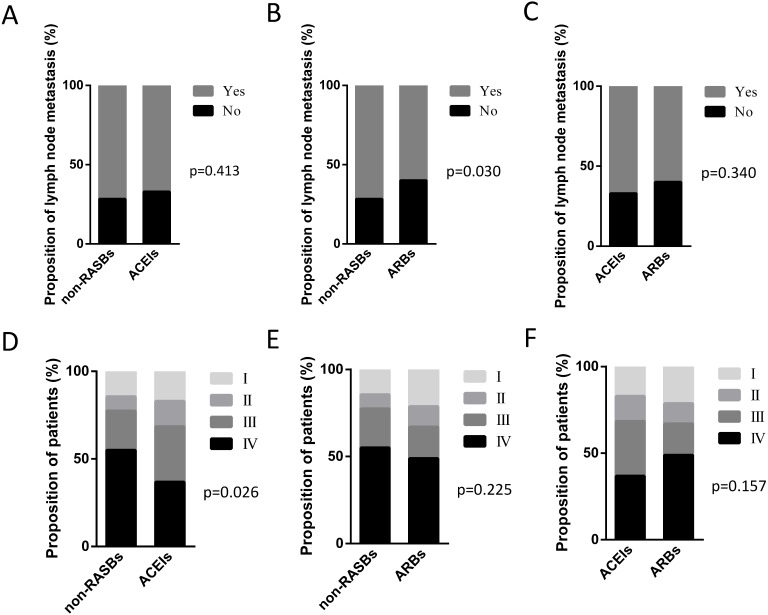
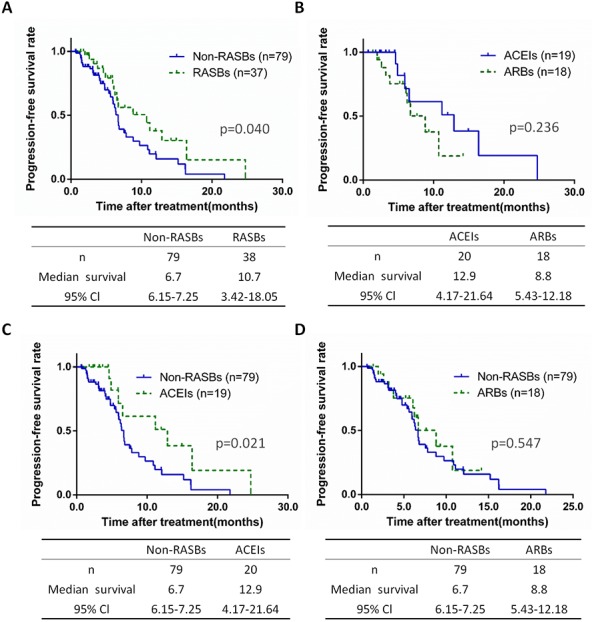
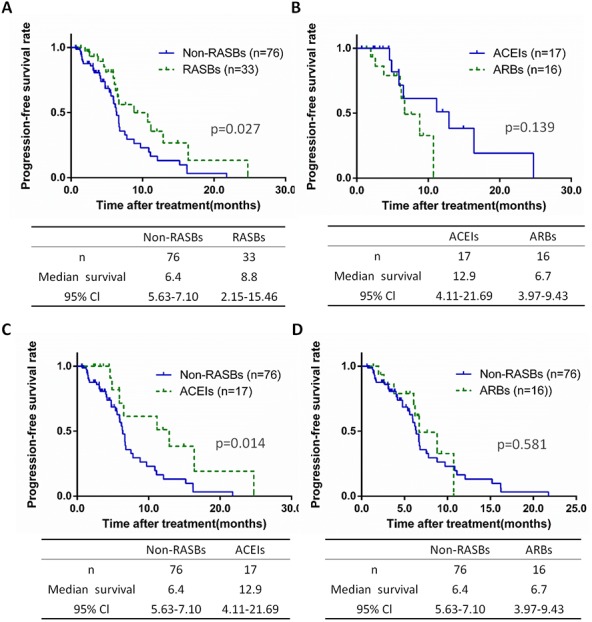
Significant differences were observed in lymph node metastasis between the RASBs and non-RASBs groups. The RASBs group (62.8% vs 71.7%, = 0.037) and ARBs group (60.0% vs 71.7%, = 0.030) had lower lymph node metastasis, and patients with RASBs had a lower pathological stage than those in non-RASBs groups (67.1% vs 77.4%, = 0.044 ). The PFS of the RASBs (10.7 vs. 6.7 months, = 0.040) and ACEIs (12.9 vs 6.7 months, = 0.021) groups were longer than that of the non-RASBs group, while no statistical difference was shown between the ACEIs and ARBs groups. Moreover, the significant results of PFS were further confirmed in pathological stage III-IV patients. In the non-RASB group, 55% of patients took calcium channel blockers (CCBs), and the ACEIs group have a significantly longer PFS compared to the non-CCBs group (6.4 vs 12.9 months, = 0.036).
In this study, we showed that the use of RASBs is a positive factor for pathological stage and prognosis of lung cancer patients. Therefore, it is necessary to actively evaluate medical history, especially the use of anti-hypertension medication, in patients with lung cancer and reflect medical history in the treatment and management plans of these patients.
肾素-血管紧张素系统阻滞剂(RASBs),包括血管紧张素转换酶抑制剂(ACEIs)和血管紧张素2受体1阻滞剂(ARBs),已被报道与肺癌转移、放疗和化疗有关。到目前为止,关于RASBs对中国肺癌患者化疗的诊断和预后影响的临床数据非常有限。
共有678例高血压肺癌患者,其中461例(68%)在非RASBs组,217例(32%)在RASBs组。回顾性分析两组患者的性别、年龄、吸烟状况、组织学分化、肿瘤大小、病理分级、淋巴结转移、病理分期和无进展生存期(PFS)。通过t检验比较ACEIs和ARBs在肺癌患者中的临床效果,并通过Kaplan-Meier分析评估无进展生存期(PFS)的潜在预后因素。
RASBs组和非RASBs组在淋巴结转移方面存在显著差异。RASBs组(62.8%对71.7%,P = 0.037)和ARBs组(60.0%对71.7%,P = 0.030)的淋巴结转移率较低,且使用RASBs的患者病理分期低于非RASBs组(67.1%对77.4%,P = 0.044)。RASBs组(10.7个月对6.7个月,P = 0.040)和ACEIs组(12.9个月对6.7个月,P = 0.021)的无进展生存期长于非RASBs组,而ACEIs组和ARBs组之间无统计学差异。此外,在病理分期为III-IV期的患者中,无进展生存期的显著结果得到进一步证实。在非RASB组中,55%的患者服用钙通道阻滞剂(CCBs),ACEIs组的无进展生存期明显长于非CCBs组(6.4个月对12.9个月,P = 0.036)。
在本研究中,我们表明使用RASBs是肺癌患者病理分期和预后的一个积极因素。因此,有必要积极评估肺癌患者的病史,特别是抗高血压药物的使用情况,并在这些患者的治疗和管理计划中反映病史。