Department of Occupational and Environmental Health, School of Public Health, Sun Yat-sen University, Guangzhou, Guangdong, China.
Department of Toxicology, Guangzhou Center for Disease Control and Prevention, Guangzhou, Guangdong, China.
PLoS One. 2019 Dec 18;14(12):e0225813. doi: 10.1371/journal.pone.0225813. eCollection 2019.
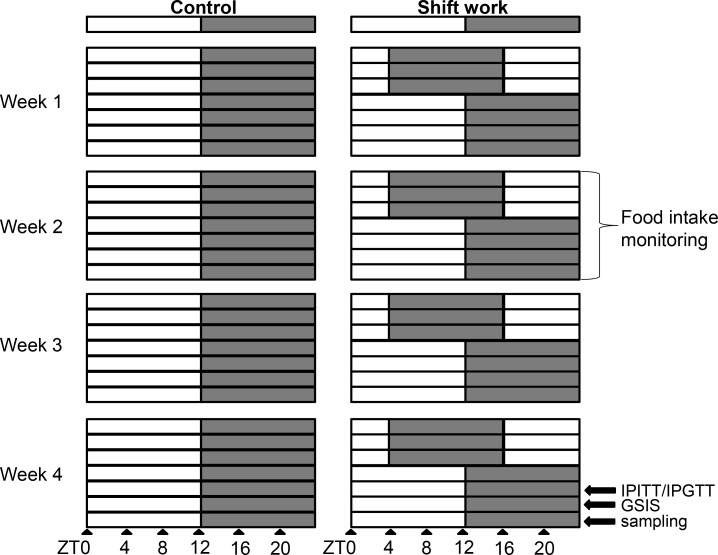
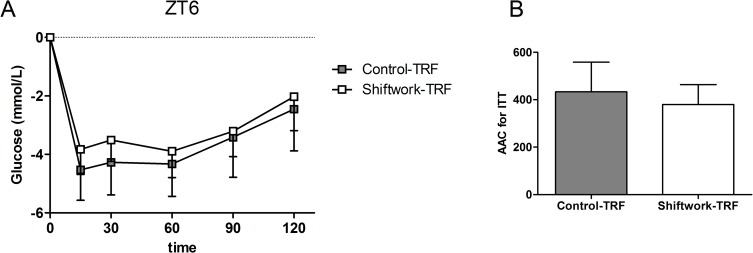
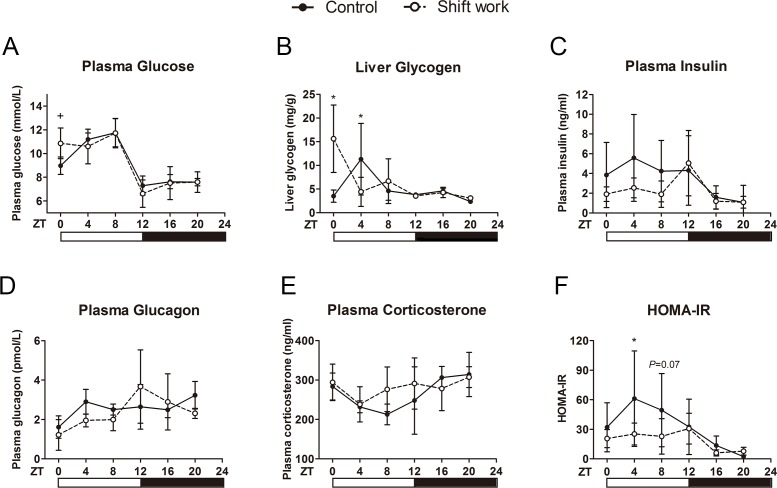
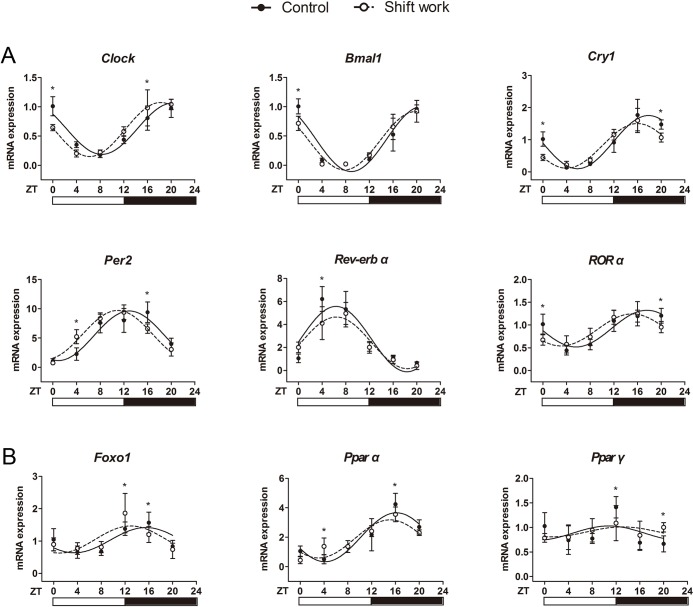
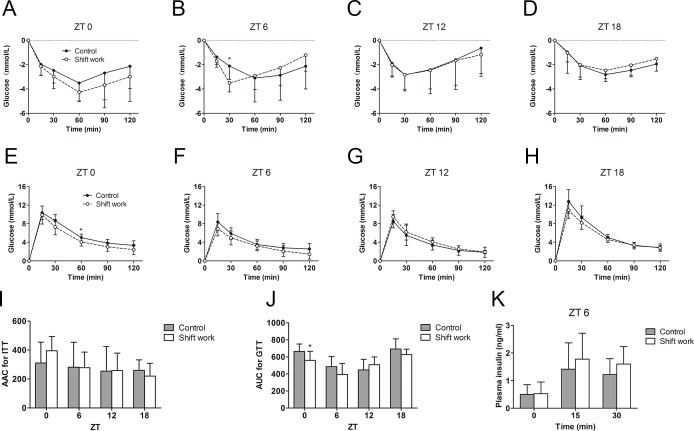
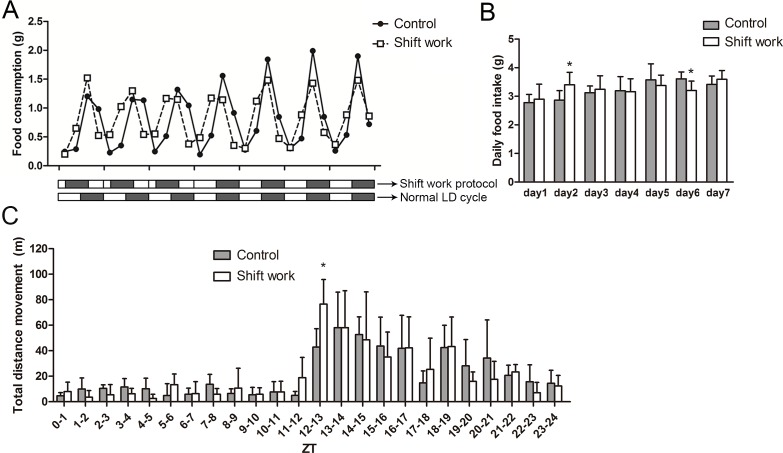
Shift work and jet lag, characterized by circadian misalignment, can disrupt several physiological activities, but whether they affect the rhythm of glucose uptake and insulin sensitivity remain unclear. In the present study, female C57BL/6J mice were maintained for four weeks under the condition of 8-hour phase advance and delay every 3-4 days to mimic shift work. Intraperitoneal glucose tolerance test (IPGTT) and intraperitoneal insulin tolerance test (IPITT) were performed repeatedly at Zeitgeber time (ZT) 0, ZT6, ZT12, and ZT18. Glucose-stimulated insulin secretion (GSIS) test was performed at ZT6. We found that the average level of daily glucose tolerance did not decrease but the phase of glucose tolerance advanced by 2.27 hours and the amplitude attenuated by 20.4% in shift work mice. At ZT6, IPITT showed blood glucose at 30 min after insulin injection decreased faster in shift work mice (-3.50±0.74mmol/L, -61.58±7.89%) than that in control mice (-2.11±1.10mmol/L, -33.72±17.24%), but IPGTT and GSIS test showed no significant difference between the two groups. Food intake monitor showed that the feeding time of shift work mice continued to advance. Restricting feed to a fixed 12-hour period alleviated the increase of insulin sensitivity induced by shift-work. We also observed that an increase of blood glucose and liver glycogen at ZT0, as well as a phase advance of liver clock genes and some glucose metabolism-related genes such as forkhead box O1 (Foxo1) and peroxisome proliferator activated receptor alpha (Pparα) in shift work mice. Our results showed that light change-simulated shift work altered insulin sensitivity during the light phase and shifted glucose tolerance rhythms in female mice, suggesting a causal association between long-term shift work and type 2 diabetes.
轮班工作和时差,表现为昼夜节律失调,可能会扰乱几种生理活动,但它们是否会影响葡萄糖摄取和胰岛素敏感性的节律尚不清楚。在本研究中,雌性 C57BL/6J 小鼠每隔 3-4 天进行 8 小时的相位提前和延迟,以模拟轮班工作。在 Zeitgeber 时间(ZT)0、ZT6、ZT12 和 ZT18 时反复进行腹腔内葡萄糖耐量试验(IPGTT)和腹腔内胰岛素耐量试验(IPITT)。在 ZT6 时进行葡萄糖刺激的胰岛素分泌(GSIS)试验。我们发现,轮班工作小鼠的平均日糖耐量水平没有下降,但糖耐量的相位提前了 2.27 小时,幅度降低了 20.4%。在 ZT6 时,胰岛素注射后 30 分钟的 IPITT 显示轮班工作小鼠的血糖下降更快(-3.50±0.74mmol/L,-61.58±7.89%),而对照组小鼠为(-2.11±1.10mmol/L,-33.72±17.24%),但 IPGTT 和 GSIS 试验两组间无显著差异。食物摄入量监测显示,轮班工作小鼠的进食时间继续提前。将进食时间限制在固定的 12 小时内,可以缓解轮班工作引起的胰岛素敏感性增加。我们还观察到,轮班工作小鼠在 ZT0 时血糖和肝糖原增加,以及肝脏时钟基因和一些葡萄糖代谢相关基因(如叉头框 O1(Foxo1)和过氧化物酶体增殖物激活受体α(Pparα))的相位提前。我们的结果表明,光变化模拟的轮班工作改变了光照期女性小鼠的胰岛素敏感性,并改变了葡萄糖耐量节律,提示长期轮班工作与 2 型糖尿病之间存在因果关系。