
进食-禁食节律的慢性昼夜节律失调会导致小鼠每日血糖、低密度脂蛋白胆固醇血症和微生物群组成发生改变。
Chronic circadian desynchronization of feeding-fasting rhythm generates alterations in daily glycemia, LDL cholesterolemia and microbiota composition in mice.
作者信息
Trebucq Laura Lucía, Lamberti Melisa Luciana, Rota Rosana, Aiello Ignacio, Borio Cristina, Bilen Marcos, Golombek Diego Andrés, Plano Santiago Andrés, Chiesa Juan José
机构信息
Laboratorio de Cronobiología, Departamento de Ciencia y Tecnología, Universidad Nacional de Quilmes (UNQ), Consejo Nacional de Investigaciones Científicas y Técnicas (CONICET), Bernal, Argentina.
Laboratorio de Ingeniería Genética, Biología Celular y Molecular, Departamento de Ciencia y Tecnología, Universidad Nacional de Quilmes (UNQ), Consejo Nacional de Investigaciones Científicas y Técnicas (CONICET), Bernal, Argentina.
出版信息
Front Nutr. 2023 Apr 14;10:1154647. doi: 10.3389/fnut.2023.1154647. eCollection 2023.
INTRODUCTION
The circadian system synchronizes behavior and physiology to the 24-h light- dark (LD) cycle. Timing of food intake and fasting periods provide strong signals for peripheral circadian clocks regulating nutrient assimilation, glucose, and lipid metabolism. Mice under 12 h light:12 h dark (LD) cycles exhibit behavioral activity and feeding during the dark period, while fasting occurs at rest during light. Disruption of energy metabolism, leading to an increase in body mass, was reported in experimental models of circadian desynchronization. In this work, the effects of chronic advances of the LD cycles (chronic jet-lag protocol, CJL) were studied on the daily homeostasis of energy metabolism and weight gain.
METHODS
Male C57 mice were subjected to a CJL or LD schedule, measuring IPGTT, insulinemia, microbiome composition and lipidemia.
RESULTS
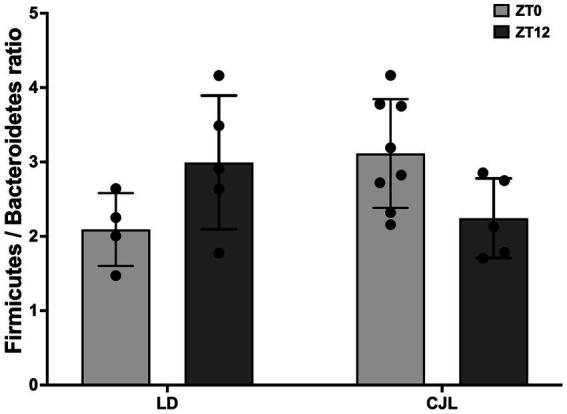
Mice under CJL show behavioral desynchronization and feeding activity distributed similarly at the light and dark hours and, although feeding a similar daily amount of food as compared to controls, show an increase in weight gain. In addition, ad libitum glycemia rhythm was abolished in CJL-subjected mice, showing similar blood glucose values at light and dark. CJL also generated glucose intolerance at dark in an intraperitoneal glucose tolerance test (IPGTT), with increased insulin release at both light and dark periods. Low-density lipoprotein (LDL) cholesterolemia was increased under this condition, but no changes in HDL cholesterolemia were observed. Firmicutes/Bacteroidetes ratio was analyzed as a marker of circadian disruption of microbiota composition, showing opposite phases at the light and dark when comparing LD vs. CJL.
DISCUSSION
Chronic misalignment of feeding/fasting rhythm leads to metabolic disturbances generating nocturnal hyperglycemia, glucose intolerance and hyperinsulinemia in a IPGTT, increased LDL cholesterolemia, and increased weight gain, underscoring the importance of the timing of food consumption with respect to the circadian system for metabolic health.
引言
昼夜节律系统使行为和生理机能与24小时的明暗(LD)周期同步。食物摄入时间和禁食期为调节营养吸收、葡萄糖和脂质代谢的外周生物钟提供了强烈信号。处于12小时光照:12小时黑暗(LD)周期下的小鼠在黑暗期表现出行为活动和进食,而在光照期休息时禁食。在昼夜节律失调的实验模型中,有报道称能量代谢紊乱会导致体重增加。在这项研究中,我们研究了LD周期的慢性提前(慢性时差方案,CJL)对能量代谢和体重增加的每日稳态的影响。
方法
对雄性C57小鼠采用CJL或LD方案,测量腹腔注射葡萄糖耐量试验(IPGTT)、胰岛素血症、微生物群组成和血脂。
结果
CJL方案下的小鼠表现出行为失调,进食活动在光照和黑暗时间分布相似,尽管与对照组相比每日进食量相似,但体重增加。此外,CJL方案下的小鼠随意血糖节律消失,在光照和黑暗时血糖值相似。在腹腔注射葡萄糖耐量试验(IPGTT)中,CJL还导致黑暗期葡萄糖不耐受,在光照和黑暗期胰岛素释放均增加。在此条件下,低密度脂蛋白(LDL)胆固醇血症增加,但高密度脂蛋白胆固醇血症未观察到变化。分析厚壁菌门/拟杆菌门的比例作为微生物群组成昼夜节律紊乱的标志物,与LD组相比,CJL组在光照和黑暗时呈现相反的相位。
讨论
进食/禁食节律的长期失调会导致代谢紊乱,在IPGTT中产生夜间高血糖、葡萄糖不耐受和高胰岛素血症,LDL胆固醇血症增加,体重增加,这突出了食物摄入时间相对于昼夜节律系统对代谢健康的重要性。


 Zotero 插件