Institute of Movement Sciences, National Centre for Scientific Research, Aix-Marseille University, Marseille, 13009, France.
Sci Rep. 2019 Dec 18;9(1):19357. doi: 10.1038/s41598-019-55443-w.
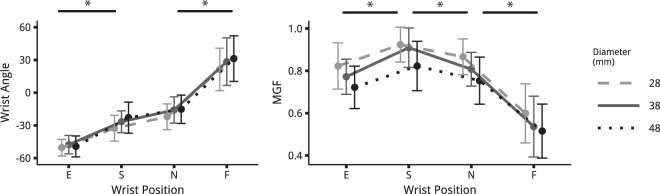
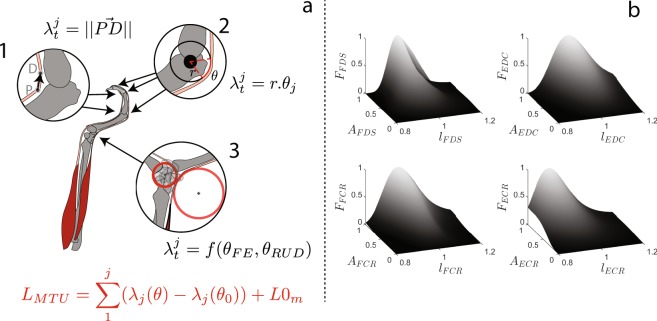
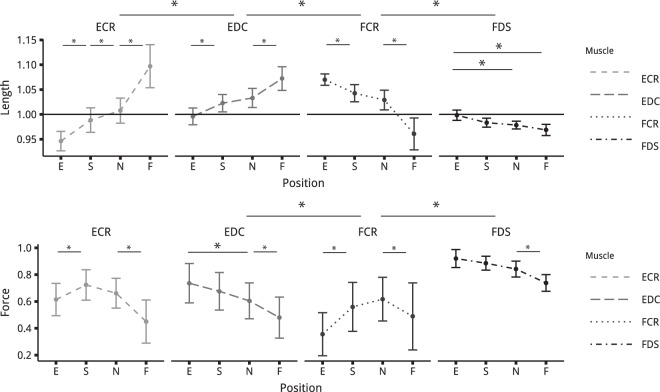
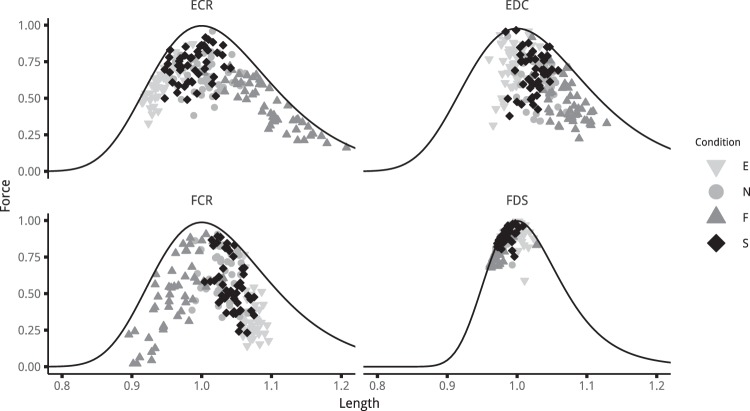
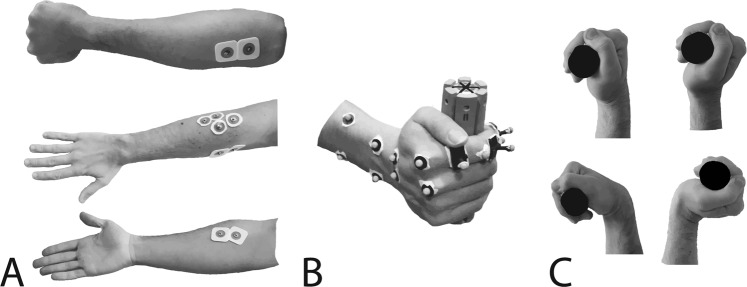
The relationship between posture, muscle length properties and performance remains unclear, because of a lack of quantitative data. Studies on grasping tasks suggested that wrist position could favour the extrinsic finger flexor in regards to their length to maximise grip force performance. The present study aimed at providing quantitative evidence of the links between wrist posture, muscle capacities and grip capabilities. It combines experimental measurements and a musculoskeletal model including the force-length relationship of the four prime muscles used in grasping. Participants exerted their maximum grip force on a cylindrical dynamometer in four different wrist postures, including one freely chosen by participants (spontaneous). A musculoskeletal model computed the muscle force level and length from motion capture and muscle activation. Results revealed that participants exerted maximum grip force spontaneously, with a loss of force when using other postures. At muscle force and length level, grip force variation seems to be associated with all the muscles under study. This observation led to a first quantitative link between power grip, posture and muscle properties, which could provide more insight into neuromechanical interaction involved when grasping. The design of ergonomic devices could also benefit from this quantification of the relationship between wrist angle and muscle length properties.
姿势、肌肉长度特性和表现之间的关系尚不清楚,因为缺乏定量数据。关于抓握任务的研究表明,腕部位置可能有利于外在手指屈肌的长度,以最大限度地提高握力表现。本研究旨在提供腕部姿势、肌肉能力和抓握能力之间联系的定量证据。它结合了实验测量和包括用于抓握的四个主要肌肉的力-长度关系的肌肉骨骼模型。参与者在四个不同的腕部姿势下(包括参与者自由选择的一种姿势)在圆柱形测力计上施加最大握力。肌肉骨骼模型从运动捕捉和肌肉激活中计算肌肉力水平和长度。结果表明,参与者自发地施加最大握力,而使用其他姿势时握力会下降。在肌肉力和长度水平上,握力变化似乎与所有研究中的肌肉有关。这一观察结果首次在力量握力、姿势和肌肉特性之间建立了定量联系,这可以更深入地了解抓握时涉及的神经肌肉相互作用。人体工程学设备的设计也可以从腕角和肌肉长度特性之间关系的这种量化中受益。