Armarego-Marriott Tegan, Sandoval-Ibañez Omar, Kowalewska Łucja
Max Planck Institute of Molecular Plant Physiology, Potsdam, Germany.
Faculty of Biology, Department of Plant Anatomy and Cytology, University of Warsaw, Warszawa, Poland.
J Exp Bot. 2020 Feb 19;71(4):1215-1225. doi: 10.1093/jxb/erz496.
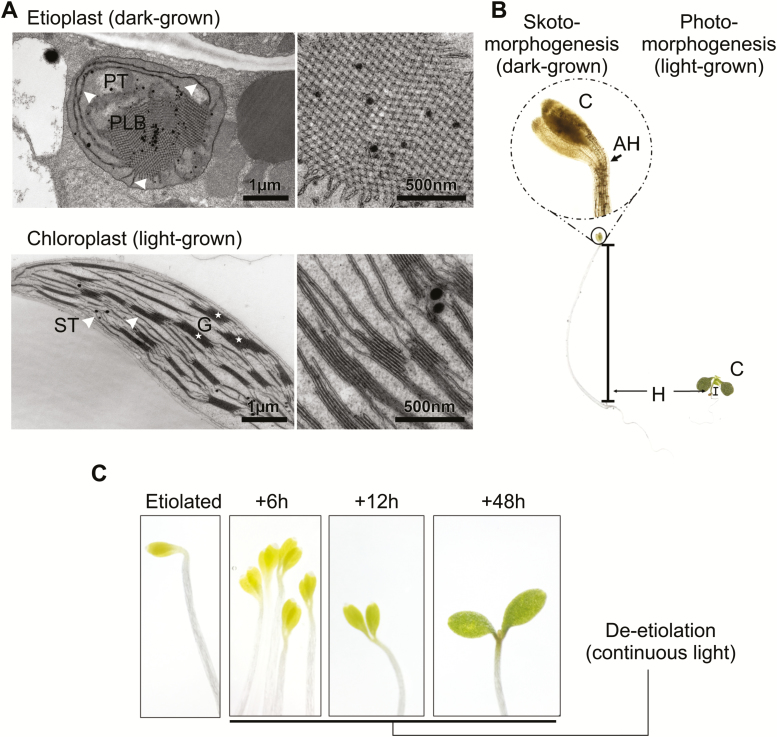
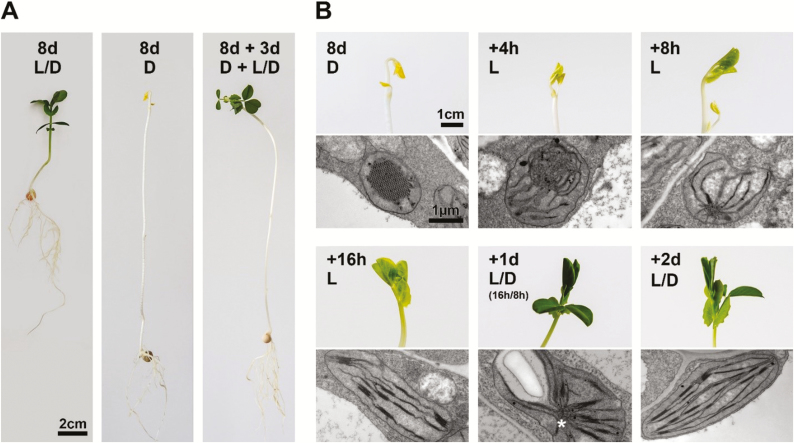
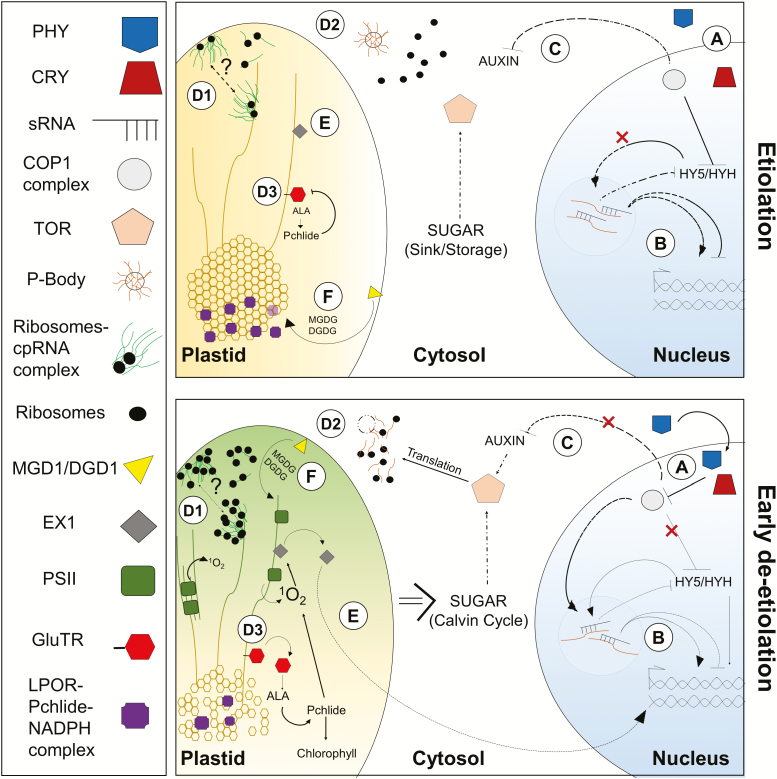
The state of etiolation is generally defined by the presence of non-green plastids (etioplasts) in plant tissues that would normally contain chloroplasts. In the commonly used dark-grown seedling system, etiolation is coupled with a type of growth called skotomorphogenesis. Upon illumination, de-etiolation occurs, marked by the transition from etioplast to chloroplast, and, at the seedling level, a switch to photomorphogenic growth. Etiolation and de-etiolation systems are therefore important for understanding both the acquisition of photosynthetic capacity during chloroplast biogenesis and plant responses to light-the most relevant signal in the life and growth of the organism. In this review, we discuss recent discoveries (within the past 2-3 years) in the field of etiolation and de-etiolation, with a particular focus on post-transcriptional processes and ultrastructural changes. We further discuss ambiguities in definitions of the term 'etiolation', and benefits and biases of common etiolation/de-etiolation systems. Finally, we raise several open questions and future research possibilities.
黄化状态通常由植物组织中存在非绿色质体(黄化质体)来定义,而这些组织通常会含有叶绿体。在常用的暗培养幼苗系统中,黄化与一种称为暗形态建成的生长类型相关联。光照后,脱黄化过程发生,其特征是从黄化质体向叶绿体的转变,并且在幼苗水平上,转向光形态建成生长。因此,黄化和脱黄化系统对于理解叶绿体生物发生过程中光合能力的获得以及植物对光的反应(生物体生命和生长中最相关的信号)都很重要。在这篇综述中,我们讨论了黄化和脱黄化领域最近(过去2 - 3年)的发现,特别关注转录后过程和超微结构变化。我们还讨论了“黄化”一词定义中的模糊之处,以及常见黄化/脱黄化系统的优点和偏差。最后,我们提出了几个未解决的问题和未来的研究可能性。