Department of Sport, Exercise and Health, Division of Sports and Exercise Medicine, University of Basel, Birsstrasse 320 B, 4052, Basel, Switzerland.
Geographical Information Systems Unit, Department of Geography, University of Zürich, Zürich, Switzerland.
BMC Public Health. 2019 Dec 19;19(1):1703. doi: 10.1186/s12889-019-8069-2.
Mobility limitations in older adults are associated with poor clinical outcomes including higher mortality and disability rates. A decline in mobility (including physical function and life-space) is detectable and should be discovered as early as possible, as it can still be stabilized or even reversed in early stages by targeted interventions. General practitioners (GPs) would be in the ideal position to monitor the mobility of their older patients. However, easy-to-use and valid instruments for GPs to conduct mobility assessment in the real-life practice setting are missing. Modern technologies such as the global positioning system (GPS) and inertial measurement units (IMUs) - nowadays embedded in every smartphone - could facilitate monitoring of different aspects of mobility in the GP's practice.
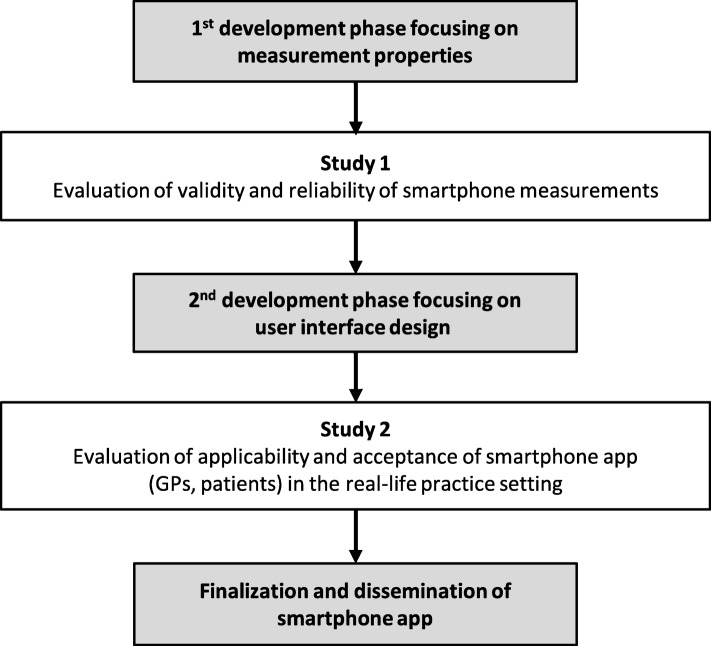
This project's aim is to provide GPs with a novel smartphone application that allows them to quantify their older patients' mobility. The project consists of three parts: development of the GPS- and IMU-based application, evaluation of its validity and reliability (Study 1), and evaluation of its applicability and acceptance (Study 2). In Study 1, participants (target N = 72, aged 65+, ≥2 chronic diseases) will perform a battery of walking tests (varying distances; varying levels of standardization). Besides videotaping and timing (gold standard), a high-end GPS device, a medium-accuracy GPS/IMU logger and three different smartphone models will be used to determine mobility parameters such as gait speed. Furthermore, participants will wear the medium-accuracy GPS/IMU logger and a smartphone for a week to determine their life-space mobility. Participants will be re-assessed after 1 week. In Study 2, participants (target N = 60, aged 65+, ≥2 chronic diseases) will be instructed on how to use the application by themselves. Participants will perform mobility assessments independently at their own homes. Aggregated test results will also be presented to GPs. Acceptance of the application will be assessed among patients and GPs. The application will then be finalized and publicly released.
If successful, the MOBITEC-GP application will offer health care providers the opportunity to follow their patients' mobility over time and to recognize impending needs (e.g. for targeted exercise) within pre-clinical stages of decline.
老年人的行动能力受限与较差的临床结果相关,包括更高的死亡率和残疾率。行动能力(包括身体功能和生活空间)的下降是可检测到的,应该尽早发现,因为通过有针对性的干预,它仍然可以在早期得到稳定甚至逆转。全科医生(GP)最适合监测其老年患者的行动能力。然而,目前缺乏用于 GP 在实际实践中进行移动性评估的简单易用且有效的工具。现代技术,如全球定位系统(GPS)和惯性测量单元(IMU) - 如今嵌入在每部智能手机中 - 可以促进 GP 实践中不同方面的移动性监测。
该项目的目的是为 GP 提供一种新的智能手机应用程序,使他们能够量化其老年患者的移动性。该项目由三部分组成:基于 GPS 和 IMU 的应用程序的开发,对其有效性和可靠性的评估(研究 1),以及对其适用性和可接受性的评估(研究 2)。在研究 1 中,参与者(目标 N = 72,年龄 65 岁以上,≥2 种慢性病)将进行一系列步行测试(不同距离;不同标准化水平)。除了录像和计时(金标准)外,还将使用高端 GPS 设备、中精度 GPS/IMU 记录器和三种不同的智能手机模型来确定步态速度等移动性参数。此外,参与者将佩戴中精度 GPS/IMU 记录器和智能手机一周,以确定他们的生活空间移动性。参与者将在一周后重新评估。在研究 2 中,参与者(目标 N = 60,年龄 65 岁以上,≥2 种慢性病)将自行学习如何使用该应用程序。参与者将在家中独立进行移动性评估。还将向 GP 呈现汇总的测试结果。将在患者和 GP 中评估对应用程序的接受程度。然后,该应用程序将最终确定并公开发布。
如果成功,MOBITEC-GP 应用程序将为医疗保健提供者提供机会,随着时间的推移跟踪患者的移动性,并在下降的临床前阶段识别即将出现的需求(例如,有针对性的运动)。