Berar Antoine, Allain Jean-Sébastien, Allard Sophie, Lefevre Charles, Baert Alain, Morel Isabelle, Bouvet Renaud, Gicquel Thomas
CHU Rennes, Department of Forensic Medicine.
CHU Rennes, Department of Internal Medicine and Clinical Immunology.
Medicine (Baltimore). 2019 Dec;98(52):e18295. doi: 10.1097/MD.0000000000018295.
3-Methoxyphencyclidine (3-MeO-PCP) is a new psychoactive substance derived from phencyclidine. Although it can lead to severe intoxications, the main manifestations and optimal management have not been well characterized. Here, we report 2 cases of 3-MeO-PCP intoxication in the same patient, and summarize the manifestations of this intoxication reported in literature.
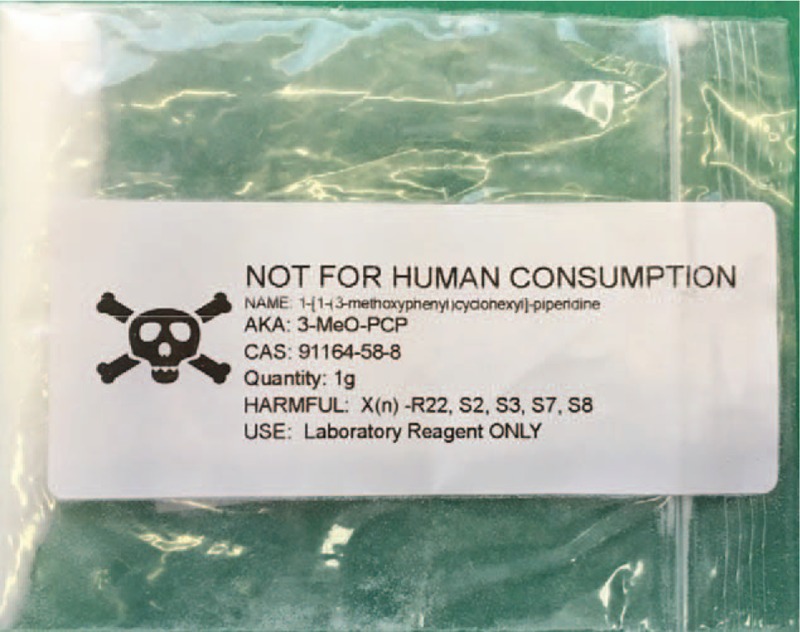
A 17-year-old male purchased a bag of 3-MeO-PCP on the Internet but took an oral dose (200 mg) that corresponds to the less active isomer 4-MeO-PCP. He developed high blood pressure (158/131 mm Hg), tachycardia (100 bpm), and neurological manifestations (confusion, hypertonia, nystagmus, and then agitation). A maculopapular rash appeared, although this may have been related to the administration of midazolam. Hyperlactatemia (2.6 mmol/L) was the main laboratory finding. Seven days later, he returned to the emergency department after sniffing 50 mg of 3-MeO-PCP. High blood pressure, tachycardia, and neurological manifestations (psychomotor impairment and dysarthria) were present but less severe than after the first intoxication.
In the first intoxication, the blood and urine 3-MeO-PCP concentrations were, respectively, 71.1 ng/mL and 706.9 ng/mL. Conventional toxicity tests were all negative. In the second intoxication, biological samples were not available.
In the first intoxication, treatment consisted of intravenous hydration and midazolam. The patient was transferred to an intensive care unit for monitoring. After the second intoxication, he was monitored for 12 hours.
The patient's condition improved quickly in both cases.
These cases provide additional information on the manifestations of 3-MeO-PCP intoxication. These manifestations are mainly cardiovascular (high blood pressure, tachycardia) and neurological. The fact that second (50 mg) intoxication was less severe than the first (200 mg) is suggestive of a dose-effect relationship for 3-MeO-PCP. The first case also emphasizes the risk of dosing errors caused by the similarity between the names "3-MeO-PCP" and "4-MeO-PCP."
3-甲氧基苯环己哌啶(3-MeO-PCP)是一种源自苯环己哌啶的新型精神活性物质。尽管它可导致严重中毒,但其主要表现和最佳处理方法尚未得到充分描述。在此,我们报告同一患者发生的2例3-MeO-PCP中毒病例,并总结文献中报道的该中毒的表现。
一名17岁男性在互联网上购买了一袋3-MeO-PCP,但口服了相当于活性较低的异构体4-MeO-PCP的剂量(200毫克)。他出现了高血压(158/131毫米汞柱)、心动过速(100次/分钟)和神经学表现(意识模糊、肌张力亢进、眼球震颤,随后出现烦躁不安)。出现了斑丘疹皮疹,不过这可能与咪达唑仑的使用有关。高乳酸血症(2.6毫摩尔/升)是主要的实验室检查结果。7天后,他在吸食50毫克3-MeO-PCP后返回急诊科。出现了高血压、心动过速和神经学表现(精神运动障碍和构音障碍),但比首次中毒时症状较轻。
首次中毒时,血液和尿液中3-MeO-PCP浓度分别为71.1纳克/毫升和706.9纳克/毫升。常规毒性检测均为阴性。第二次中毒时未获取生物样本。
首次中毒时,治疗包括静脉补液和使用咪达唑仑。患者被转至重症监护病房进行监测。第二次中毒后,对他进行了12小时的监测。
两例患者的病情均迅速好转。
这些病例提供了有关3-MeO-PCP中毒表现的更多信息。这些表现主要是心血管方面(高血压、心动过速)和神经学方面的。第二次(50毫克)中毒比第一次(200毫克)中毒症状较轻这一事实提示3-MeO-PCP存在剂量效应关系。首例病例还强调了“3-MeO-PCP”和“4-MeO-PCP”名称相似导致用药错误的风险。