
探针型和基底型超声微纳操纵系统中二维轴对称声流场的建模与分析
Modeling and Analysis of the Two-Dimensional Axisymmetric Acoustofluidic Fields in the Probe-Type and Substrate-Type Ultrasonic Micro/Nano Manipulation Systems.
作者信息
Liu Pengzhan, Tang Qiang, Su Songfei, Hu Jie, Yu Yang
机构信息
State Key Lab of Mechanics and Control of Mechanical Structures, Nanjing University of Aeronautics and Astronautics, Nanjing 210016, China.
Department of Mechanical Engineering and Materials Science, Duke University, Durham, NC 27708, USA.
出版信息
Micromachines (Basel). 2019 Dec 24;11(1):22. doi: 10.3390/mi11010022.
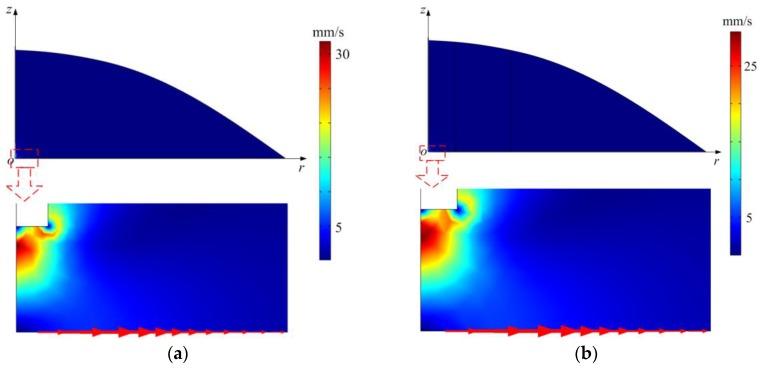
The probe-type and substrate-type ultrasonic micro/nano manipulation systems have proven to be two kinds of powerful tools for manipulating micro/nanoscale materials. Numerical simulations of acoustofluidic fields in these two kinds of systems can not only be used to explain and analyze the physical mechanisms of experimental phenomena, but also provide guidelines for optimization of device parameters and working conditions. However, in-depth quantitative study and analysis of acoustofluidic fields in the two ultrasonic micro/nano manipulation systems have scarcely been reported. In this paper, based on the finite element method (FEM), we numerically investigated the two-dimensional (2D) axisymmetric acoustofluidic fields in the probe-type and substrate-type ultrasonic micro/nano manipulation systems by the perturbation method (PM) and Reynolds stress method (RSM), respectively. Through comparing the simulation results computed by the two methods and the experimental verifications, the feasibility and reasonability of the two methods in simulating the acoustofluidic fields in these two ultrasonic micro/nano manipulation systems have been validated. Moreover, the effects of device parameters and working conditions on the acoustofluidic fields are clarified by the simulation results and qualitatively verified by the experiments.
探针型和基底型超声微纳操控系统已被证明是操控微纳尺度材料的两种强大工具。这两种系统中声流场的数值模拟不仅可用于解释和分析实验现象的物理机制,还可为器件参数和工作条件的优化提供指导。然而,关于这两种超声微纳操控系统中声流场的深入定量研究和分析鲜有报道。本文基于有限元方法(FEM),分别采用微扰法(PM)和雷诺应力法(RSM)对探针型和基底型超声微纳操控系统中的二维(2D)轴对称声流场进行了数值研究。通过比较两种方法计算得到的模拟结果和实验验证,验证了这两种方法在模拟这两种超声微纳操控系统中声流场的可行性和合理性。此外,通过模拟结果阐明了器件参数和工作条件对声流场的影响,并通过实验进行了定性验证。




 Zotero 插件