Emotion and Development Branch, National Institute of Mental Health, National Institutes of Health, Bethesda, MD, USA.
Department of Psychology, The Catholic University of America, Washington, DC, USA.
Bipolar Disord. 2020 Mar;22(2):163-173. doi: 10.1111/bdi.12885. Epub 2020 Jan 21.
Bipolar disorder (BD) and familial risk for BD have been associated with aberrant white matter (WM) microstructure in the corpus callosum and fronto-limbic pathways. These abnormalities might constitute trait or state marker and have been suggested to result from aberrant maturation and to relate to difficulties in emotion regulation.
To determine whether WM alterations represent a trait, disease or resilience marker, we compared youth at risk for BD (n = 36 first-degree relatives, REL) to youth with BD (n = 36) and healthy volunteers (n = 36, HV) using diffusion tensor imaging.
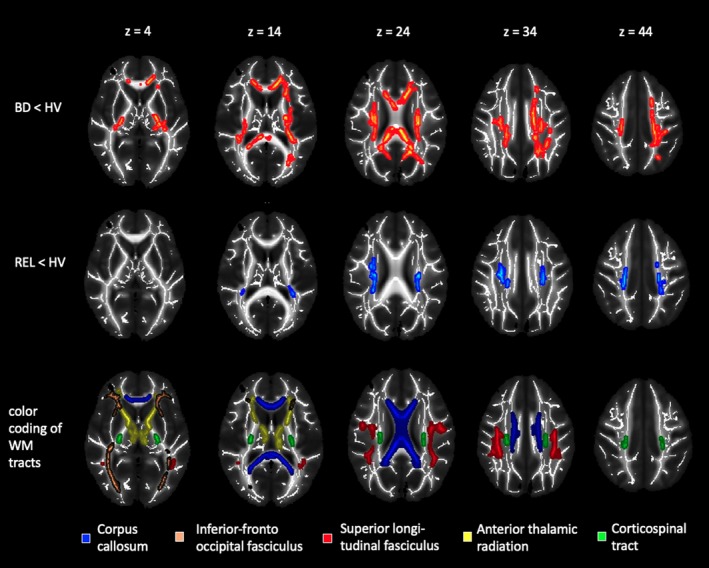
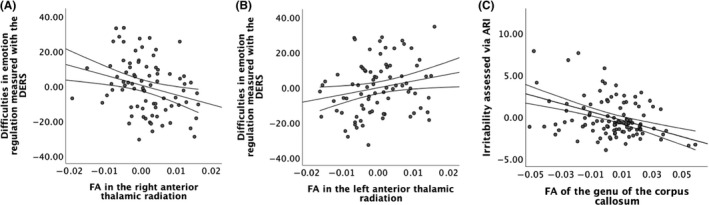
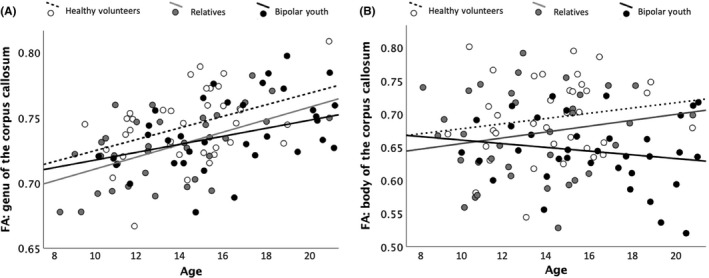
Individuals with BD and REL did not differ from each other in WM microstructure and, compared to HV, showed similar aberrations in the superior corona radiata (SCR)/corticospinal tract (CST) and the body of the corpus callosum. WM microstructure of the anterior CC showed reduced age-related in-creases in BD compared to REL and HV. Further, individuals with BD and REL showed in-creased difficulties in emotion regulation, which were associated with the microstructure of the anterior thalamic radiation.
Alterations in the SCR/CST and the body of the corpus callosum appear to represent a trait marker of BD, whereas changes in other WM tracts seem to be a disease state marker. Our findings also support the role of aberrant developmental trajectories of WM microstructure in the risk architecture of BD, although longitudinal studies are needed to confirm this association. Finally, our findings show the relevance of WM microstructure for difficulties in emotion regulation-a core characteristic of BD.
双相障碍(BD)及其家族性发病风险与胼胝体和额-边缘通路的异常白质(WM)结构有关。这些异常可能构成特征或状态标志物,并被认为是由于异常成熟引起的,并与情绪调节困难有关。
为了确定 WM 改变是否代表特征、疾病或适应力标志物,我们使用弥散张量成像比较了 BD 发病风险青年(n=36 名一级亲属,REL)、BD 患者(n=36)和健康对照者(n=36,HV)。
BD 患者和 REL 患者在 WM 微观结构上彼此之间没有差异,与 HV 相比,他们在前胼胝体(CC)体部和上放射冠(SCR)/皮质脊髓束(CST)显示出类似的异常。与 REL 和 HV 相比,BD 患者的前 CC 的 WM 微观结构显示出年龄相关的增加减少。此外,BD 患者和 REL 患者的情绪调节困难增加,这与前丘脑辐射的微观结构有关。
SCR/CST 和胼胝体体部的改变似乎代表了 BD 的特征标志物,而其他 WM 束的改变似乎是疾病状态标志物。我们的研究结果还支持 WM 微观结构异常的发育轨迹在 BD 的风险结构中的作用,尽管需要进行纵向研究来证实这种关联。最后,我们的研究结果表明 WM 微观结构与情绪调节困难有关,这是 BD 的一个核心特征。