Xie Yong, Pan Meng, Gao Yanpan, Zhang Licheng, Ge Wei, Tang Peifu
1Department of Orthopedics, Chinese PLA General Hospital, Beijing, 100853 China.
2State Key Laboratory of Medical Molecular Biology and Department of Immunology, Institute of Basic Medical Sciences, Chinese Academy of Medical Sciences, Beijing, 100005 China.
Cell Biosci. 2019 Dec 23;9:103. doi: 10.1186/s13578-019-0369-9. eCollection 2019.
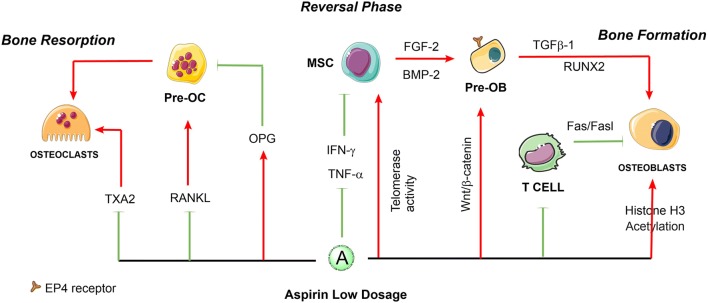
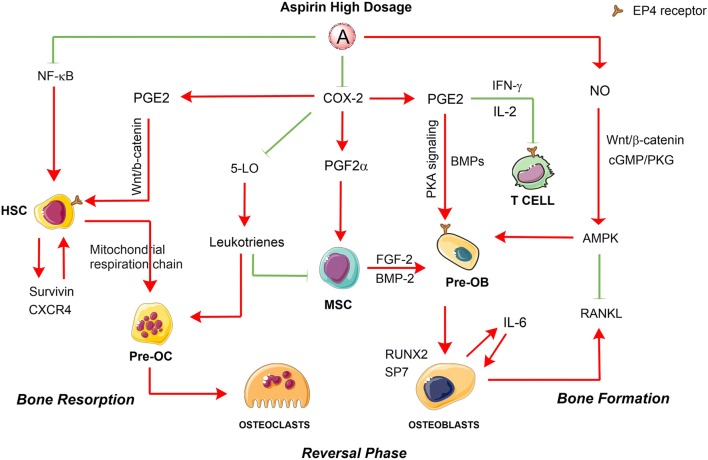
The failure of remodeling process that constantly regenerates effete, aged bone is highly associated with bone nonunion and degenerative bone diseases. Numerous studies have demonstrated that aspirin and other non-steroidal anti-inflammatory drugs (NSAIDs) activate cytokines and mediators on osteoclasts, osteoblasts and their constituent progenitor cells located around the remodeling area. These cells contribute to a complex metabolic scenario, resulting in degradative or synthetic functions for bone mineral tissues. The spatiotemporal effects of aspirin and NSAIDs in the bone remodeling are controversial according the specific therapeutic doses used for different clinical conditions. Herein, we review in vitro, in vivo, and clinical studies on the dose-dependent roles of aspirin and NSAIDs in bone remodeling. Our results show that low-dose aspirin (< 100 μg/mL), which is widely recommended for prevention of thrombosis, is very likely to be benefit for maintaining bone mass and qualities by activation of osteoblastic bone formation and inhibition of osteoclast activities via cyclooxygenase-independent manner. While, the roles of high-dose aspirin (150-300 μg/mL) and other NSAIDs in bone self-regeneration and fracture-healing process are difficult to elucidate owing to their dual effects on osteoclast activity and bone formation of osteoblast. In conclusion, this study highlighted the potential clinical applications of low-dose aspirin in abnormal bone remodeling as well as the risks of high-dose aspirin and other NSAIDs for relieving pain and anti-inflammation in fractures and orthopedic operations.
持续再生衰老、陈旧骨组织的重塑过程失败与骨不连和退行性骨病密切相关。大量研究表明,阿司匹林和其他非甾体抗炎药(NSAIDs)可激活破骨细胞、成骨细胞及其位于重塑区域周围的组成祖细胞上的细胞因子和介质。这些细胞促成了复杂的代谢情况,导致骨矿物质组织出现降解或合成功能。根据用于不同临床情况的特定治疗剂量,阿司匹林和NSAIDs在骨重塑中的时空效应存在争议。在此,我们综述了阿司匹林和NSAIDs在骨重塑中剂量依赖性作用的体外、体内及临床研究。我们的结果表明,广泛推荐用于预防血栓形成的低剂量阿司匹林(<100μg/mL)很可能通过以不依赖环氧化酶的方式激活成骨细胞骨形成并抑制破骨细胞活性,对维持骨量和骨质量有益。然而,高剂量阿司匹林(150 - 300μg/mL)和其他NSAIDs在骨自我再生和骨折愈合过程中的作用难以阐明,因为它们对破骨细胞活性和成骨细胞骨形成具有双重影响。总之,本研究强调了低剂量阿司匹林在异常骨重塑中的潜在临床应用,以及高剂量阿司匹林和其他NSAIDs在骨折和骨科手术中缓解疼痛及抗炎的风险。