Nuffield Department of Orthopaedics Rheumatology and Musculoskeletal Science, Botnar Research Centre, Oxford, Oxfordshire, UK.
University College London Great Ormond Street Institute of Child Health Library, London, UK.
BMJ Open. 2019 Dec 30;9(12):e033233. doi: 10.1136/bmjopen-2019-033233.
To identify and prioritise research questions concerning the elective surgical management of children with conditions affecting the lower limb by engaging patients, carers and healthcare professionals.
A modified nominal group technique.
UK.
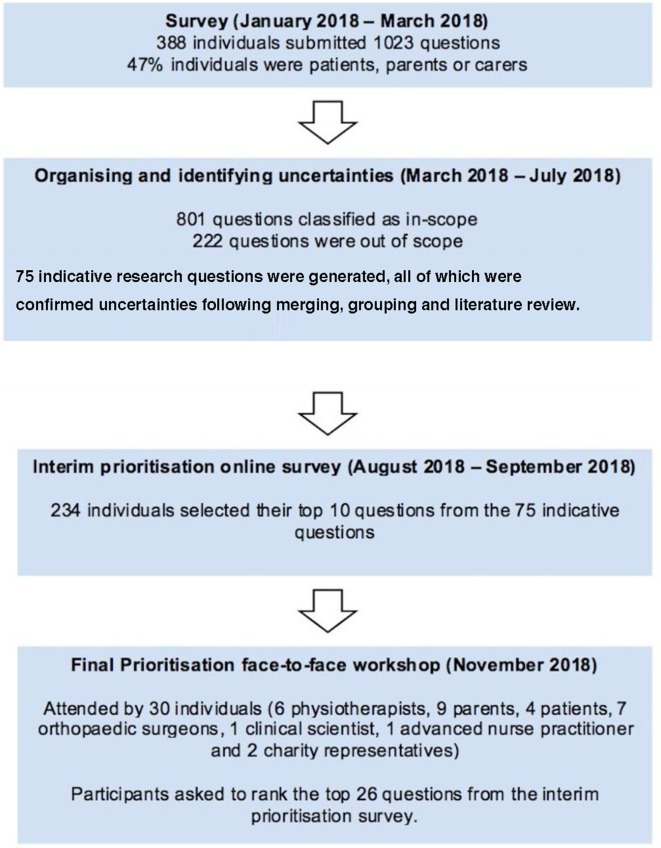
388 individuals (29 patients, 155 parents/carers, 204 healthcare professionals) were recruited through hospital clinics, patient charities and professional organisations and participated in the initial prioritisation survey; 234 individuals took part in the interim prioritisation survey. 33 individuals (3 patients, 9 parents/carers, 11 healthcare professionals, 7 individuals representing the project's steering group and 3 James Lind Alliance (JLA) facilitators) attended the final face-to-face workshop to rank the top 10 research priorities.
Surveys were distributed using various media resources such as newsletters, internet messaging boards and the 'Paediatric Lower Limb Surgery Priority Setting Partnership (PSP) website. Printed copies of the questionnaire were also made available to families in outpatient clinics.
Survey results, top 10 and top 26 priority rankings RESULTS: The process took 18 months to complete (July 2017-January 2019); 388 people generated 1023 questions; a total of 801 research questions were classified as true uncertainties. Following the JLA methodology, 75 uncertainties were developed from the initial 801 questions. Twenty six of those were selected through a second survey and were taken to the final face-to-face workshop where the top 10 research priorities were selected. The top10 priorities included questions on cerebral palsy, common hip conditions (ie, Perthes' disease and developmental dysplasia of the hip) as well as rehabilitation techniques and methods to improve shared decision-making between clinicians and patients/families.
This is the first JLA PSP in children's orthopaedic surgery, a particularly under-researched and underfunded area. We have identified important research topics which will guide researchers and funders and direct their efforts in future research.
通过让患者、照顾者和医疗保健专业人员参与,确定并优先考虑影响下肢的疾病的选择性手术管理的研究问题。
改良的名义小组技术。
英国。
通过医院诊所、患者慈善机构和专业组织招募了 388 名参与者(29 名患者,155 名父母/照顾者,204 名医疗保健专业人员),并参与了最初的优先排序调查;234 名参与者参加了中期优先排序调查。33 名参与者(3 名患者,9 名父母/照顾者,11 名医疗保健专业人员,7 名代表项目指导委员会和 3 名詹姆斯·林德联盟(JLA)促进者)参加了最终的面对面研讨会,对前 10 项研究重点进行了排名。
使用各种媒体资源(如通讯、互联网留言板和“儿科下肢手术优先设置伙伴关系(PSP)网站”)分发调查。还在门诊诊所为家庭提供了问卷的印刷副本。
调查结果,前 10 名和前 26 名优先事项排名。
该过程耗时 18 个月(2017 年 7 月至 2019 年 1 月);388 人提出了 1023 个问题;共有 801 个研究问题被归类为真正的不确定性。根据 JLA 方法,从最初的 801 个问题中开发了 75 个不确定性。其中 26 个通过第二次调查选出,并在最终的面对面研讨会上进行了选择,确定了前 10 项研究重点。前 10 项重点包括脑瘫、常见髋关节疾病(如 Perthes 病和发育性髋关节发育不良)以及康复技术和改善临床医生和患者/家庭之间共同决策的方法等问题。
这是儿童矫形外科领域的第一个 JLA PSP,这是一个特别研究不足和资金不足的领域。我们已经确定了重要的研究课题,这将指导研究人员和资助者,并指导他们在未来的研究中努力。