Lisova Ksenia, Chen Bao Ying, Wang Jia, Fong Kelly Mun-Ming, Clark Peter M, van Dam R Michael
Physics in Biology and Medicine Interdepartmental Graduate Program, University of California, Los Angeles, Los Angeles, CA, USA.
Crump Institute for Molecular Imaging, University of California, Los Angeles, Los Angeles, CA, USA.
EJNMMI Radiopharm Chem. 2019 Dec 31;5(1):1. doi: 10.1186/s41181-019-0082-3.
Conventional scale production of small batches of PET tracers (e.g. for preclinical imaging) is an inefficient use of resources. Using O-(2-[F]fluoroethyl)-L-tyrosine ([F]FET), we demonstrate that simple microvolume radiosynthesis techniques can improve the efficiency of production by consuming tiny amounts of precursor, and maintaining high molar activity of the tracers even with low starting activity.
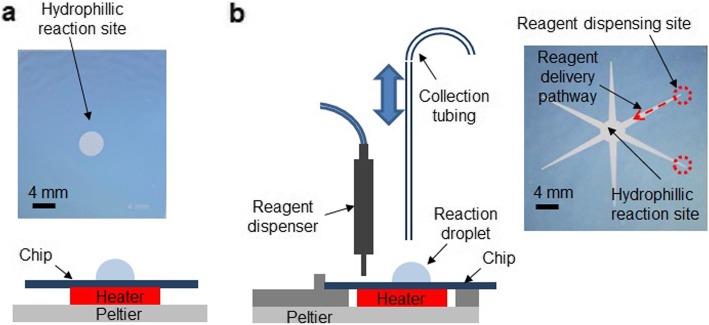
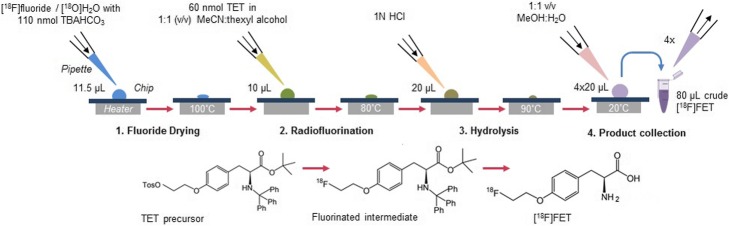
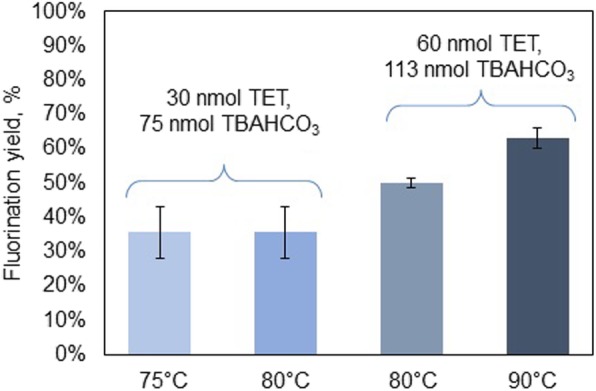
The synthesis was carried out in microvolume droplets manipulated on a disposable patterned silicon "chip" affixed to a heater. A droplet of [F]fluoride containing TBAHCO was first deposited onto a chip and dried at 100 °C. Subsequently, a droplet containing 60 nmol of precursor was added to the chip and the fluorination reaction was performed at 90 °C for 5 min. Removal of protecting groups was accomplished with a droplet of HCl heated at 90 °C for 3 min. Finally, the crude product was collected in a methanol-water mixture, purified via analytical-scale radio-HPLC and formulated in saline. As a demonstration, using [F]FET produced on the chip, we prepared aliquots with different molar activities to explore the impact on preclinical PET imaging of tumor-bearing mice.
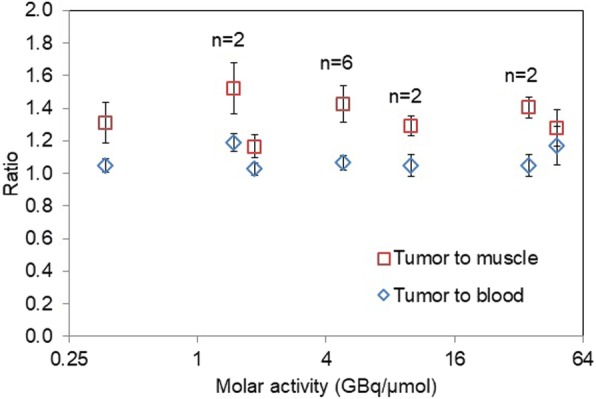
The microdroplet synthesis exhibited an overall decay-corrected radiochemical yield of 55 ± 7% (n = 4) after purification and formulation. When automated, the synthesis could be completed in 35 min. Starting with < 370 MBq of activity, ~ 150 MBq of [F]FET could be produced, sufficient for multiple in vivo experiments, with high molar activities (48-119 GBq/μmol). The demonstration imaging study revealed the uptake of [F]FET in subcutaneous tumors, but no significant differences in tumor uptake as a result of molar activity differences (ranging 0.37-48 GBq/μmol) were observed.
A microdroplet synthesis of [F]FET was developed demonstrating low reagent consumption, high yield, and high molar activity. The approach can be expanded to tracers other than [F]FET, and adapted to produce higher quantities of the tracer sufficient for clinical PET imaging.
传统的小批量生产PET示踪剂(如用于临床前成像)的规模化生产方式资源利用效率低下。使用O-(2-[F]氟乙基)-L-酪氨酸([F]FET),我们证明简单的微量体积放射合成技术可以通过消耗少量前体来提高生产效率,并且即使在起始活度较低的情况下也能保持示踪剂的高摩尔活度。
合成在固定于加热器上的一次性图案化硅“芯片”上操控的微量体积液滴中进行。首先将含有四丁基碳酸氢铵的[F]氟化物液滴沉积到芯片上,并在100°C下干燥。随后,将含有60 nmol前体的液滴添加到芯片上,并在90°C下进行氟化反应5分钟。用在90°C下加热3分钟的HCl液滴完成保护基团的去除。最后,将粗产物收集在甲醇-水混合物中,通过分析规模的放射性高效液相色谱法纯化并配制成生理盐水溶液。作为示例,使用在芯片上生产的[F]FET,我们制备了具有不同摩尔活度的等分试样,以探索其对荷瘤小鼠临床前PET成像的影响。
微量液滴合成在纯化和配制后显示出经衰变校正后的总体放射化学产率为55±7%(n = 4)。当实现自动化时,合成可在35分钟内完成。起始活度<370 MBq时,可生产约150 MBq的[F]FET,足以进行多次体内实验,且具有高摩尔活度(48 - 119 GBq/μmol)。示例成像研究显示[F]FET在皮下肿瘤中有摄取,但未观察到由于摩尔活度差异(范围为0.37 - 48 GBq/μmol)导致的肿瘤摄取有显著差异。
开发了一种[F]FET的微量液滴合成方法,该方法显示出低试剂消耗、高产率和高摩尔活度。该方法可扩展到除[F]FET之外的其他示踪剂,并适用于生产足以用于临床PET成像的更多数量的示踪剂。