Biosciences, Environment and Sustainability Institute, University of Exeter, Penryn, TR10 9FE, UK.
Institute of Integrative Biology, University of Liverpool, Liverpool, L69 7ZB, UK.
ISME J. 2020 Mar;14(3):828-836. doi: 10.1038/s41396-019-0577-7. Epub 2020 Jan 2.
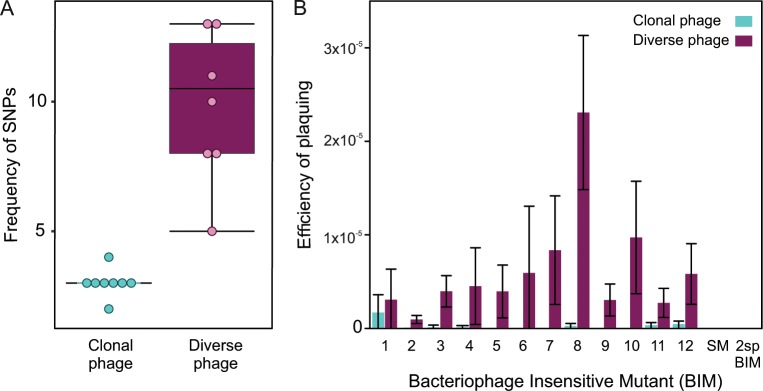
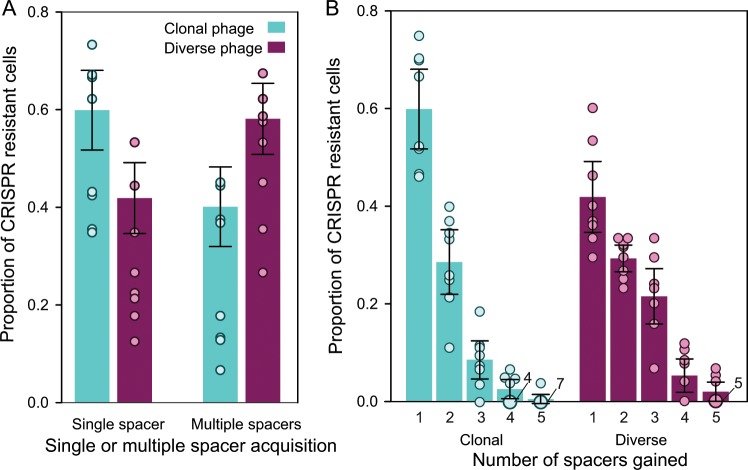
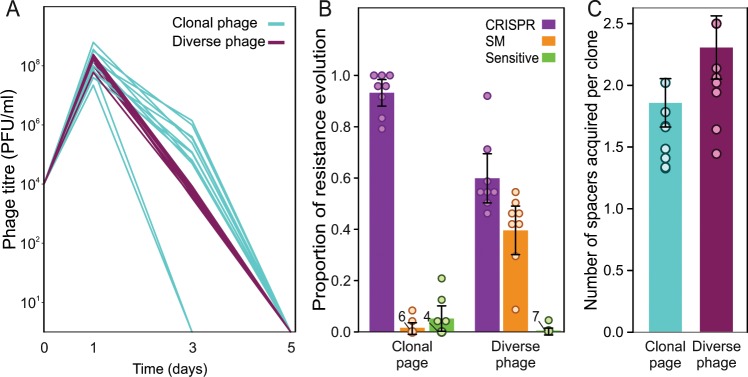
CRISPR-Cas adaptive immune systems are found in bacteria and archaea and provide defence against phage by inserting phage-derived sequences into CRISPR loci on the host genome to provide sequence specific immunological memory against re-infection. Under laboratory conditions the bacterium Pseudomonas aeruginosa readily evolves the high levels of CRISPR-based immunity against clonal populations of its phage DMS3vir, which in turn causes rapid extinction of the phage. However, in nature phage populations are likely to be more genetically diverse, which could theoretically impact the frequency at which CRISPR-based immunity evolves which in turn can alter phage persistence over time. Here we experimentally test these ideas and found that a smaller proportion of infected bacterial populations evolved CRISPR-based immunity against more genetically diverse phage populations, with the majority of the population evolving a sm preventing phage adsorption and providing generalised defence against a broader range of phage genotypes. However, those cells that do evolve CRISPR-based immunity in response to infection with more genetically diverse phage acquire greater numbers of CRISPR memory sequences in order to resist a wider range of phage genotypes. Despite differences in bacterial resistance evolution, the rates of phage extinction were similar in the context of clonal and diverse phage infections suggesting selection for CRISPR-based immunity or sm-based resistance plays a relatively minor role in the ecological dynamics in this study. Collectively, these data help to understand the drivers of CRISPR-based immunity and their consequences for bacteria-phage coexistence, and, more broadly, when generalised defences will be favoured over more specific defences.
CRISPR-Cas 适应性免疫系统存在于细菌和古菌中,通过将噬菌体衍生序列插入宿主基因组中的 CRISPR 基因座,为再次感染提供序列特异性免疫记忆,从而提供针对噬菌体的防御。在实验室条件下,铜绿假单胞菌很容易进化出高水平的基于 CRISPR 的免疫,以抵抗其噬菌体 DMS3vir 的克隆种群,而这反过来又导致噬菌体的快速灭绝。然而,在自然界中,噬菌体种群可能具有更高的遗传多样性,这从理论上可以影响基于 CRISPR 的免疫进化的频率,进而可以改变噬菌体随时间的持久性。在这里,我们通过实验测试了这些想法,发现感染的细菌种群中只有一小部分进化出针对遗传多样性更高的噬菌体种群的基于 CRISPR 的免疫,而大多数种群进化出一种 sm,以阻止噬菌体吸附并提供针对更广泛的噬菌体基因型的一般防御。然而,那些在感染遗传多样性更高的噬菌体时进化出基于 CRISPR 的免疫的细胞会获得更多数量的 CRISPR 记忆序列,以抵抗更广泛的噬菌体基因型。尽管细菌耐药性进化存在差异,但在克隆和多样化噬菌体感染的情况下,噬菌体灭绝的速度相似,这表明基于 CRISPR 的免疫或 sm 介导的耐药性的选择在本研究的生态动力学中相对较小。总的来说,这些数据有助于理解基于 CRISPR 的免疫的驱动因素及其对细菌-噬菌体共存的影响,更广泛地说,何时一般防御将优先于更具体的防御。