ESI, Biosciences, University of Exeter, Cornwall Campus, Penryn, United Kingdom.
Centre d'Ecologie Fonctionnelle et Evolutive (CEFE), UMR 5175, CNRS-Université de Montpellier-Université Paul-Valéry Montpellier-EPHE, Montpellier, France.
PLoS Biol. 2023 Sep 15;21(9):e3002122. doi: 10.1371/journal.pbio.3002122. eCollection 2023 Sep.
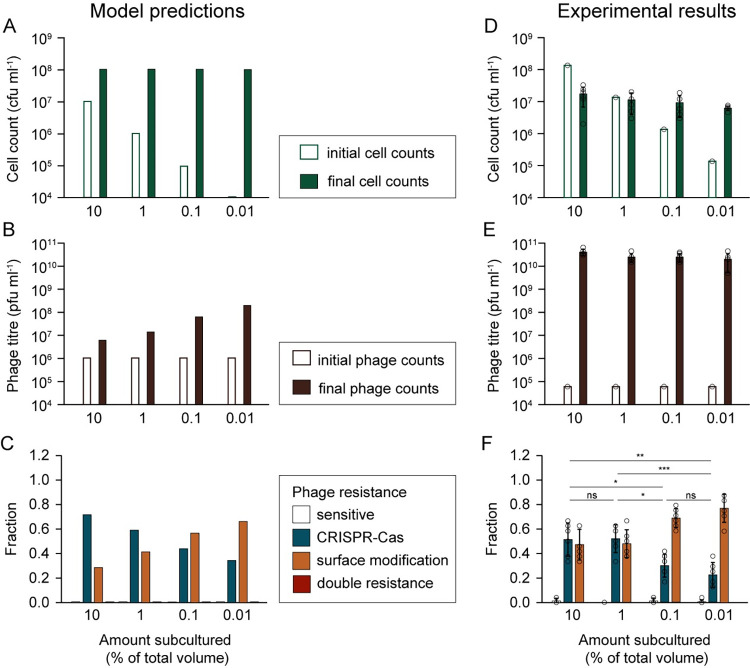
Organisms have evolved a range of constitutive (always active) and inducible (elicited by parasites) defence mechanisms, but we have limited understanding of what drives the evolution of these orthogonal defence strategies. Bacteria and their phages offer a tractable system to study this: Bacteria can acquire constitutive resistance by mutation of the phage receptor (surface mutation, sm) or induced resistance through their CRISPR-Cas adaptive immune system. Using a combination of theory and experiments, we demonstrate that the mechanism that establishes first has a strong advantage because it weakens selection for the alternative resistance mechanism. As a consequence, ecological factors that alter the relative frequencies at which the different resistances are acquired have a strong and lasting impact: High growth conditions promote the evolution of sm resistance by increasing the influx of receptor mutation events during the early stages of the epidemic, whereas a high infection risk during this stage of the epidemic promotes the evolution of CRISPR immunity, since it fuels the (infection-dependent) acquisition of CRISPR immunity. This work highlights the strong and lasting impact of the transient evolutionary dynamics during the early stages of an epidemic on the long-term evolution of constitutive and induced defences, which may be leveraged to manipulate phage resistance evolution in clinical and applied settings.
生物已经进化出了一系列组成型(始终活跃)和诱导型(由寄生虫引发)的防御机制,但我们对是什么驱动这些正交防御策略的进化知之甚少。细菌及其噬菌体为研究这一问题提供了一个可行的系统:细菌可以通过噬菌体受体的突变(表面突变,sm)获得组成型抗性,也可以通过其 CRISPR-Cas 适应性免疫系统获得诱导抗性。我们通过理论和实验相结合的方法证明,首先建立的机制具有很强的优势,因为它削弱了对替代抗性机制的选择。因此,改变不同抗性获得频率的生态因素具有强烈而持久的影响:高生长条件通过增加流行早期受体突变事件的流入,促进了 sm 抗性的进化,而在流行早期的高感染风险促进了 CRISPR 免疫的进化,因为它促进了(感染依赖)CRISPR 免疫的获得。这项工作强调了在流行病早期阶段的短暂进化动态对组成型和诱导型防御的长期进化的强烈而持久的影响,这可能被用来操纵临床和应用环境中的噬菌体抗性进化。