1 School of Biological Sciences, Georgia Institute of Technology , Atlanta, GA 30314 , USA.
2 The Rockefeller University , New York, NY 10065 , USA.
Philos Trans R Soc Lond B Biol Sci. 2019 May 13;374(1772):20180096. doi: 10.1098/rstb.2018.0096.
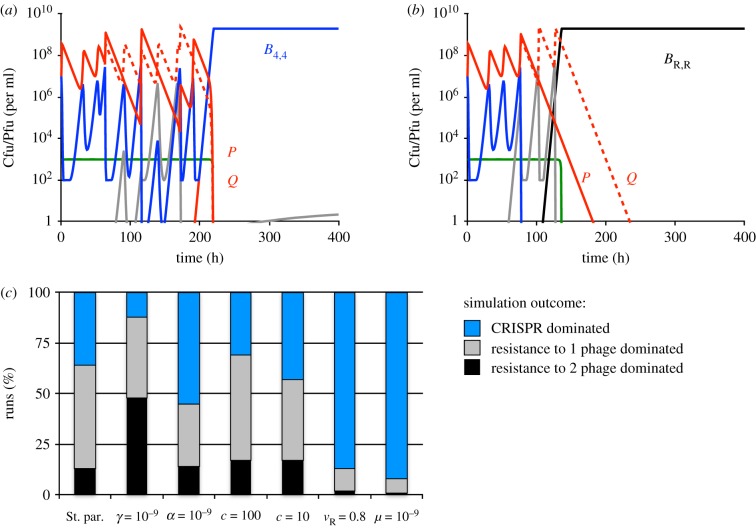
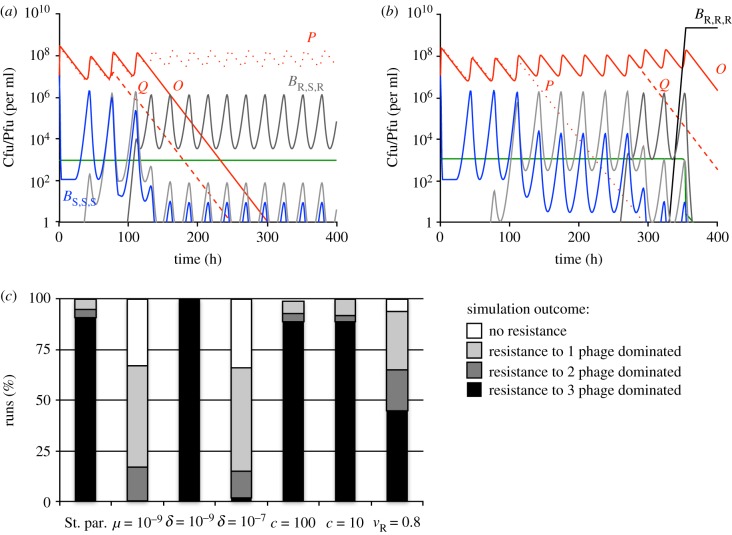
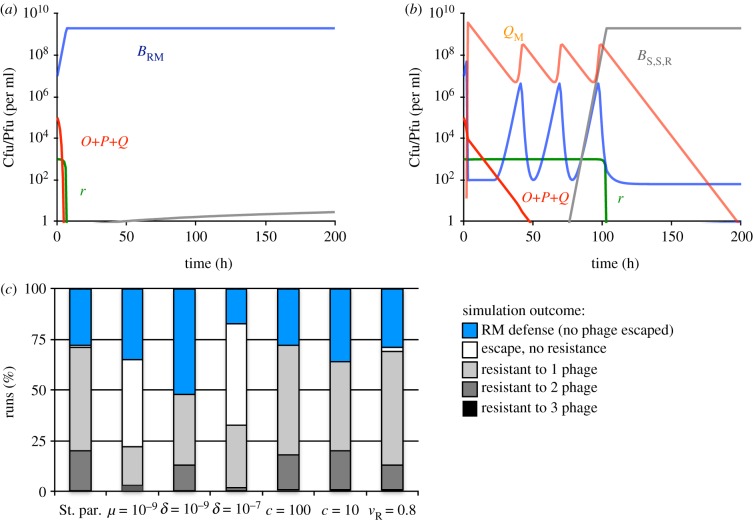
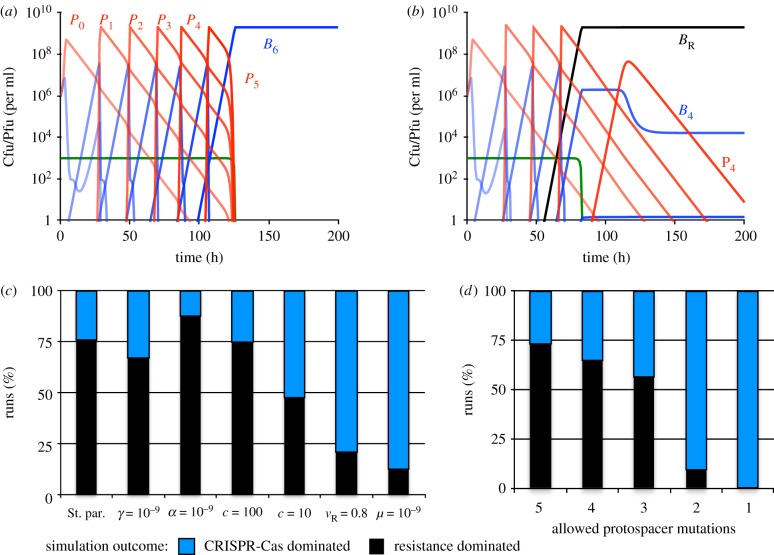
Bacteria can readily generate mutations that prevent bacteriophage (phage) adsorption and thus make bacteria resistant to infections with these viruses. Nevertheless, the majority of bacteria carry complex innate and/or adaptive immune systems: restriction-modification (RM) and CRISPR-Cas, respectively. Both RM and CRISPR-Cas are commonly assumed to have evolved and be maintained to protect bacteria from succumbing to infections with lytic phage. Using mathematical models and computer simulations, we explore the conditions under which selection mediated by lytic phage will favour such complex innate and adaptive immune systems, as opposed to simple envelope resistance. The results of our analysis suggest that when populations of bacteria are confronted with lytic phage: (i) In the absence of immunity, resistance to even multiple bacteriophage species with independent receptors can evolve readily. (ii) RM immunity can benefit bacteria by preventing phage from invading established bacterial populations and particularly so when there are multiple bacteriophage species adsorbing to different receptors. (iii) Whether CRISPR-Cas immunity will prevail over envelope resistance depends critically on the number of steps in the coevolutionary arms race between the bacteria-acquiring spacers and the phage-generating CRISPR-escape mutants. We discuss the implications of these results in the context of the evolution and maintenance of RM and CRISPR-Cas and highlight fundamental questions that remain unanswered. This article is part of a discussion meeting issue 'The ecology and evolution of prokaryotic CRISPR-Cas adaptive immune systems'.
细菌很容易产生突变,从而阻止噬菌体(噬菌体)吸附,使细菌对这些病毒的感染产生抗性。然而,大多数细菌都携带复杂的先天和/或适应性免疫系统:分别是限制修饰(RM)和 CRISPR-Cas。RM 和 CRISPR-Cas 通常被认为是为了保护细菌免受裂解噬菌体感染而进化和维持的。我们使用数学模型和计算机模拟来探索由裂解噬菌体介导的选择有利于这种复杂的先天和适应性免疫系统而不是简单的包膜抗性的条件。我们的分析结果表明,当细菌种群面临裂解噬菌体时:(i)在没有免疫力的情况下,即使对具有独立受体的多种噬菌体物种的抗性也很容易进化。(ii)RM 免疫可以通过防止噬菌体入侵已建立的细菌种群来使细菌受益,尤其是当有多种噬菌体物种吸附到不同的受体上时。(iii)CRISPR-Cas 免疫是否会战胜包膜抗性,关键取决于细菌获取间隔区和噬菌体产生的 CRISPR 逃逸突变体之间的协同进化军备竞赛中的步骤数。我们讨论了这些结果在 RM 和 CRISPR-Cas 的进化和维持方面的意义,并强调了仍然存在的基本问题。本文是“原核 CRISPR-Cas 适应性免疫系统的生态和进化”讨论会议议题的一部分。