Niu Shuyi, Sun Tie, Wang Mozhi, Yao Litong, He Tianyi, Wang Yusong, Zhang Hengjun, Li Xiang, Xu Yingying
Department of Breast Surgery, the First Hospital of China Medical University, Shenyang, Liaoning, 110001, China.
The Third Department of General Surgery, People's Hospital of China Medical University (Liaoning Provincial People's Hospital), Shenyang, Liaoning, 110001, China.
BMC Cancer. 2025 Jan 22;25(1):115. doi: 10.1186/s12885-025-13526-0.
Not all breast cancer (BC) patients can benefit from neoadjuvant therapy (NAT). A poor response may result in patients missing the best opportunity for treatment, ultimately leading to a poor prognosis. Thus, to identify an effective predictor that can assess and predict patient response at early time points, we focused on circulating tumor DNA (ctDNA), which is a vital noninvasive liquid biopsy biomarker. We performed a meta-analysis to explore the predictive value of response by monitoring ctDNA at four time points of NAT using pathologic complete response (pCR) and residual cancer burden (RCB).
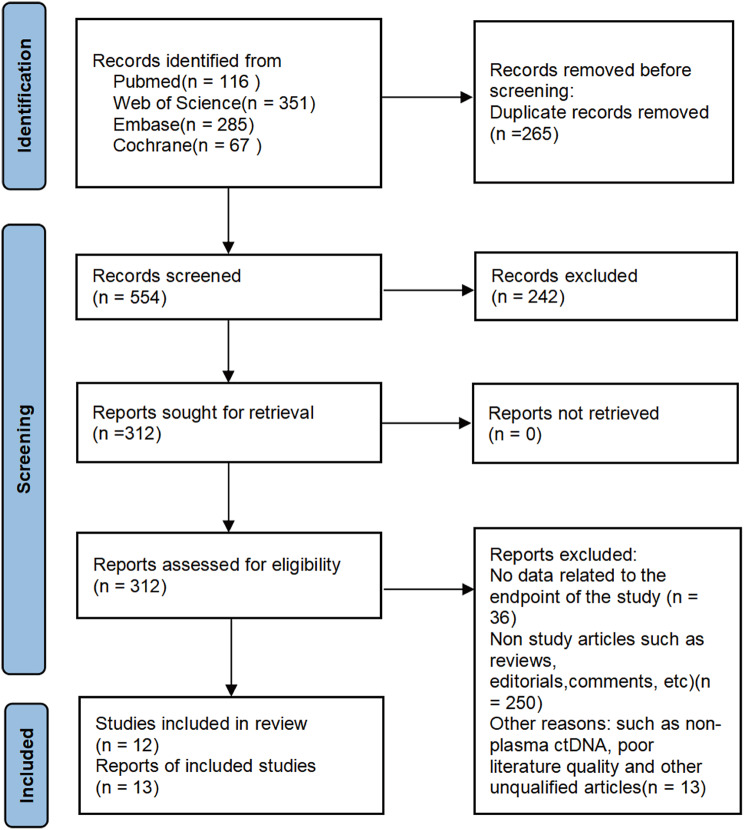
By searching Embase, PubMed, the Cochrane Library, and the Web of Science until December 24, 2023, we selected studies concerning the relationship between ctDNA and response or prognosis. We analysed the results at the following various time points: baseline (T0), first cycle of NAT (T1), mid-treatment (MT), and end of NAT (EOT). pCR and RCB were used to evaluate the response as the primary endpoint. The secondary endpoint was to investigate the relationship between ctDNA and prognosis. Odds ratios (ORs) and hazard ratios (HRs) were used as effect indicators.
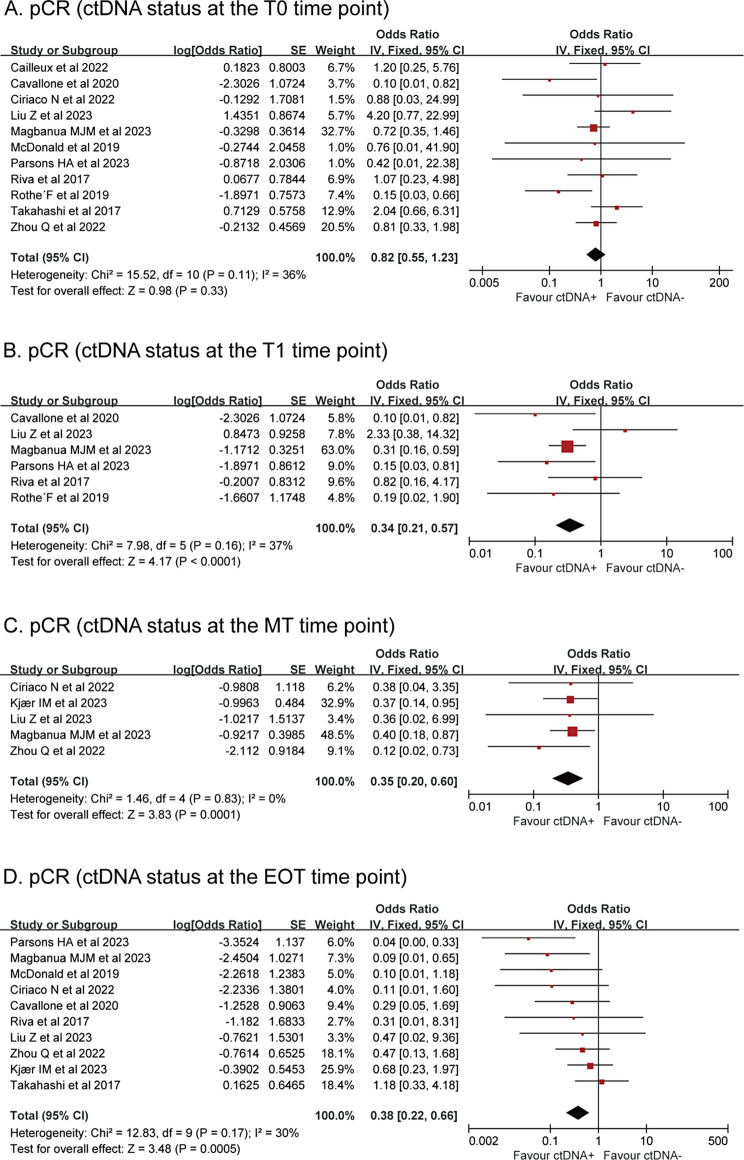
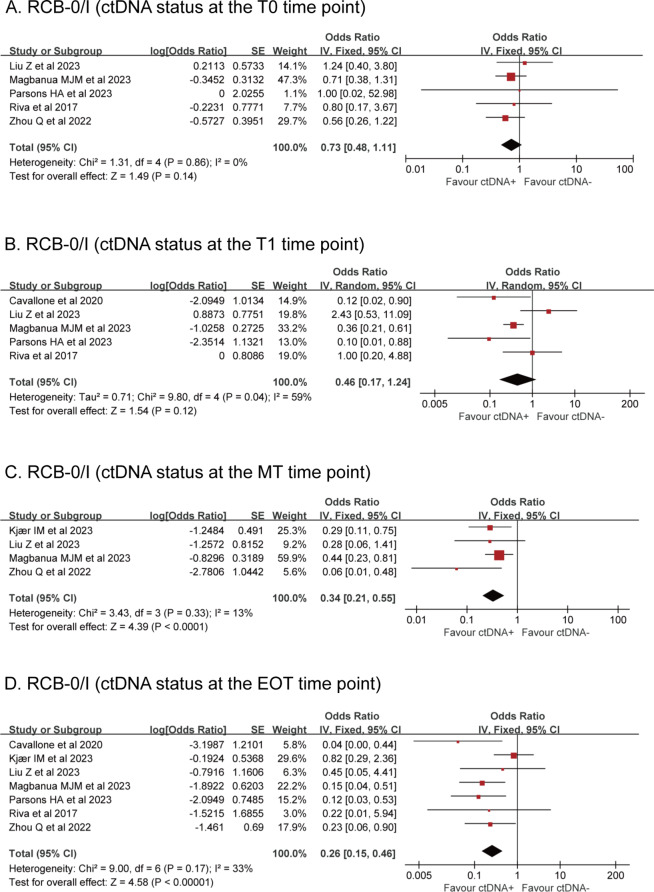
Thirteen reports from twelve studies were eligible for inclusion in this meta-analysis. The results demonstrated that ctDNA negativity was associated with pCR at T1 (OR = 0.34; 95% CI: 0.21-0.57), MT (OR = 0.35; 95% CI: 0.20-0.60), and EOT (OR = 0.38; 95% CI: 0.22-0.66). When RCB was used to evaluate responses, ctDNA negativity was associated with RCB-0/I at the MT (OR = 0.34; 95% CI: 0.21-0.55) and EOT (OR = 0.26; 95% CI: 0.15-0.46). Furthermore, ctDNA positivity at T1 predicted a worse prognosis for patients (HR = 2.73; 95% CI: 1.29-5.75). We also performed a subgroup analysis to more accurately assess the predictive value of ctDNA for triple-negative breast cancer.
Our meta-analysis suggested that the ctDNA status at the early stage of NAT can predict patient response, which provides evidence for adjusting personalized treatment strategies and improving patient survival.
CRD42024496465.
并非所有乳腺癌(BC)患者都能从新辅助治疗(NAT)中获益。反应不佳可能导致患者错过最佳治疗时机,最终导致预后不良。因此,为了确定一种能够在早期评估和预测患者反应的有效预测指标,我们将重点放在循环肿瘤DNA(ctDNA)上,它是一种重要的非侵入性液体活检生物标志物。我们进行了一项荟萃分析,以探讨在NAT的四个时间点监测ctDNA对反应的预测价值,采用病理完全缓解(pCR)和残余癌负担(RCB)进行评估。
通过检索Embase、PubMed、Cochrane图书馆和Web of Science直至2023年12月24日,我们选择了有关ctDNA与反应或预后关系的研究。我们在以下不同时间点分析结果:基线(T0)、NAT的第一个周期(T1)、治疗中期(MT)和NAT结束时(EOT)。采用pCR和RCB作为主要终点评估反应。次要终点是研究ctDNA与预后的关系。采用比值比(OR)和风险比(HR)作为效应指标。
来自12项研究的13份报告符合纳入本荟萃分析的条件。结果表明,ctDNA阴性与T1时的pCR相关(OR = 0.34;95%CI:0.21 - 0.57)、MT时的pCR相关(OR = 0.35;95%CI:0.20 - 0.60)以及EOT时的pCR相关(OR = 0.38;95%CI:0.22 - 0.66)。当用RCB评估反应时,ctDNA阴性与MT时的RCB-0/I相关(OR = 0.34;95%CI:0.21 - 0.55)以及EOT时的RCB-0/I相关(OR = 0.26;95%CI:0.15 - 0.46)。此外,T1时ctDNA阳性预测患者预后较差(HR = 2.73;95%CI:1.29 - 5.75)。我们还进行了亚组分析,以更准确地评估ctDNA对三阴性乳腺癌的预测价值。
我们的荟萃分析表明,NAT早期的ctDNA状态可预测患者反应,这为调整个性化治疗策略和提高患者生存率提供了证据。
PROSPERO注册号:CRD42024496465。