Department of Computer Science & IT, Neelum Campus, The University of Azad Jammu and Kashmir, Muzaffarabad, Azad Kashmir, Pakistan.
Department of Computer Science & IT, King Abdullah Campus, The University of Azad Jammu and Kashmir, Muzaffarabad, Azad Kashmir, Pakistan.
Biomed Eng Online. 2021 Jun 28;20(1):63. doi: 10.1186/s12938-021-00899-z.
This study used machine learning classification of texture features from MRI of breast tumor and peri-tumor at multiple treatment time points in conjunction with molecular subtypes to predict eventual pathological complete response (PCR) to neoadjuvant chemotherapy.
This study employed a subset of patients (N = 166) with PCR data from the I-SPY-1 TRIAL (2002-2006). This cohort consisted of patients with stage 2 or 3 breast cancer that underwent anthracycline-cyclophosphamide and taxane treatment. Magnetic resonance imaging (MRI) was acquired pre-neoadjuvant chemotherapy, early, and mid-treatment. Texture features were extracted from post-contrast-enhanced MRI, pre- and post-contrast subtraction images, and with morphological dilation to include peri-tumoral tissue. Molecular subtypes and Ki67 were also included in the prediction model. Performance of classification models used the receiver operating characteristics curve analysis including area under the curve (AUC). Statistical analysis was done using unpaired two-tailed t-tests.
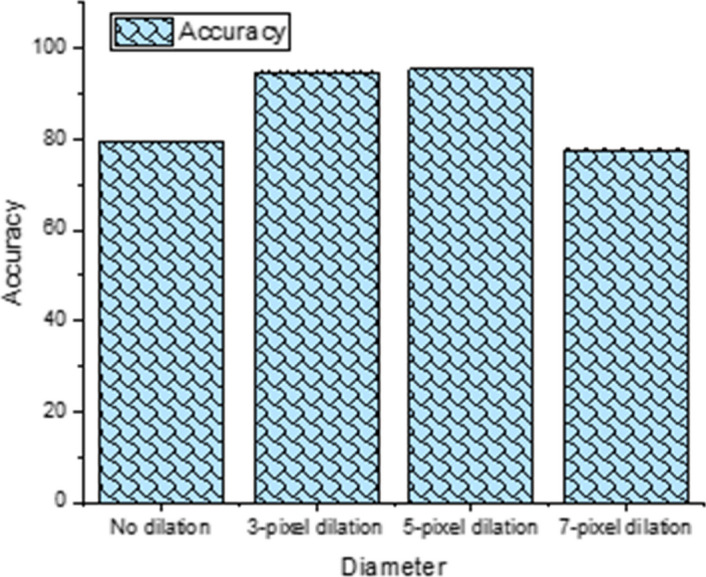
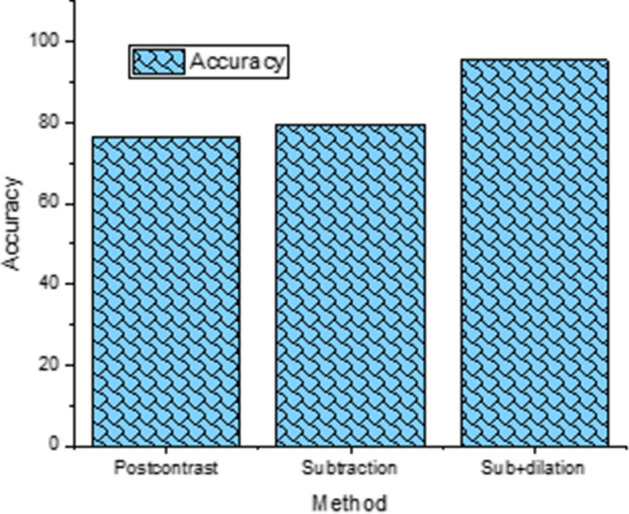
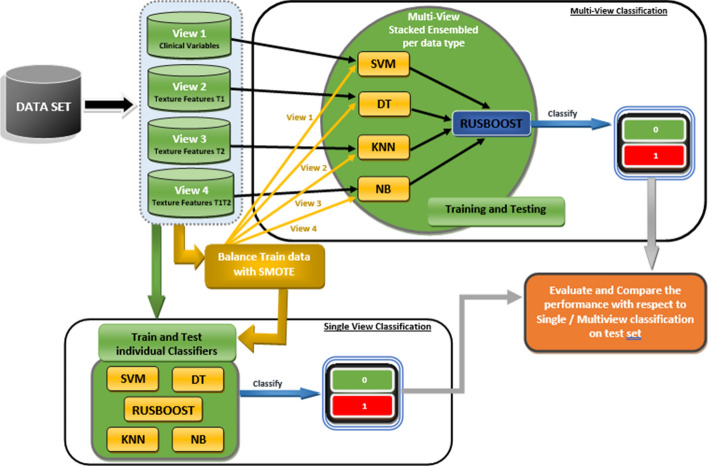
Molecular subtypes alone yielded moderate prediction performance of PCR (AUC = 0.82, p = 0.07). Pre-, early, and mid-treatment data alone yielded moderate performance (AUC = 0.88, 0.72, and 0.78, p = 0.03, 0.13, 0.44, respectively). The combined pre- and early treatment data markedly improved performance (AUC = 0.96, p = 0.0003). Addition of molecular subtypes improved performance slightly for individual time points but substantially for the combined pre- and early treatment (AUC = 0.98, p = 0.0003). The optimal morphological dilation was 3-5 pixels. Subtraction of post- and pre-contrast MRI further improved performance (AUC = 0.98, p = 0.00003). Finally, among the machine-learning algorithms evaluated, the RUSBoosted Tree machine-learning method yielded the highest performance.
AI-classification of texture features from MRI of breast tumor at multiple treatment time points accurately predicts eventual PCR. Longitudinal changes in texture features and peri-tumoral features further improve PCR prediction performance. Accurate assessment of treatment efficacy early on could minimize unnecessary toxic chemotherapy and enable mid-treatment modification for patients to achieve better clinical outcomes.
本研究采用机器学习对来自多个治疗时间点的乳腺肿瘤和肿瘤周围磁共振成像(MRI)的纹理特征进行分类,并结合分子亚型预测新辅助化疗后病理完全缓解(PCR)的最终结果。
本研究采用了 I-SPY-1 试验(2002-2006 年)中 PCR 数据的患者子集(N=166)。该队列包括接受蒽环类环磷酰胺和紫杉烷治疗的 II 期或 III 期乳腺癌患者。新辅助化疗前、早期和中期进行 MRI 检查。从增强后 MRI、增强前后减影图像以及形态学扩张中提取纹理特征,以包括肿瘤周围组织。预测模型还包括分子亚型和 Ki67。使用接收者操作特征曲线分析(包括曲线下面积(AUC))来评估分类模型的性能。使用未配对双侧 t 检验进行统计分析。
单独的分子亚型对 PCR 有中等预测性能(AUC=0.82,p=0.07)。单独的治疗前、早期和中期数据具有中等性能(AUC=0.88、0.72 和 0.78,p=0.03、0.13 和 0.44)。联合治疗前和早期数据显著提高了性能(AUC=0.96,p=0.0003)。在各个时间点,添加分子亚型略微提高了性能,但对联合治疗前和早期治疗的提高更为显著(AUC=0.98,p=0.0003)。最佳形态学扩张为 3-5 像素。减去增强前后的 MRI 进一步提高了性能(AUC=0.98,p=0.00003)。最后,在所评估的机器学习算法中,RUSBoosted Tree 机器学习方法的性能最高。
对来自多个治疗时间点的乳腺肿瘤 MRI 的纹理特征进行 AI 分类,可以准确预测最终的 PCR。纹理特征和肿瘤周围特征的纵向变化进一步提高了 PCR 预测性能。早期准确评估治疗效果,可以最大限度地减少不必要的毒性化疗,并使患者在中期进行治疗调整,以获得更好的临床结果。