Vilchez-Cavazos Félix, Millán-Alanís Juan Manuel, Blázquez-Saldaña Jaime, Álvarez-Villalobos Neri, Peña-Martínez Víctor Manuel, Acosta-Olivo Carlos Alberto, Simental-Mendía Mario
Universidad Autónoma de Nuevo León, Orthopedics and Traumatology Service, Facultad de Medicina y Hospital Universitario Dr José Eleuterio González, Monterrey, México.
Universidad Autónoma de Nuevo León, Plataforma Invest-KER Unit Mexico, Facultad de Medicina y Hospital Universitario Dr José Eleuterio González, Monterrey, México.
Orthop J Sports Med. 2019 Dec 16;7(12):2325967119887116. doi: 10.1177/2325967119887116. eCollection 2019 Dec.
Reports have concluded that platelet-rich plasma (PRP) is an effective and safe biological approach in the treatment of knee osteoarthritis (OA). However, no consensus has been established regarding the number of injections required to observe a therapeutic effect.
To compare the clinical effectiveness reported in randomized controlled trials (RCTs) of single versus multiple PRP injections in the treatment of knee OA.
Systematic review; Level of evidence, 1.
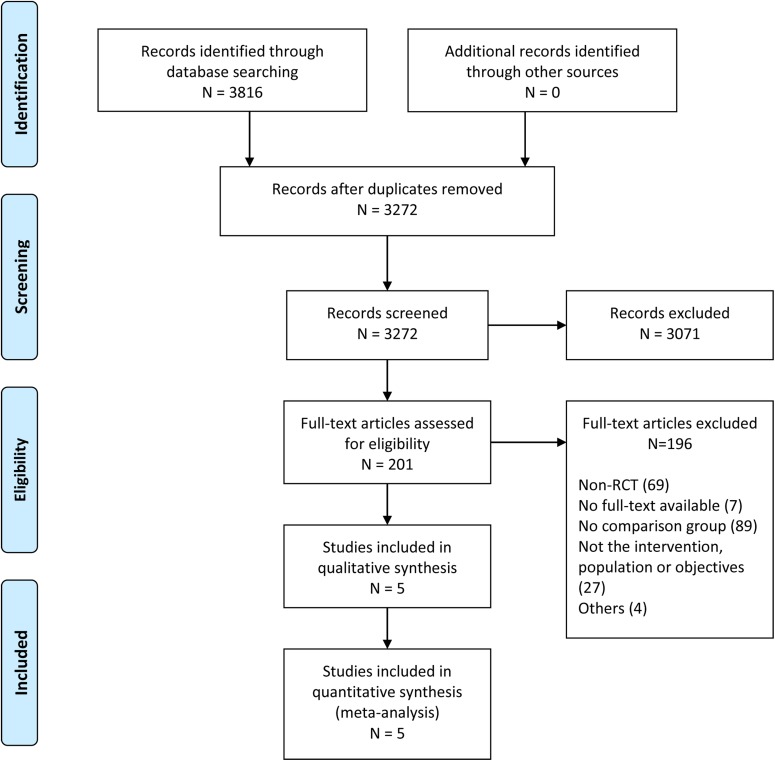
A comprehensive search was conducted for RCTs published between 1970 and 2019 that compared the effect of single versus multiple PRP injections on pain and functionality in patients with knee OA. Searched databases included MEDLINE, Scopus, Embase, Web of Science, and the Cochrane Central Register of Controlled Trials. A data extraction form was designed to obtain bibliographic information of the study as well as patient, intervention, comparison, and outcomes of interest data. A random-effects model was used to pool quantitative data from the primary outcomes.
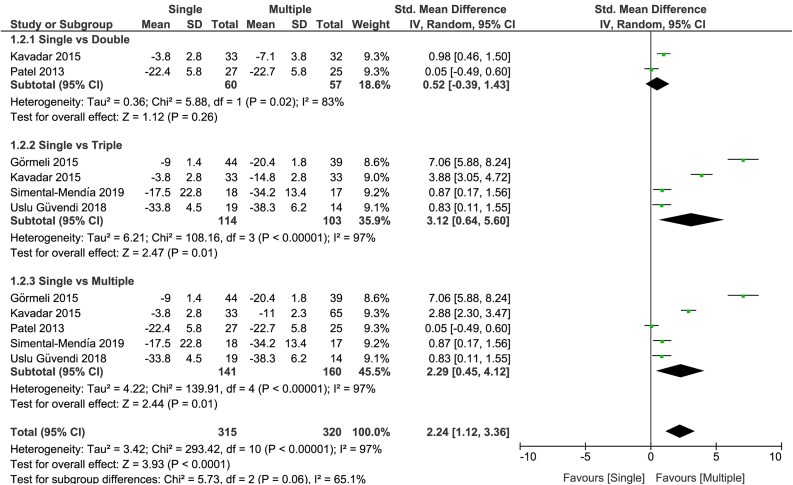
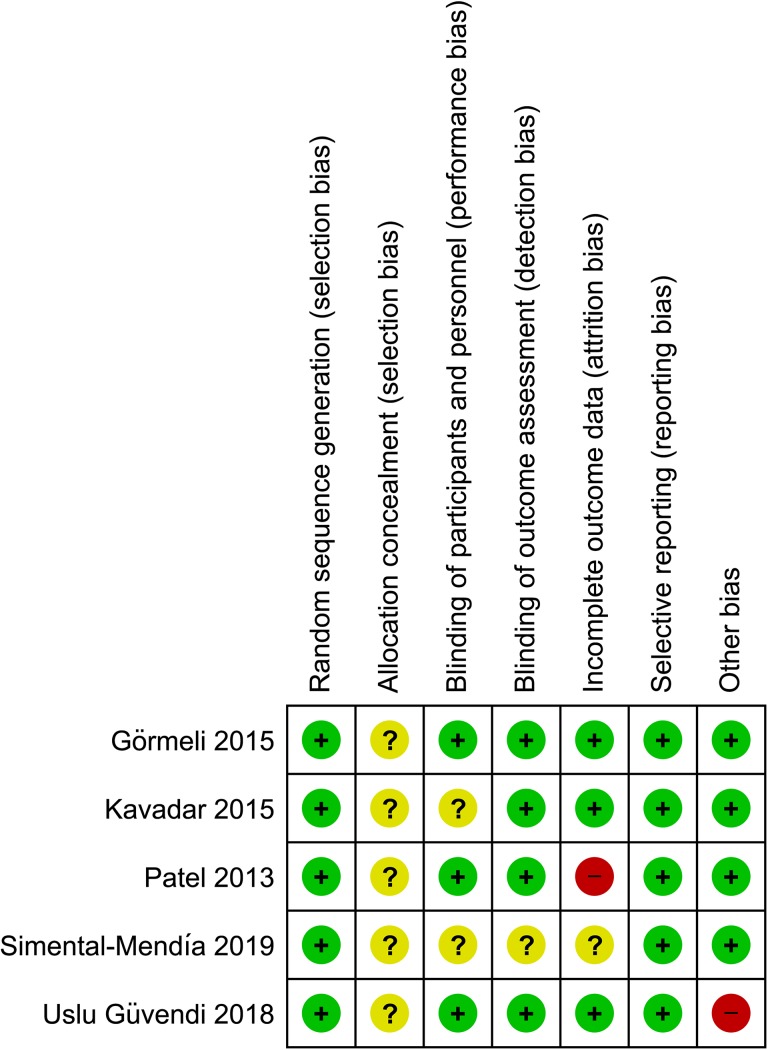
We included 5 clinical trials with a low-moderate risk of bias that reported data for 301 patients. Meta-analysis showed that, at 6 months after the intervention, single and multiple (double or triple) injections had similar pain improvement, with no significant differences (standardized mean difference [SMD], 0.61 [95% CI, -1.09 to 2.31]; = 97%; = .48). A significant improvement in knee functionality was observed in favor of multiple injections (SMD, 2.29 [95% CI, 0.45-4.12]; = 97%; = .01). Subanalysis showed that the significant improvement was only evident for the results of single versus triple injections (SMD, 3.12 [95% CI, 0.64-5.60]; = 97%; = .01).
According to our results, a single injection was as effective as multiple PRP injections in pain improvement; however, multiple injections seemed more effective in joint functionality than a single injection at 6 months. We consider that the available evidence is still insufficient, and future research on this specific topic is needed to confirm our results.
报告得出结论,富血小板血浆(PRP)是治疗膝关节骨关节炎(OA)的一种有效且安全的生物学方法。然而,关于观察到治疗效果所需的注射次数尚未达成共识。
比较单剂量与多剂量PRP注射治疗膝关节OA的随机对照试验(RCT)中报告的临床疗效。
系统评价;证据等级,1级。
对1970年至2019年间发表的RCT进行全面检索,比较单剂量与多剂量PRP注射对膝关节OA患者疼痛和功能的影响。检索的数据库包括MEDLINE、Scopus、Embase、科学引文索引和Cochrane对照试验中央注册库。设计了一份数据提取表,以获取研究的书目信息以及患者、干预措施、对照和感兴趣的结局数据。采用随机效应模型汇总主要结局的定量数据。
我们纳入了5项偏倚风险为低到中度的临床试验,报告了301例患者的数据。荟萃分析表明,在干预后6个月,单剂量和多剂量(双剂量或三剂量)注射在疼痛改善方面相似,无显著差异(标准化均值差[SMD],0.61[95%可信区间,-1.09至2.31];I² = 97%;P = 0.48)。观察到膝关节功能有显著改善,多剂量注射更具优势(SMD,2.29[95%可信区间,0.45 - 4.12];I² = 97%;P = 0.01)。亚组分析表明,显著改善仅在单剂量与三剂量注射的结果中明显(SMD,3.12[95%可信区间,0.64 - 5.60];I² = 97%;P = 0.01)。
根据我们的结果,单剂量注射在疼痛改善方面与多剂量PRP注射一样有效;然而,在6个月时,多剂量注射在关节功能方面似乎比单剂量注射更有效。我们认为现有证据仍然不足,需要对这一特定主题进行进一步研究以证实我们的结果。