State Key Laboratory of Natural and Biomimetic Drugs, School of Pharmaceutical Sciences, Peking University, Beijing 100191, China.
Proteomics Laboratory, Medical and Healthy Analytical Center, Peking University Health Science Center, Beijing 100191, China.
Theranostics. 2020 Jan 1;10(2):797-815. doi: 10.7150/thno.38483. eCollection 2020.
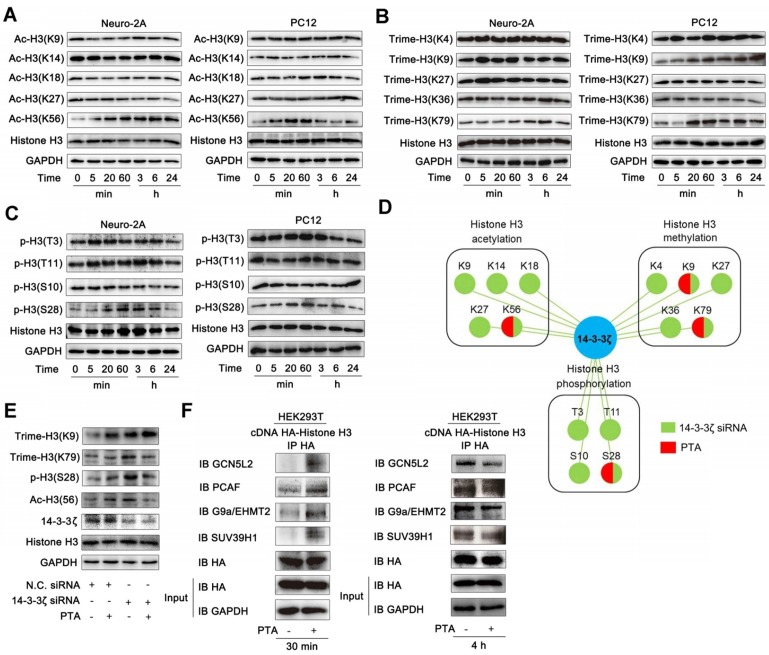
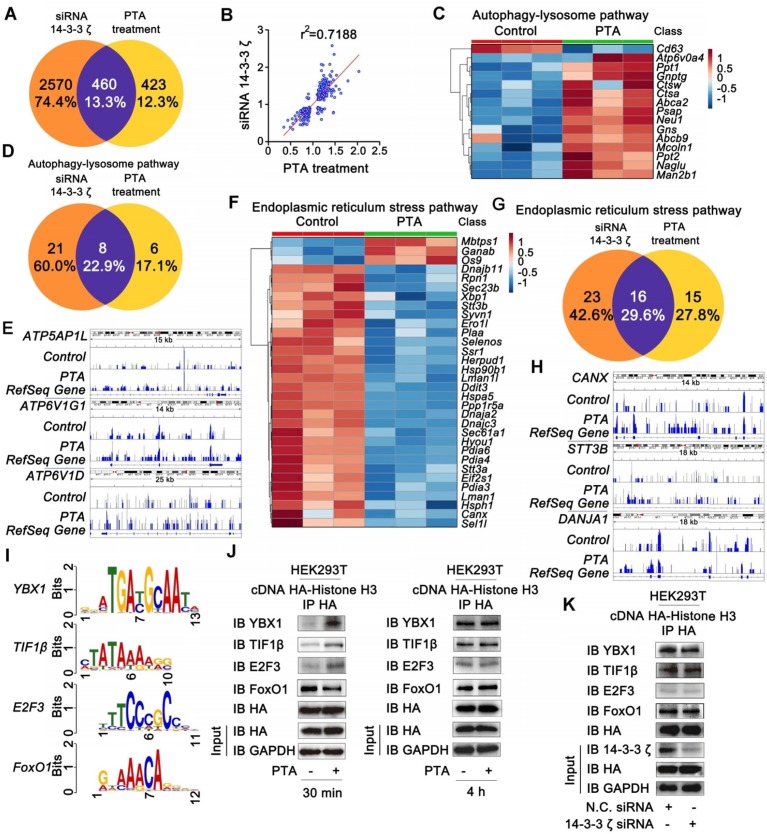
Histone post-translational modifications (PTMs) are involved in various biological processes such as transcriptional activation, chromosome packaging, and DNA repair. Previous studies mainly focused on PTMs by directly targeting histone-modifying enzymes such as HDACs and HATs. In this study, we discovered a previously unexplored regulation mechanism for histone PTMs by targeting transcription regulation factor 14-3-3ζ. Mechanistic studies revealed 14-3-3ζ dimerization as a key prerequisite, which could be dynamically induced via an allosteric effect. The selective inhibition of 14-3-3ζ dimer interaction with histone H3 modulated histone H3 PTMs by exposing specific modification sites including acetylation, trimethylation, and phosphorylation, and reprogrammed gene transcription profiles for autophagy-lysosome function and endoplasmic reticulum stress. Our findings demonstrate the feasibility of editing histone PTM patterns by targeting transcription regulation factor 14-3-3ζ, and provide a distinctive PTM editing strategy which differs from current histone modification approaches.
组蛋白翻译后修饰 (PTMs) 参与多种生物过程,如转录激活、染色体包装和 DNA 修复。先前的研究主要集中在通过直接靶向组蛋白修饰酶(如 HDAC 和 HAT)来研究 PTMs。在这项研究中,我们发现了一种以前未被探索的通过靶向转录调节因子 14-3-3ζ 来调节组蛋白 PTM 的调控机制。机制研究表明,14-3-3ζ 二聚化是一个关键的前提条件,它可以通过变构作用动态诱导。选择性抑制 14-3-3ζ 二聚体与组蛋白 H3 的相互作用,通过暴露特定的修饰位点,包括乙酰化、三甲基化和磷酸化,调节组蛋白 H3 的 PTM,并重新编程自噬-溶酶体功能和内质网应激的基因转录谱。我们的研究结果表明,通过靶向转录调节因子 14-3-3ζ 来编辑组蛋白 PTM 模式是可行的,并提供了一种独特的 PTM 编辑策略,与当前的组蛋白修饰方法不同。