Grupo Promoción y Prevención Farmacéutica, Facultad de Ciencias Farmacéuticas y Alimentarias, Universidad de Antioquia, Calle 70 No 52-21, Medellín, Colombia.
Grupo de investigación en Tecnología en Regencia de Farmacia, Universidad de Antioquia U de A, Calle 70 No 52-21, Medellín, Colombia.
Trials. 2020 Jan 6;21(1):26. doi: 10.1186/s13063-019-3945-8.
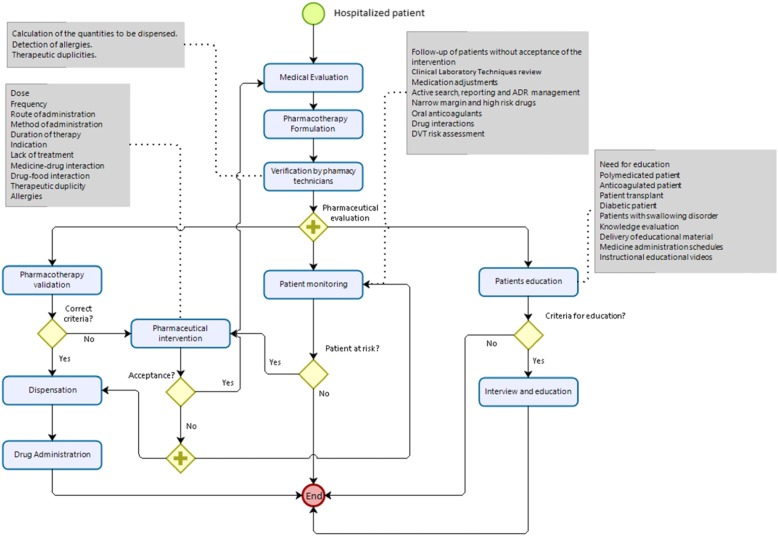
According to WHO, medication error (ME) is a subject that requires attention at all levels of care to reduce severe and preventable damage related to medication use. Clinical pharmacy practice standards have been proposed around the world so that the pharmacist, as part of a multidisciplinary health team, can help improve patient safety; however, further evidence derived from adequate studies is needed to demonstrate this. This study aims to assess the effect of a clinical pharmacy practice model (CPPM) in preventing MEs associated with the medication use process.
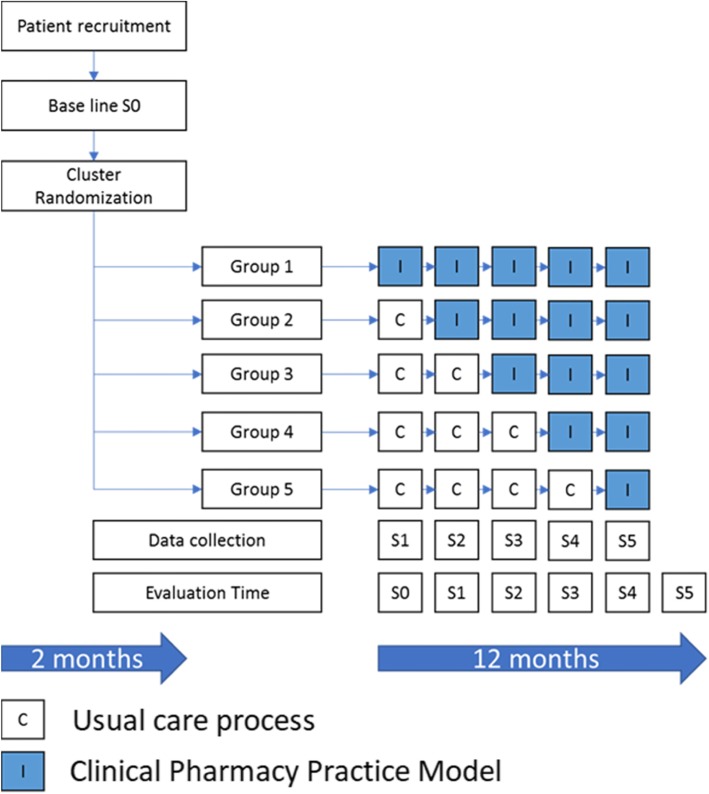
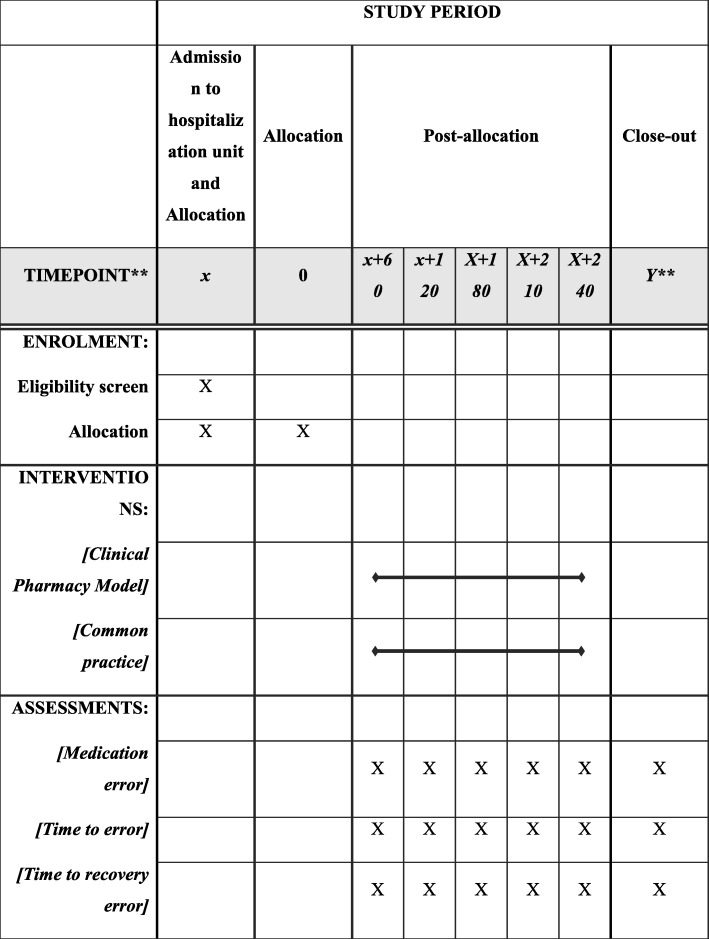
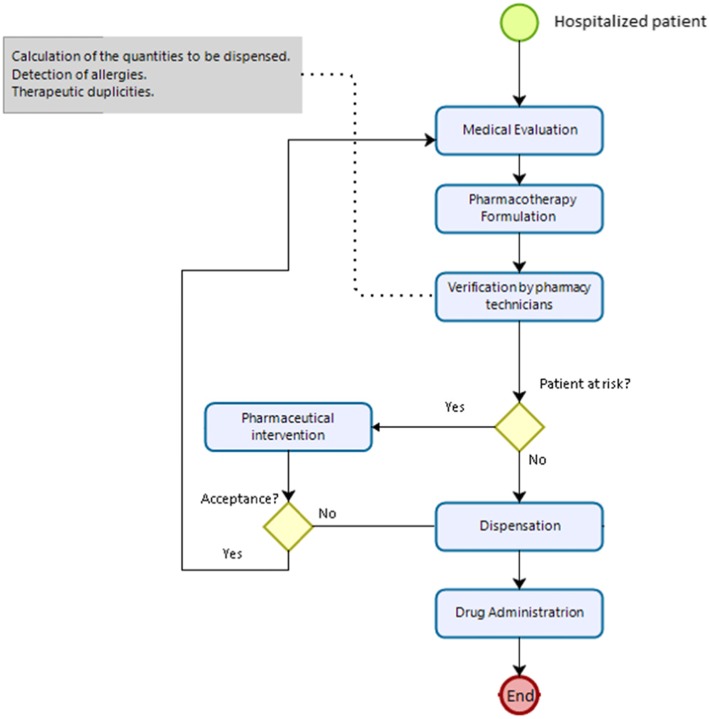
A prospective, stepped-wedge, cluster-randomized, controlled trial with a duration of 14 months will be performed to compare the effect of a CPPM along with the usual care process of patients in the Pablo Tobón Uribe Hospital (Medellin, Colombia). The study is designed as a cluster-randomized controlled trial, involving five hospital wards (clusters) and 720 patients. Medical wards are allocated to interventions using a stepped-wedge design. Clusters are initially assigned to the control group. After a 2-month observation period, hospital clusters were randomly allocated to the intervention group. Study outcomes will be assessed at baseline and at 2, 4, 6, 8, 10, and 12 months after randomization. The primary outcome will be to assess the effect of a CPPM on the incidence of medication errors associated with the medication use process. Drug-related problems and factors that contribute to the occurrence of MEs will be assessed as secondary outcomes. Statistical analyses will be performed using a mixed model, with the treatment group and time as fixed effects and the clustering structure as a random effect. Statistical analysis will be performed using Pearson chi-square tests and Student's t-tests, and a P value < 0.05 will be considered statistically significant.
As far as we know, this is the first stepped-wedge, cluster-randomized, controlled trial designed to assess the change of a CPPM on the incidence of medication errors in a hospital in Colombia, and it could generate valuable information about a standardized and patient-centered clinical pharmacy model to improve the safety of inpatient care.
ClinicalTrials.gov, NCT03338725. Registered on 9 November 2017. The first patient was randomized on 2 February 2018.
0010112018JG.
根据世界卫生组织(WHO)的说法,用药错误(ME)是一个需要在各个护理层面关注的问题,以减少与用药相关的严重和可预防的损害。全球范围内已经提出了临床药学实践标准,以便药剂师作为多学科卫生团队的一部分,能够帮助提高患者安全;然而,还需要进一步的充分研究证据来证明这一点。本研究旨在评估临床药学实践模式(CPPM)在预防与用药过程相关的用药错误方面的效果。
这是一项前瞻性、逐步楔形、集群随机、对照试验,持续时间为 14 个月,将比较 Pablo Tobón Uribe 医院(哥伦比亚麦德林)患者在 CPPM 与常规护理过程中的效果。该研究设计为集群随机对照试验,涉及 5 个医院病房(集群)和 720 名患者。采用逐步楔形设计对医疗病房进行干预分配。集群最初被分配到对照组。在为期 2 个月的观察期后,医院集群被随机分配到干预组。研究结果将在随机分组后 2、4、6、8、10 和 12 个月进行评估。主要结果是评估 CPPM 对与用药过程相关的用药错误发生率的影响。药物相关问题和导致用药错误发生的因素将作为次要结果进行评估。统计分析将使用混合模型进行,治疗组和时间作为固定效应,聚类结构作为随机效应。统计分析将使用 Pearson 卡方检验和学生 t 检验进行,P 值<0.05 将被认为具有统计学意义。
据我们所知,这是第一个在哥伦比亚医院设计的评估 CPPM 对药物错误发生率变化的逐步楔形、集群随机对照试验,它可以提供有关标准化和以患者为中心的临床药学模式的宝贵信息,以提高住院患者护理的安全性。
ClinicalTrials.gov,NCT03338725。于 2017 年 11 月 9 日注册。第一个患者于 2018 年 2 月 2 日随机分组。
0010112018JG。