Schmidt Anne Mette, Schiøttz-Christensen Berit, Foster Nadine E, Laurberg Trine Bay, Maribo Thomas
Department of Public Health, Centre for Rehabilitation Research, Aarhus University, Aarhus, Denmark.
Sano, Højbjerg, Denmark.
Clin Rehabil. 2020 Mar;34(3):382-393. doi: 10.1177/0269215519897968. Epub 2020 Jan 8.
To compare the effectiveness of an integrated rehabilitation programme with an existing rehabilitation programme in patients with chronic low back pain.
A single-centre, pragmatic, two-arm parallel, randomized controlled trial (1:1 ratio).
A rheumatology inpatient rehabilitation centre in Denmark.
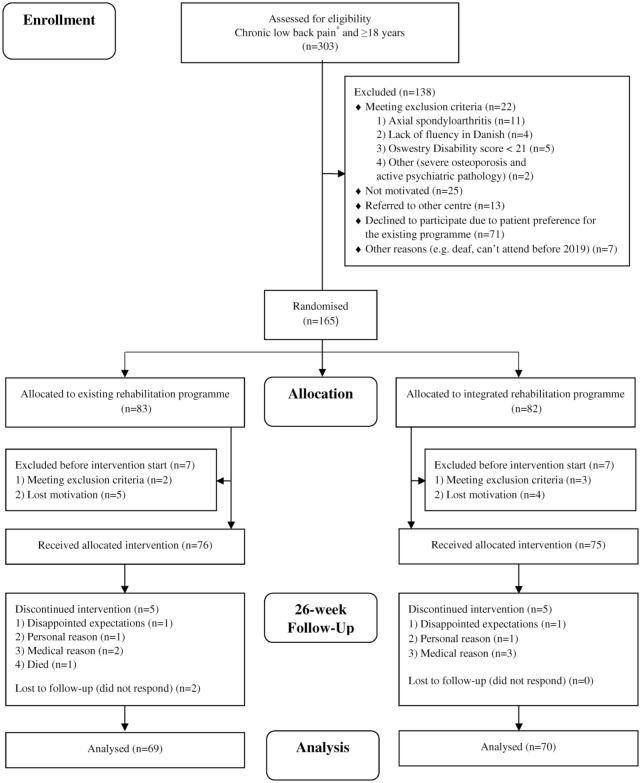
A total of 165 adults (aged ⩾ 18 years) with chronic low back pain.
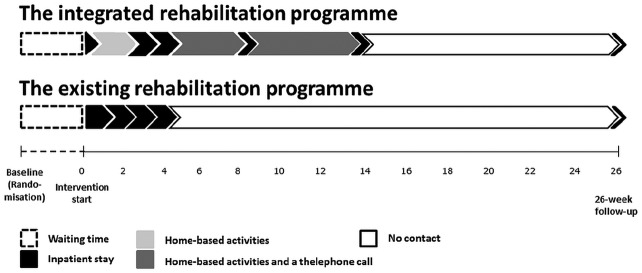
An integrated rehabilitation programme comprising an alternation of three weeks of inpatient stay and 12 weeks of home-based activities was compared with an existing rehabilitation programme of four weeks of inpatient stay.
Patient-reported outcomes were collected at baseline and at the 26-week follow-up. The primary outcome was back-specific disability (Oswestry Disability Index). Secondary outcomes included pain intensity (Numerical Rating Scale), pain self-efficacy (Pain Self-Efficacy Questionnaire), health-related quality of life (EuroQol-5 Domain 5-level (EQ-5D)), and depression (Major Depression Inventory). A complete case analysis was performed.
A total of 303 patients were assessed for eligibility of whom 165 (mean age: 50 years (SD 13) and mean Oswestry Disability Index score 42 (SD 11)) were randomized (83 to existing rehabilitation programme and 82 to integrated rehabilitation programme). Overall, 139 patients provided the 26-week follow-up data. Baseline demographic and clinical characteristics were comparable between programmes. The between-group difference in the Oswestry Disability Index score when adjusting for the corresponding baseline score was -0.28 (95% confidence interval (CI): -4.02, 3.45) which was neither statistically nor clinically significant. No significant differences were found in the secondary outcomes.
An integrated rehabilitation programme was no more effective than an existing rehabilitation programme at the 26-week follow-up.
比较综合康复计划与现有康复计划对慢性下腰痛患者的疗效。
单中心、实用、双臂平行随机对照试验(1:1比例)。
丹麦的一个风湿病住院康复中心。
总共165名患有慢性下腰痛的成年人(年龄⩾18岁)。
将包含三周住院治疗和12周居家活动交替进行的综合康复计划与四周住院治疗的现有康复计划进行比较。
在基线和26周随访时收集患者报告的结果。主要结局是背部特异性残疾(奥斯威斯残疾指数)。次要结局包括疼痛强度(数字评定量表)、疼痛自我效能感(疼痛自我效能量表)、健康相关生活质量(欧洲五维健康量表(EQ-5D))和抑郁(重度抑郁量表)。进行了完整病例分析。
共评估了303名患者的 eligibility,其中165名(平均年龄:50岁(标准差13),平均奥斯威斯残疾指数评分42(标准差11))被随机分组(83名接受现有康复计划,82名接受综合康复计划)。总体而言,139名患者提供了26周的随访数据。各计划之间的基线人口统计学和临床特征具有可比性。调整相应基线评分后,奥斯威斯残疾指数评分的组间差异为-0.28(95%置信区间(CI):-4.02,3.45),在统计学和临床上均无显著意义。次要结局未发现显著差异。
在26周随访时,综合康复计划并不比现有康复计划更有效。