Division of Gastroenterology, Hepatology and Nutrition, The Hospital for Sick Children, University of Toronto, Toronto, Ontario, Canada.
Transplant and Regenerative Medicine Centre, The Hospital for Sick Children, University of Toronto, Toronto, Ontario, Canada.
J Cachexia Sarcopenia Muscle. 2020 Apr;11(2):405-414. doi: 10.1002/jcsm.12514. Epub 2020 Jan 9.
Sarcopenia, the unintentional loss of skeletal muscle mass, is associated with poor outcomes in adult patient populations. In adults, sarcopenia is often ascertained by cross-sectional imaging of the psoas muscle area (PMA). Although children with chronic medical illnesses may be at increased risk for muscle loss because of nutritional deficiencies, physical deconditioning, endocrine anomalies, and systemic inflammation, consistent quantitative definitions for sarcopenia in children are lacking. We aimed to generate paediatric reference values for PMA at two intervertebral lumbar levels, L3-4 and L4-5.
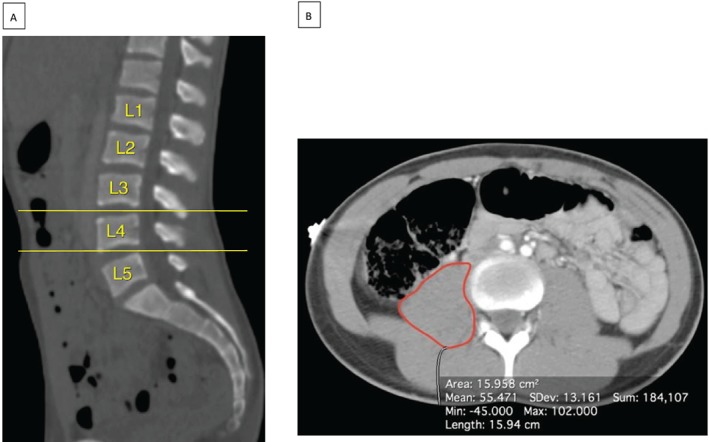
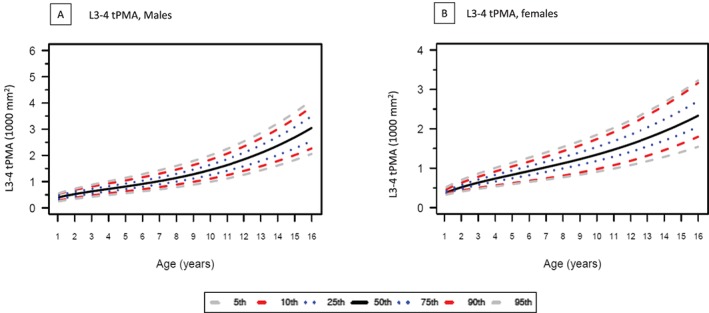
In this cross-sectional study, we analysed abdominal computed tomography scans of consecutive children presenting to the emergency department. Participants were children 1-16 years who required abdominal cross-sectional imaging after paediatric trauma between January 1, 2005 and December 31, 2015 in a large Canadian quaternary care centre. Children with a documented chronic medical illness or an acute spinal trauma at presentation were excluded. Total PMA (tPMA) at levels L3-4 and L4-5 were measured in square millimetres (mm ) as the sum of left and right PMA. Age-specific and sex-specific tPMA percentile curves were modelled using quantile regression.
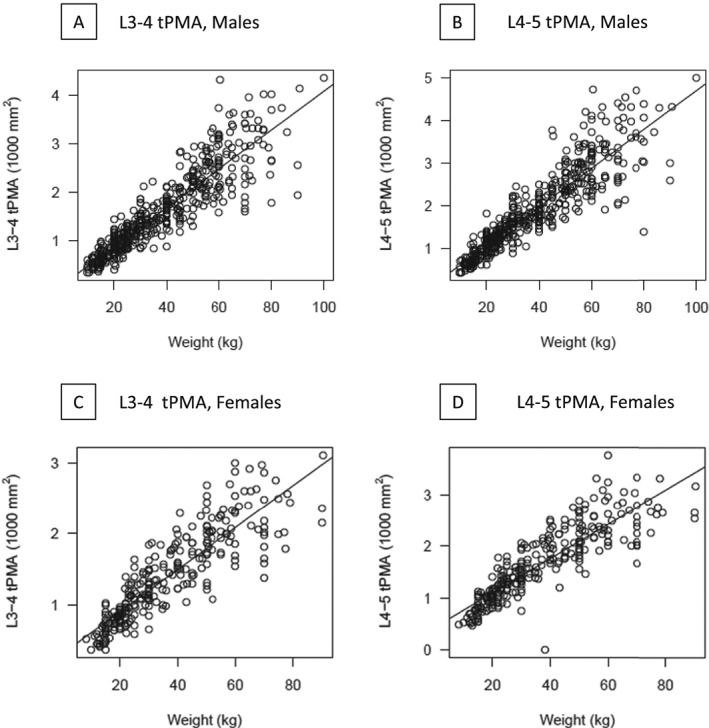
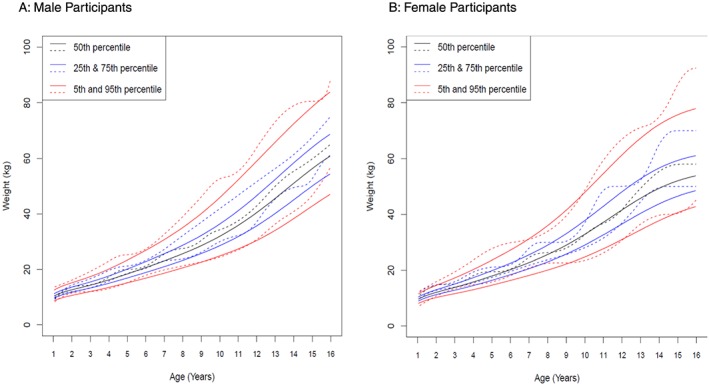
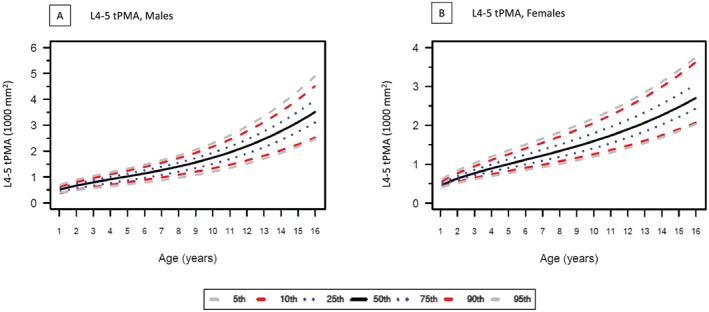
Computed tomography images from 779 children were included. Values of tPMA at L4-5 were significantly larger than at L3-4 at all ages, but their correlation was high for both girls (r = 0.95) and boys (r = 0.98). Amongst girls, tPMA 50th percentile values ranged from 365 to 2336 mm at L3-4 and from 447 to 2704 mm for L4-5. Amongst boys, 50th percentile values for tPMA ranged between 394 and 3050 mm at L3-4 and from 498 to 3513 mm at L4-5. Intraclass correlation coefficients were excellent at L3-4 (0.97, 95% CI 0.94 to 0.981) and L4-5 (0.99, 95% CI 0.986 to 0.995). Weight and tPMA were correlated, stratified by sex for boys (L3-4 r = 0.90; L4-5 r = 0.90) and for girls (L3-4 r = 0.87; L4-5 r = 0.87). An online application was subsequently developed to easily calculate age-specific and sex-specific z-scores and percentiles.
We provide novel paediatric age-specific and sex-specific growth curves for tPMA at intervertebral L3-4 and L4-5 levels for children between the ages of 1-16 years. Together with an online tool (https://ahrc-apps.shinyapps.io/sarcopenia/), these tPMA curves should serve as a reference enabling earlier identification and targeted intervention of sarcopenia in children with chronic medical conditions.
骨骼肌减少症是指骨骼肌的非有意丢失,与成年患者人群的不良结局有关。在成年人中,通常通过腰椎的横断面上的腰大肌面积(PMA)的影像学检查来确定骨骼肌减少症。尽管患有慢性疾病的儿童可能由于营养缺乏、身体适应不良、内分泌异常和全身炎症而增加肌肉丧失的风险,但儿童骨骼肌减少症的一致定量定义仍缺乏。我们旨在生成两个腰椎水平(L3-4 和 L4-5)的小儿 PMA 参考值。
在这项横断面研究中,我们分析了连续到急诊科就诊的儿童的腹部计算机断层扫描(CT)扫描。参与者为 1-16 岁的儿童,在加拿大四级医疗中心于 2005 年 1 月 1 日至 2015 年 12 月 31 日期间因儿科外伤需要进行腹部横断面成像。排除有记录的慢性疾病或就诊时发生急性脊柱外伤的儿童。L3-4 和 L4-5 处的总 PMA(tPMA)以平方毫米(mm )为单位,通过左右 PMA 的总和来测量。使用分位数回归对年龄特异性和性别特异性 tPMA 百分位曲线进行建模。
共纳入 779 名儿童的 CT 图像。在所有年龄段,L4-5 处的 tPMA 值均明显大于 L3-4 处,但两者之间的相关性很高,女孩为(r = 0.95),男孩为(r = 0.98)。在女孩中,tPMA 的第 50 百分位值在 L3-4 处为 365 至 2336 mm,在 L4-5 处为 447 至 2704 mm。在男孩中,tPMA 的第 50 百分位值在 L3-4 处为 394 至 3050 mm,在 L4-5 处为 498 至 3513 mm。L3-4(0.97,95%CI 0.94 至 0.981)和 L4-5(0.99,95%CI 0.986 至 0.995)的组内相关系数均很好。按性别分层,体重和 tPMA 之间存在相关性,男孩(L3-4 r = 0.90;L4-5 r = 0.90)和女孩(L3-4 r = 0.87;L4-5 r = 0.87)。随后开发了一个在线应用程序,用于轻松计算年龄特异性和性别特异性 z 分数和百分位数。
我们为 1-16 岁儿童提供了腰椎 L3-4 和 L4-5 水平的新的小儿年龄特异性和性别特异性 tPMA 生长曲线。结合在线工具(https://ahrc-apps.shinyapps.io/sarcopenia/),这些 tPMA 曲线应作为参考,以便更早地识别和针对患有慢性疾病的儿童的骨骼肌减少症进行靶向干预。