Department of Immunology, St. Jude Children's Research Hospital, Memphis, TN, United States.
Front Immunol. 2019 Dec 11;10:2716. doi: 10.3389/fimmu.2019.02716. eCollection 2019.
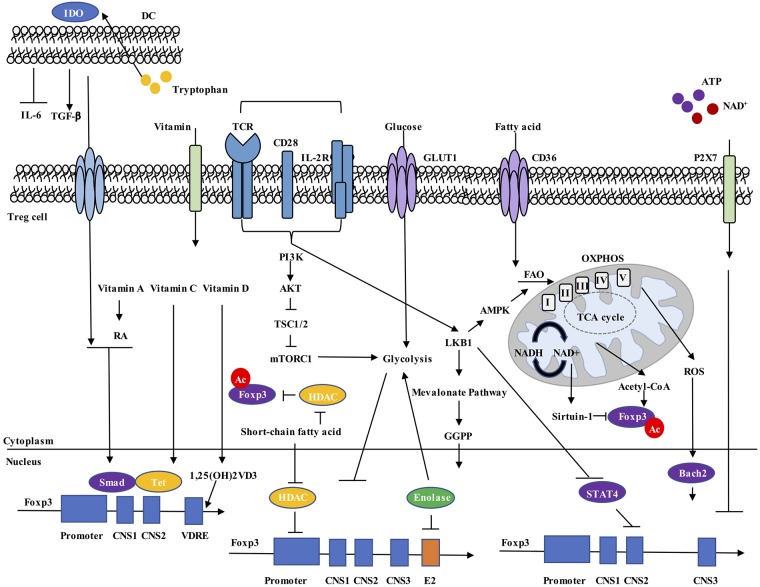
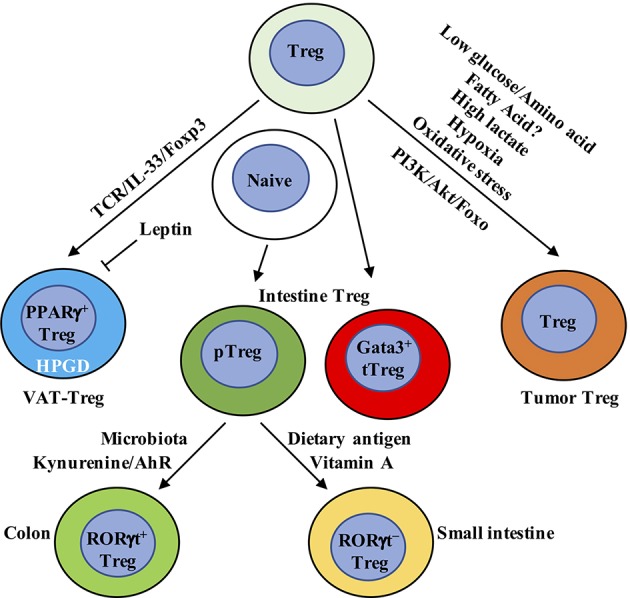
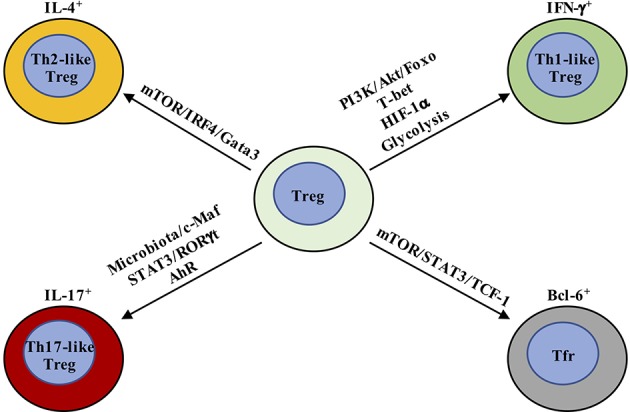
Regulatory T (Treg) cells are crucial for peripheral immune tolerance and prevention of autoimmunity and tissue damage. Treg cells are inherently defined by the expression of the transcription factor Foxp3, which enforces lineage development and immune suppressive function of these cells. Under various conditions as observed in autoimmunity, cancer and non-lymphoid tissues, a proportion of Treg cells respond to specific environmental signals and display altered stability, plasticity and tissue-specific heterogeneity, which further shape their context-dependent suppressive functions. Recent studies have revealed that metabolic programs play pivotal roles in controlling these processes in Treg cells, thereby considerably expanding our understanding of Treg cell biology. Here we summarize these recent advances that highlight how cell-extrinsic factors, such as nutrients, vitamins and metabolites, and cell-intrinsic metabolic programs, orchestrate Treg cell stability, plasticity, and tissue-specific heterogeneity. Understanding metabolic regulation of Treg cells should provide new insight into immune homeostasis and disease, with important therapeutic implications for autoimmunity, cancer, and other immune-mediated disorders.
调节性 T(Treg)细胞对于外周免疫耐受和预防自身免疫及组织损伤至关重要。Treg 细胞通过转录因子 Foxp3 的表达来固有地定义,Foxp3 强制这些细胞的谱系发育和免疫抑制功能。在自身免疫、癌症和非淋巴组织中观察到的各种情况下,一部分 Treg 细胞对特定的环境信号作出反应,并表现出改变的稳定性、可塑性和组织特异性异质性,从而进一步塑造它们依赖于环境的抑制功能。最近的研究表明,代谢程序在控制 Treg 细胞中的这些过程中起着关键作用,从而大大扩展了我们对 Treg 细胞生物学的理解。在这里,我们总结了这些最新进展,强调了细胞外因素(如营养物质、维生素和代谢物)和细胞内代谢程序如何协调 Treg 细胞的稳定性、可塑性和组织特异性异质性。对 Treg 细胞代谢调控的理解应该为免疫稳态和疾病提供新的见解,并为自身免疫、癌症和其他免疫介导的疾病提供重要的治疗意义。