Bertelsen A S, Storm A, Minet L, Ryg J
1Department of Geriatric Medicine, Odense University Hospital, J. B. Winsløwsvej 4, 5000 Odense, Denmark.
2Department of Rehabilitation, Odense University Hospital, Odense, Denmark.
Pilot Feasibility Stud. 2020 Jan 6;6:1. doi: 10.1186/s40814-019-0545-z. eCollection 2020.
Along with an aging population, the field of robot technology in rehabilitation is expanding. As new technologies develop, it is important to test these clinically before implementation. To assess the possibilities of undertaking a future randomized controlled trial (RCT), the aim of this study was to pilot test and investigate the feasibility of a newly developed passive mobilization robot device in geriatric medicine patients.
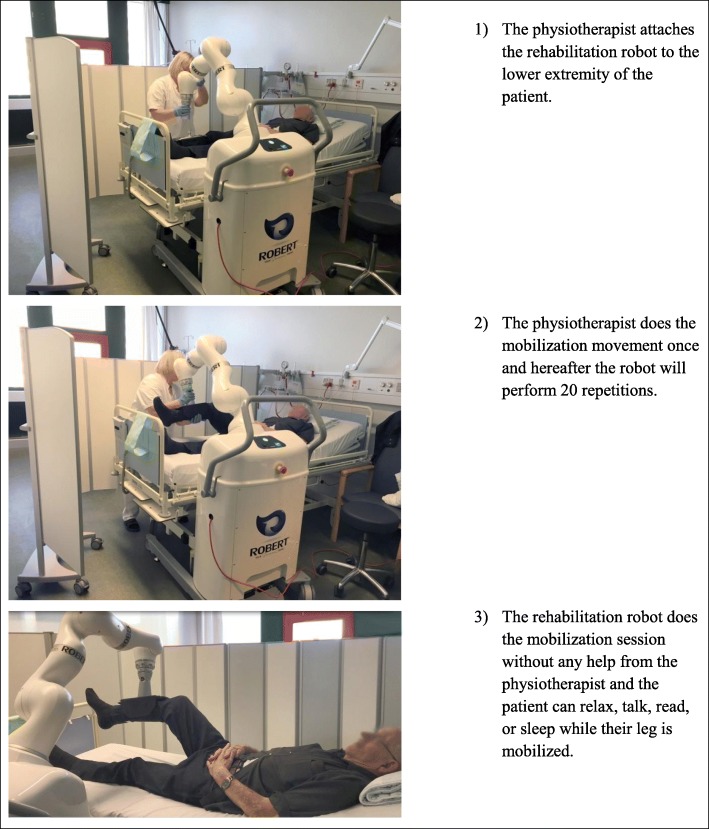
We used a robot to perform passive mobilization for all recruited patients while they were lying in bed. Inclusion criteria include the following: ≥ 65 years of age, able to walk before hospitalization, and not capable of walking > 2 m at the first day of hospitalization. Exclusion criteria include the following: known moderate/severe dementia, unstable fractures (back, pelvis, or legs), high intracranial pressure, pressure ulcers/risk of developing pressure ulcers due to fragile skin, positive Confusion and Assessment Method (CAM) score, not able to understand Danish, and medical instability. A mixed-methods approach, including structured interviews for patients and relatives, questionnaires and semi-structured interviews for the staff, and observations in the clinic were used as data collection methods. A 6-week pilot test preceded the feasibility study to test study design, safety, interview guide, and setting, and to become familiar with the robot.
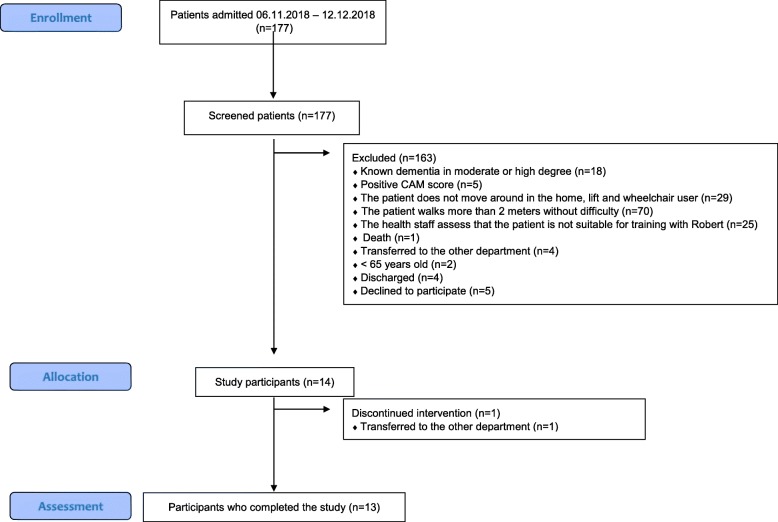
The pilot test included 13 patients, made the staff confident in the use of the robot, and led to the correction of the interview guide. In the feasibility study, 177 patients were screened, 14 patients (four men, nine women) included, and 13 completed the intervention (median [IQR] age 86 [82-92] years). Overall, the robot was easy to use during passive mobilization and fully accepted by patients and relatives. Staff, however, found the robot difficult to maneuver. No adverse events were reported.
Use of robot technology in passive mobilization of older patients was feasible and well accepted by patients, relatives, and staff. Technical and workflow-related issues, as well as the robot not performing active mobilization, affects the launch of a RCT and thereby its implementation in geriatric medicine patients.
随着人口老龄化,康复机器人技术领域正在不断拓展。随着新技术的发展,在临床应用前对其进行测试非常重要。为评估未来进行随机对照试验(RCT)的可能性,本研究旨在对一种新开发的被动活动机器人设备在老年医学患者中进行预试验并调查其可行性。
我们使用机器人为所有招募的患者在床上进行被动活动。纳入标准如下:年龄≥65岁,住院前能够行走,且住院第一天不能行走超过2米。排除标准如下:已知中度/重度痴呆、不稳定骨折(背部、骨盆或腿部)、高颅内压、因皮肤脆弱导致的压疮/发生压疮的风险、混乱评估方法(CAM)评分呈阳性、不懂丹麦语以及病情不稳定。采用混合方法,包括对患者及其亲属进行结构化访谈、对工作人员进行问卷调查和半结构化访谈以及在诊所进行观察作为数据收集方法。在可行性研究之前进行了为期6周的预试验,以测试研究设计、安全性、访谈指南和环境,并熟悉机器人。
预试验纳入了13名患者,使工作人员对机器人的使用充满信心,并导致对访谈指南进行了修正。在可行性研究中,筛查了177名患者,纳入14名患者(4名男性,9名女性),13名完成了干预(年龄中位数[四分位间距]为86[82 - 92]岁)。总体而言,机器人在被动活动期间易于使用,患者及其亲属完全接受。然而,工作人员发现机器人操作困难。未报告不良事件。
在老年患者的被动活动中使用机器人技术是可行的,并且患者、亲属和工作人员都能很好地接受。技术和工作流程相关问题以及机器人不能进行主动活动,影响了随机对照试验的开展及其在老年医学患者中的实施。