Kobayashi Hiromitsu, Song Chorong, Ikei Harumi, Park Bum-Jin, Kagawa Takahide, Miyazaki Yoshifumi
Department of Nursing, Ishikawa Prefectural Nursing University, Kahoku, Japan.
Center for Environment, Health and Field Sciences, Chiba University, Chiba, Japan.
Front Public Health. 2019 Dec 12;7:376. doi: 10.3389/fpubh.2019.00376. eCollection 2019.
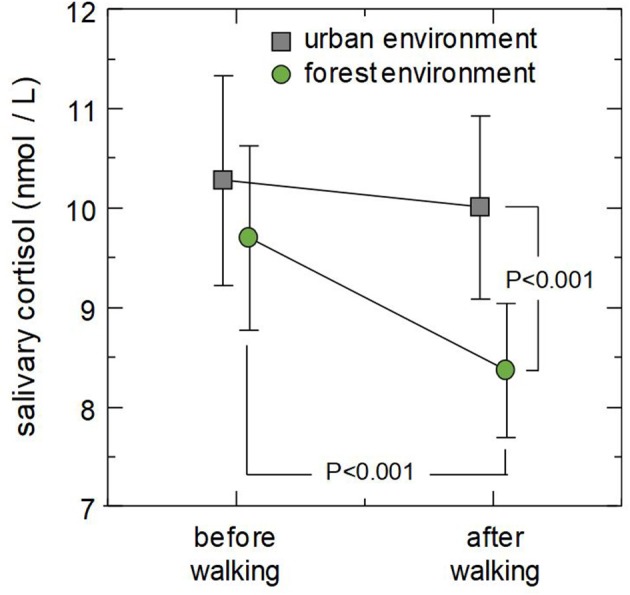
We investigated the effects of walking in a forest environment on salivary cortisol concentrations. Seventy-four young male participants walked for 15 min in forested and urban environments, and saliva was collected before and after walking. Our previous study reported salivary cortisol concentrations after walking only. This study was aimed at clarifying the combined effects of walking and environment by comparing post-walking data with pre-walking data. Walking in a forest environment decreased mean cortisol concentration from 9.70 to 8.37 nmol/L, whereas walking in an urban environment barely changed mean cortisol concentration, from 10.28 to 10.01 nmol/L. Two-way repeated analysis of variance revealed a significant interaction effect between the environment and walking ( < 0.001) in addition to the main effects of each ( < 0.001 and = 0.001, for walking and environment, respectively). For further analysis, the proportion of participants who exhibited decreased cortisol after forest-walking was compared with the previously reported proportion of participants who exhibited decreased cortisol after viewing forest landscapes. Although the proportion of positive responders was slightly higher after walking (69%) than it was after viewing (60%), this difference was not statistically significant ( = 0.093). The present study revealed a significant combined effect of walking and the environment on cortisol concentrations.
我们研究了在森林环境中行走对唾液皮质醇浓度的影响。74名年轻男性参与者在森林和城市环境中各行走15分钟,并在行走前后收集唾液。我们之前的研究仅报告了行走后的唾液皮质醇浓度。本研究旨在通过比较行走后与行走前的数据来阐明行走和环境的综合影响。在森林环境中行走使平均皮质醇浓度从9.70纳摩尔/升降至8.37纳摩尔/升,而在城市环境中行走,平均皮质醇浓度几乎没有变化,从10.28纳摩尔/升降至10.01纳摩尔/升。双向重复方差分析显示,除了各自的主效应(行走的主效应P<0.001,环境的主效应P = 0.001)外,环境和行走之间还存在显著的交互效应(P<0.001)。为了进一步分析,将在森林中行走后皮质醇降低的参与者比例与之前报告的观看森林景观后皮质醇降低的参与者比例进行了比较。尽管行走后阳性反应者的比例(69%)略高于观看后(60%),但这种差异无统计学意义(P = 0.093)。本研究揭示了行走和环境对皮质醇浓度有显著的综合影响。