Division of Bone Marrow Transplantation and Immune Deficiency, Cancer and Blood Disease Institute, Cincinnati Children's Hospital Medical Center, Cincinnati, OH.
Department of Pediatrics, University of Cincinnati College of Medicine, Cincinnati, OH.
Blood. 2020 Mar 26;135(13):1049-1057. doi: 10.1182/blood.2019004218.
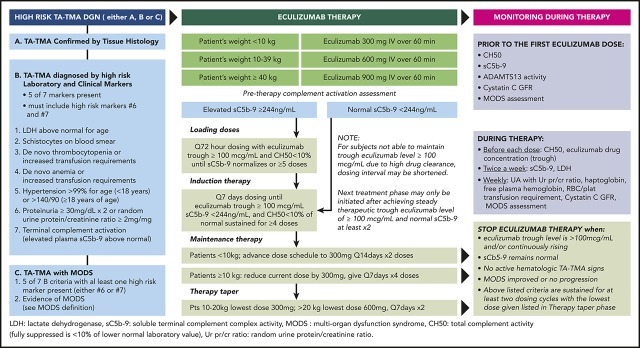
Overactivated complement is a high-risk feature in hematopoietic stem cell transplant (HSCT) recipients with transplant-associated thrombotic microangiopathy (TA-TMA), and untreated patients have dismal outcomes. We present our experience with 64 pediatric HSCT recipients who had high-risk TA-TMA (hrTA-TMA) and multiorgan injury treated with the complement blocker eculizumab. We demonstrate significant improvement to 66% in 1-year post-HSCT survival in treated patients from our previously reported untreated cohort with same hrTA-TMA features that had 1-year post-HSCT survival of 16.7%. Responding patients benefited from a brief but intensive course of eculizumab using pharmacokinetic/pharmacodynamic-guided dosing, requiring a median of 11 doses of eculizumab (interquartile range [IQR] 7-20). Treatment was discontinued because TA-TMA resolved at a median of 66 days (IQR 41-110). Subjects with higher complement activation measured by elevated blood sC5b-9 at the start of treatment were less likely to respond (odds ratio, 0.15; P = .0014) and required more doses of eculizumab (r = 0.43; P = .0004). Patients with intestinal bleeding had the fastest eculizumab clearance, required the highest number of eculizumab doses (20 vs 9; P = .0015), and had lower 1-year survival (44% vs 78%; P = .01). Over 70% of survivors had proteinuria on long-term follow-up. The best glomerular filtration rate (GFR) recovery in survivors was a median 20% lower (IQR, 7.3%-40.3%) than their pre-HSCT GFR. In summary, complement blockade with eculizumab is an effective therapeutic strategy for hrTA-TMA, but some patients with severe disease lacked a complete response, prompting us to propose early intervention and search for additional targetable endothelial injury pathways.
补体过度激活是造血干细胞移植(HSCT)患者伴发移植相关血栓性微血管病(TA-TMA)的高危特征,未经治疗的患者预后不良。我们报告了 64 例接受补体抑制剂依库珠单抗治疗的伴有多器官损伤的高危 TA-TMA(hrTA-TMA)儿科 HSCT 受者的经验。我们证明,与我们之前报道的具有相同 hrTA-TMA 特征且无治疗的未治疗队列相比,治疗组患者在 HSCT 后 1 年的生存率显著提高(从 66%提高至 1 年生存率为 66%)。接受治疗的患者受益于依库珠单抗的短程但强化治疗,该治疗采用药代动力学/药效学指导的剂量给药,中位需要 11 剂依库珠单抗(四分位距 [IQR] 7-20)。中位治疗停止时间为 66 天(IQR 41-110),此时 TA-TMA 已得到缓解。治疗开始时血液 sC5b-9 升高提示补体激活程度更高的患者更可能无反应(比值比,0.15;P =.0014),需要更多剂量的依库珠单抗(r = 0.43;P =.0004)。有肠道出血的患者依库珠单抗清除速度最快,需要的依库珠单抗剂量最高(20 剂比 9 剂;P =.0015),且 1 年生存率较低(44%比 78%;P =.01)。70%以上的幸存者在长期随访中有蛋白尿。幸存者中最佳肾小球滤过率(GFR)恢复中位数比 HSCT 前 GFR 低 20%(IQR,7.3%-40.3%)。总之,依库珠单抗的补体阻断是治疗 hrTA-TMA 的有效治疗策略,但一些病情严重的患者缺乏完全反应,促使我们提出早期干预并寻找其他可靶向的内皮损伤途径。