Department of Trauma-, Hand and Reconstructive Surgery, University Hospital Frankfurt, Frankfurt, Germany.
German Institute for Cell and Tissue Replacement (DIZG gemeinnützige GmbH), Berlin, Germany.
Eur J Trauma Emerg Surg. 2020 Apr;46(2):317-327. doi: 10.1007/s00068-019-01296-x. Epub 2020 Jan 13.
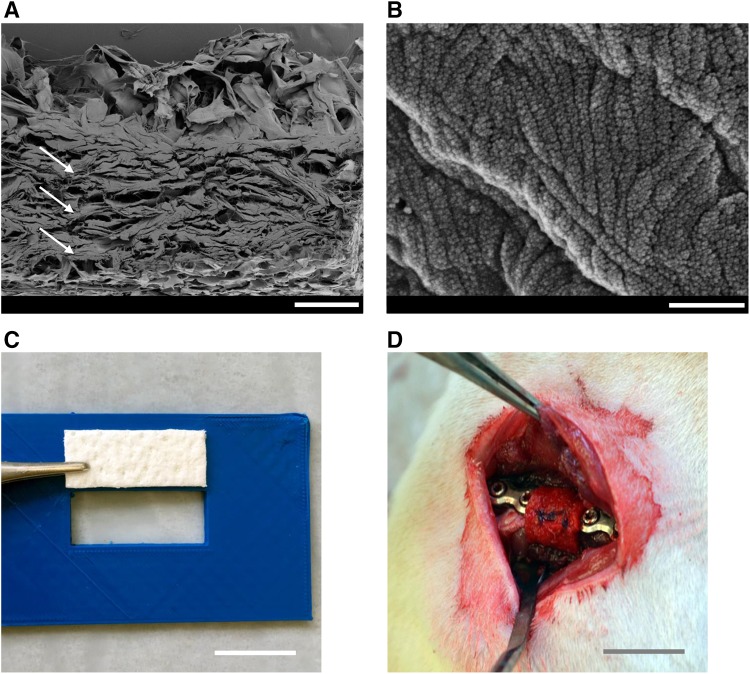
The induced membrane technique for the treatment of large bone defects is a two-step procedure. In the first operation, a foreign body membrane is induced around a spacer, then, in the second step, several weeks or months later, the spacer is removed and the Membrane pocket is filled with autologous bone material. Induction of a functional biological membrane might be avoided by initially using a biological membrane. In this study, the effect of a human acellular dermis (hADM, Epiflex, DIZG gGmbH) was evaluated for the treatment of a large (5 mm), plate-stabilised femoral bone defect.
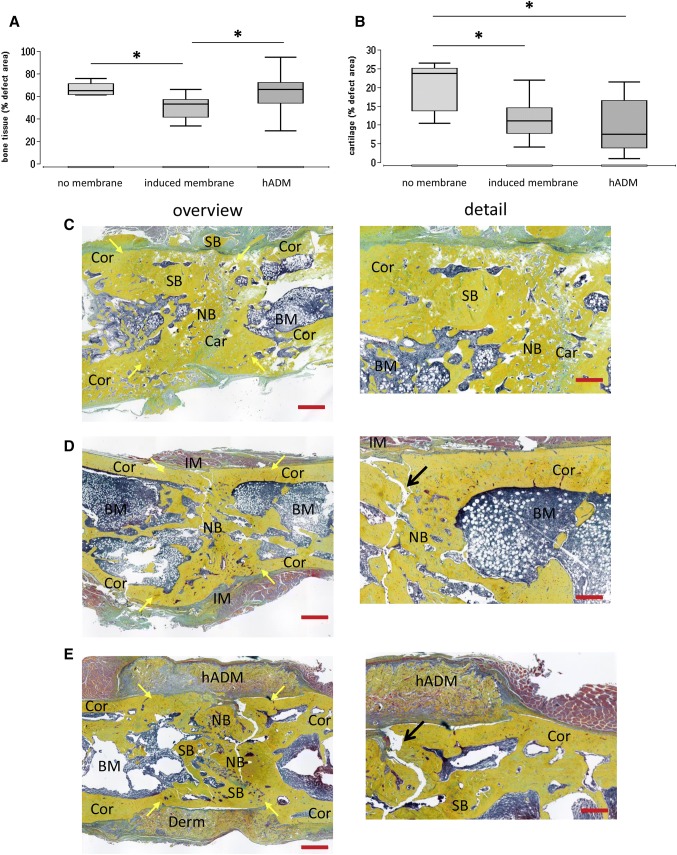
In an established rat model, hADM was compared to the two-stage induced membrane technique and a bone defect without membrane cover. Syngeneous spongiosa from donor animals was used for defect filling in all groups. The group size in each case was n = 5, the induction time of the membrane was 3-4 weeks and the healing time after filling of the defect was 8 weeks.
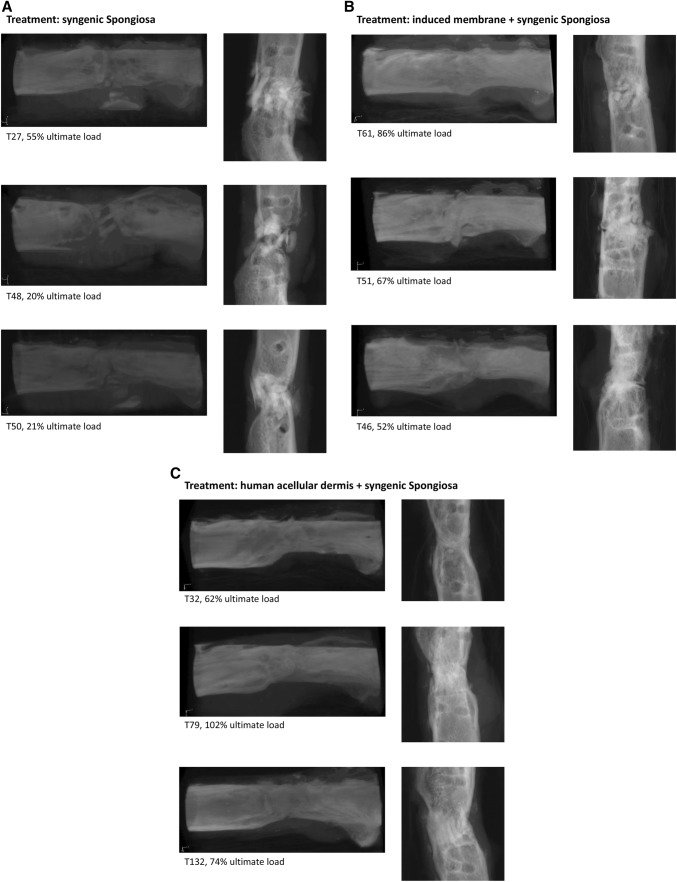
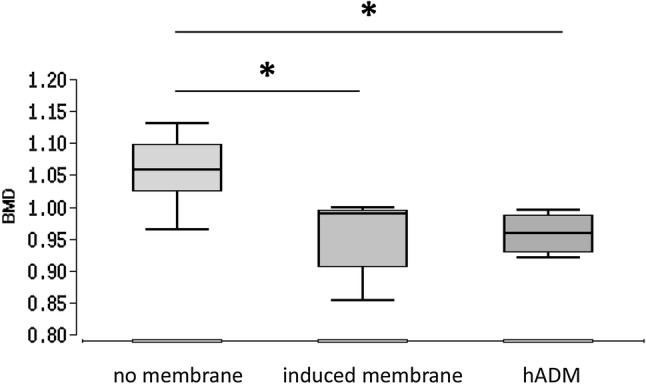
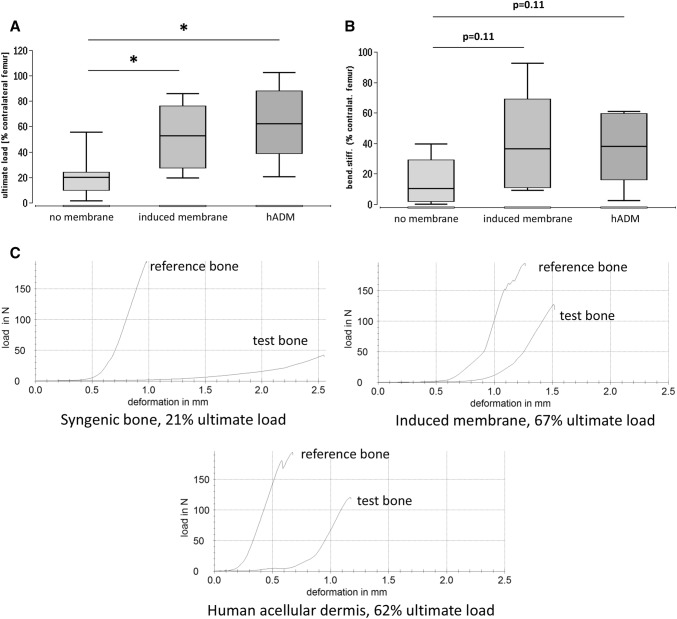
The ultimate loads were increased to levels comparable with native bone in both membrane groups (hADM: 63.2% ± 29.6% of the reference bone, p < 0.05 vs. no membrane, induced membrane: 52.1% ± 25.8% of the reference bone, p < 0.05 vs. no membrane) and were significantly higher than the control group without membrane (21.5%). The membrane groups were radiologically and histologically almost completely bridged by new bone formation, in contrast to the control Group where no closed osseous bridging could be observed.
The use of the human acellular dermis leads to equivalent healing results in comparison to the two-stage induced membrane technique. This could lead to a shortened therapy duration of large bone defects.
诱导膜技术治疗大骨缺损是一个两步法。在第一步手术中,在外来体周围诱导形成一层膜,然后在几周或几个月后,将间隔物取出,将膜袋填满自体骨材料。通过最初使用生物膜,可以避免诱导形成功能性生物膜。在这项研究中,评估了人去细胞真皮(hADM,Epiflex,DIZG gGmbH)在治疗 5mm 大的(5 毫米)、钢板稳定的股骨骨缺损中的作用。
在建立的大鼠模型中,将 hADM 与两阶段诱导膜技术和无膜覆盖的骨缺损进行比较。所有组均使用供体动物的同种异体松质骨进行缺损填充。每组的样本量均为 n = 5,膜的诱导时间为 3-4 周,填充缺损后的愈合时间为 8 周。
在两个膜组中,最终载荷均增加到与天然骨相当的水平(hADM:参考骨的 63.2%±29.6%,p<0.05 与无膜组相比,诱导膜:参考骨的 52.1%±25.8%,p<0.05 与无膜组相比),并且明显高于无膜对照组(21.5%)。与对照组(无膜)相比,膜组在影像学和组织学上几乎完全由新骨形成桥接,而对照组则无法观察到闭合性骨桥接。
与两阶段诱导膜技术相比,使用人去细胞真皮可获得等效的愈合效果。这可能会缩短大骨缺损的治疗时间。