Zhang Jian-Gang, Huang Xiao-Yan, Ma Yun-Bao, Chen Ji-Jun, Geng Chang-An
State Key Laboratory of Phytochemistry and Plant Resources in West China, Kunming Institute of Botany, Chinese Academy of Sciences, Yunnan Key Laboratory of Natural Medicinal Chemistry, 132# Lanhei Road, Kunming, 650201, Yunnan, People's Republic of China.
University of Chinese Academy of Sciences, Beijing, 100049, People's Republic of China.
Nat Prod Bioprospect. 2020 Feb;10(1):23-36. doi: 10.1007/s13659-020-00230-8. Epub 2020 Jan 13.
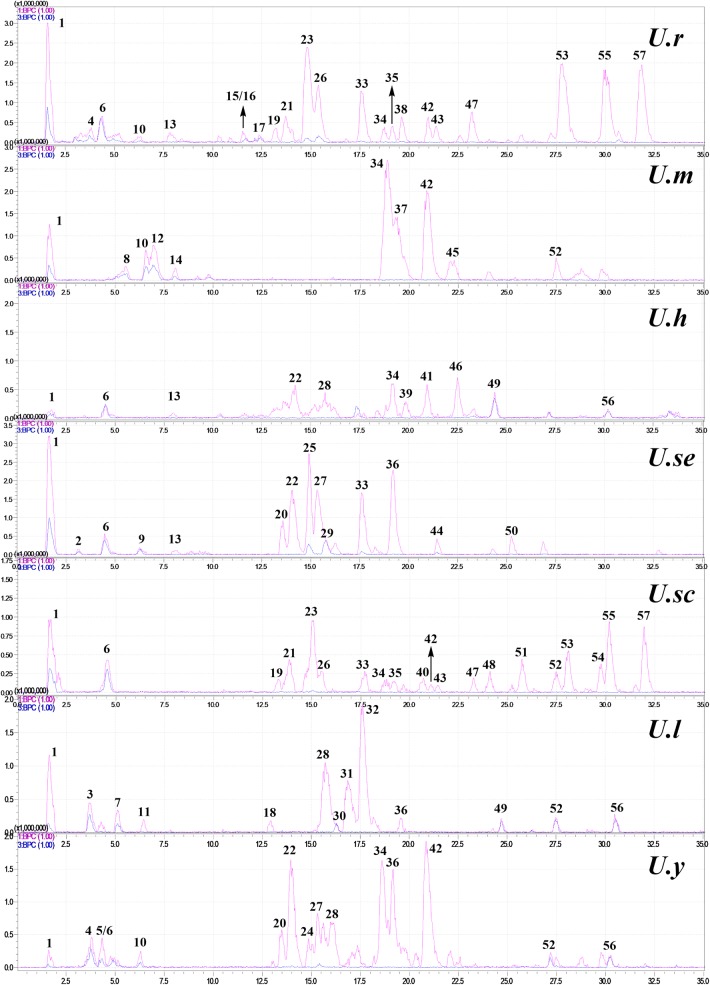
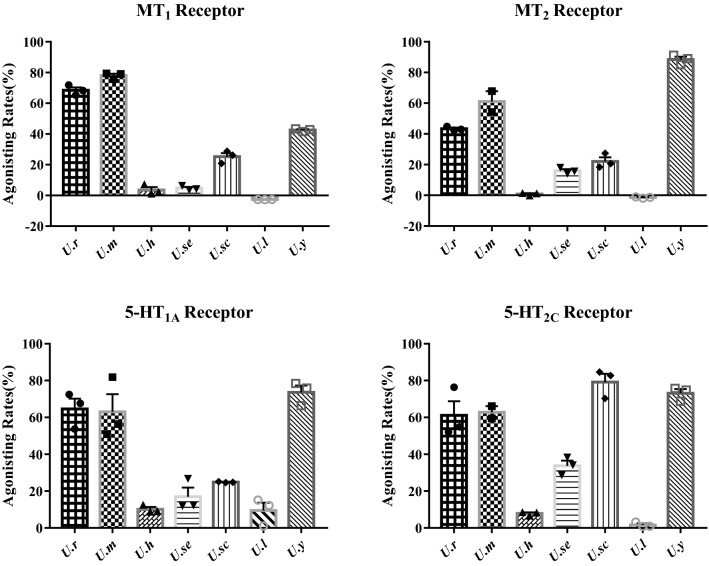
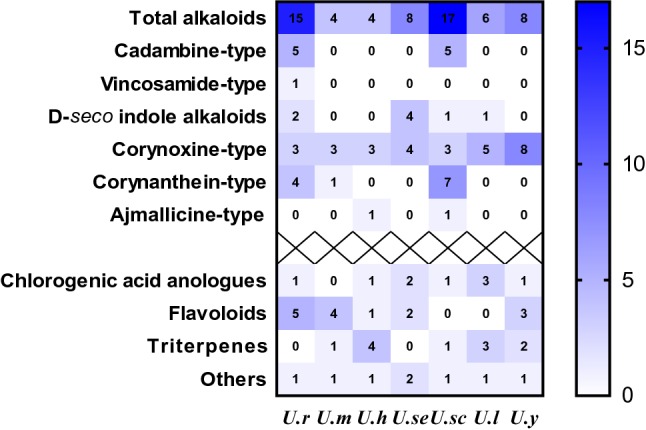
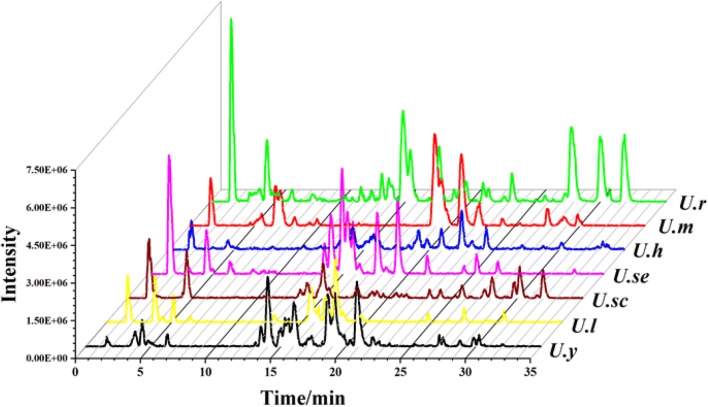
Uncariae Ramulus Cum Uncis (Gou-Teng), the dried hook-bearing stems of several Uncaria plants (Rubiaceae), is a well-known herbal medicine in China. The clinical application of Gou-Teng is bewildered for the morphological and chemical similarity between different species. In order to discern their chemical and biological difference, an ultra-fast liquid chromatography equipped with ion trap time-of-flight mass spectrometry (UFLC-IT/TOF-MS) combining with melatonin (MT and MT) and 5-hydroxytryptamine (5-HT and 5-HT) receptors agonistic assay in vitro was conducted on seven Uncaria species. As a result, 57 compounds including 35 indole alkaloids, ten flavonoids, five triterpenoids, five chlorogenic analogues, and two other compounds were characterized based on their MS/MS patterns and UV absorptions. Specifically, cadambine-type and corynanthein-type alkaloids were exclusively present in U.rhynchophylla and U.scandens, whereas corynoxine-type alkaloids were commonly detected in all the seven Uncaria plants. Three Uncaria species, U. rhynchophylla, U. macrophylla, and U. yunnanensis showed obviously agnostic activity on four neurotransmitter receptors (MT, MT, 5-HT, and 5-HT). This first-time UFLCMS-IT-TOF analyses integrated with biological assay on seven Uncaria plants will provide scientific viewpoints for the clinical application of Gou-Teng.
钩藤为茜草科多种钩藤属植物带钩的干燥茎枝,是我国一味著名的草药。由于不同物种之间形态和化学性质相似,钩藤的临床应用受到困扰。为了辨别它们的化学和生物学差异,对七种钩藤属植物进行了超快速液相色谱-离子阱飞行时间质谱联用(UFLC-IT/TOF-MS)以及褪黑素(MT和MT)和5-羟色胺(5-HT和5-HT)受体体外激动试验。结果,基于二级质谱图和紫外吸收鉴定出57种化合物,包括35种吲哚生物碱、10种黄酮类化合物、5种三萜类化合物、5种绿原酸类似物和2种其他化合物。具体而言,卡丹宾型和柯楠因型生物碱仅存在于钩藤和攀茎钩藤中,而柯诺辛型生物碱在所有七种钩藤属植物中均普遍检测到。三种钩藤属植物,即钩藤、大叶钩藤和云南钩藤,对四种神经递质受体(MT、MT、5-HT和5-HT)表现出明显的激动活性。首次对七种钩藤属植物进行的UFLCMS-IT-TOF分析与生物学试验相结合,将为钩藤的临床应用提供科学依据。