Kumar Sandeep, Principe Daniel R, Singh Sunil Kumar, Viswakarma Navin, Sondarva Gautam, Rana Basabi, Rana Ajay
Department of Surgery, Division of Surgical Oncology, University of Illinois at Chicago, IL 60612, USA.
Jesse Brown VA Medical Center, Chicago, IL 60612, USA.
Pharmaceuticals (Basel). 2020 Jan 7;13(1):9. doi: 10.3390/ph13010009.
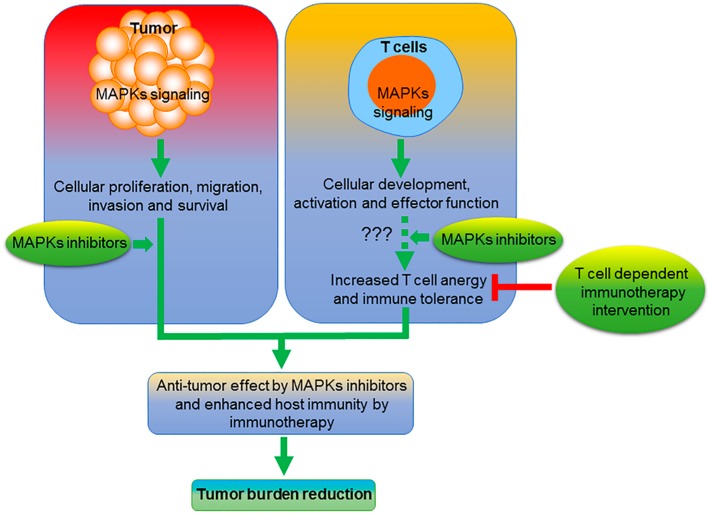
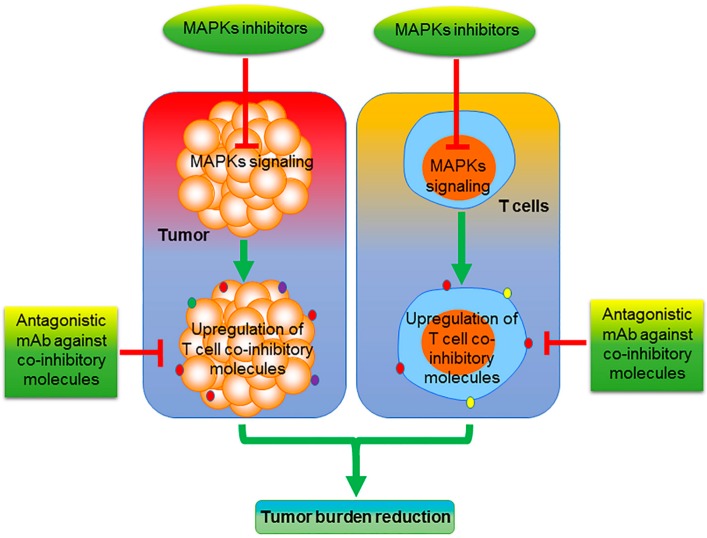
Mitogen-activated protein kinase (MAPK) signaling networks serve to regulate a wide range of physiologic and cancer-associated cell processes. For instance, a variety of oncogenic mutations often lead to hyperactivation of MAPK signaling, thereby enhancing tumor cell proliferation and disease progression. As such, several components of the MAPK signaling network have been proposed as viable targets for cancer therapy. However, the contributions of MAPK signaling extend well beyond the tumor cells, and several MAPK effectors have been identified as key mediators of the tumor microenvironment (TME), particularly with respect to the local immune infiltrate. In fact, a blockade of various MAPK signals has been suggested to fundamentally alter the interaction between tumor cells and T lymphocytes and have been suggested a potential adjuvant to immune checkpoint inhibition in the clinic. Therefore, in this review article, we discuss the various mechanisms through which MAPK family members contribute to T-cell biology, as well as circumstances in which MAPK inhibition may potentiate or limit cancer immunotherapy.
丝裂原活化蛋白激酶(MAPK)信号网络用于调节广泛的生理和癌症相关细胞过程。例如,多种致癌突变通常会导致MAPK信号过度激活,从而增强肿瘤细胞增殖和疾病进展。因此,MAPK信号网络的几个组成部分已被提议作为癌症治疗的可行靶点。然而,MAPK信号的作用远远超出肿瘤细胞,并且几种MAPK效应器已被确定为肿瘤微环境(TME)的关键介质,特别是在局部免疫浸润方面。事实上,有人提出阻断各种MAPK信号会从根本上改变肿瘤细胞与T淋巴细胞之间的相互作用,并被认为在临床上可能是免疫检查点抑制的潜在佐剂。因此,在这篇综述文章中,我们讨论了MAPK家族成员影响T细胞生物学的各种机制,以及MAPK抑制可能增强或限制癌症免疫治疗的情况。