Rutt Cameron L, Jirinec Vitek, Cohn-Haft Mario, Laurance William F, Stouffer Philip C
Biological Dynamics of Forest Fragments Project Instituto Nacional de Pesquisas da Amazônia (INPA) Manaus Brazil.
School of Renewable Natural Resources Louisiana State University and Louisiana State University AgCenter Baton Rouge LA USA.
Ecol Evol. 2019 Nov 27;9(24):13850-13861. doi: 10.1002/ece3.5822. eCollection 2019 Dec.
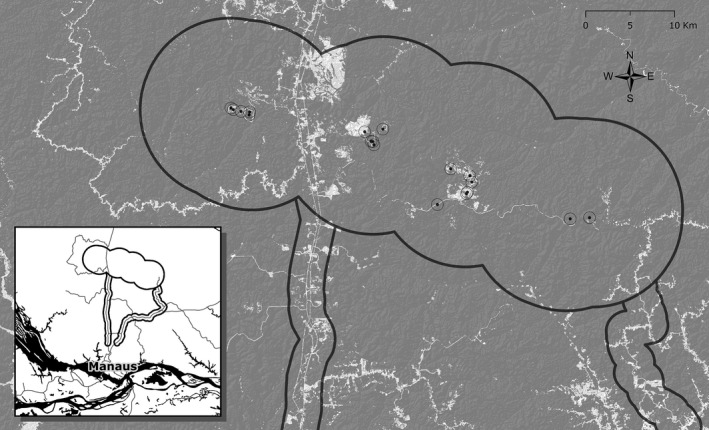
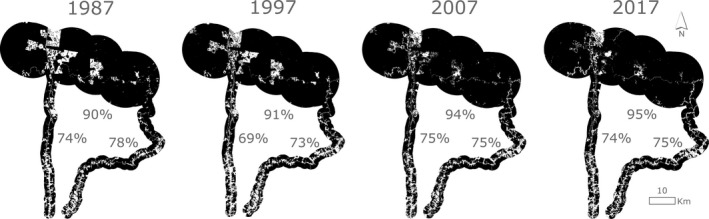
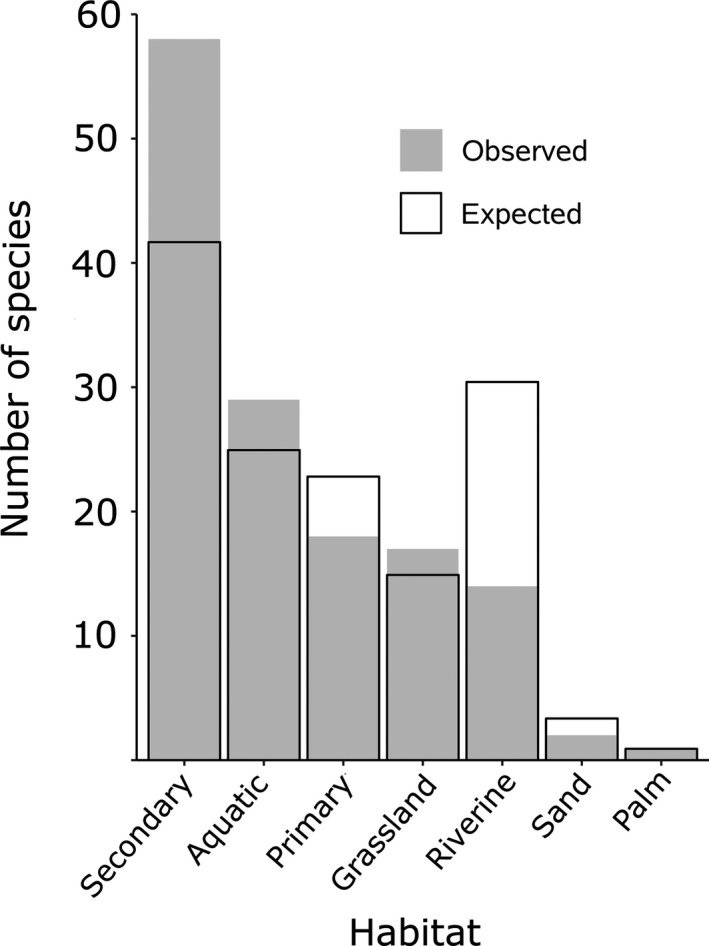
Approximately 20% of the Brazilian Amazon has now been deforested, and the Amazon is currently experiencing the highest rates of deforestation in a decade, leading to large-scale land-use changes. Roads have consistently been implicated as drivers of ongoing Amazon deforestation and may act as corridors to facilitate species invasions. Long-term data, however, are necessary to determine how ecological succession alters avian communities following deforestation and whether established roads lead to a constant influx of new species.We used data across nearly 40 years from a large-scale deforestation experiment in the central Amazon to examine the avian colonization process in a spatial and temporal framework, considering the role that roads may play in facilitating colonization.Since 1979, 139 species that are not part of the original forest avifauna have been recorded, including more secondary forest species than expected based on the regional species pool. Among the 35 species considered to have colonized and become established, a disproportionate number were secondary forest birds (63%), almost all of which first appeared during the 1980s. These new residents comprise about 13% of the current community of permanent residents.Widespread generalists associated with secondary forest colonized quickly following deforestation, with few new species added after the first decade, despite a stable road connection. Few species associated with riverine forest or specialized habitats colonized, despite road connection to their preferred source habitat. Colonizing species remained restricted to anthropogenic habitats and did not infiltrate old-growth forests nor displace forest birds.Deforestation and expansion of road networks into rainforest will continue to create degraded anthropogenic habitat. Even so, the initial pulse of colonization by nonprimary forest bird species was not the beginning of a protracted series of invasions in this study, and the process appears to be reversible by forest succession.
目前,巴西亚马逊地区约20%的土地已遭砍伐,且该地区正经历着十年来最严重的森林砍伐,导致大规模土地利用变化。道路一直被认为是亚马逊地区森林砍伐的驱动因素,可能充当促进物种入侵的通道。然而,需要长期数据来确定森林砍伐后生态演替如何改变鸟类群落,以及现有道路是否会导致新物种不断涌入。我们利用来自亚马逊中部大规模森林砍伐实验近40年的数据,在时空框架内研究鸟类的定殖过程,考虑道路在促进定殖中可能发挥的作用。自1979年以来,已记录到139种不属于原始森林鸟类群落的物种,其中次生林物种数量多于基于区域物种库预期的数量。在被认为已经定殖并站稳脚跟的35个物种中,次生林鸟类占比过高(63%),几乎所有这些物种都是在20世纪80年代首次出现的。这些新居民约占当前永久居民群落的13%。与次生林相关的广泛分布的广适性物种在森林砍伐后迅速定殖,尽管道路连接稳定,但在第一个十年后几乎没有新物种增加。与河流森林或特殊栖息地相关的物种很少定殖,尽管道路连接到它们喜欢的源栖息地。定殖物种仍局限于人为栖息地,没有渗透到老式森林中,也没有取代森林鸟类。森林砍伐和道路网络向雨林的扩张将继续造成退化的人为栖息地。即便如此,在本研究中,非原生森林鸟类物种的最初定殖脉冲并不是一系列长期入侵的开始,而且这个过程似乎可以通过森林演替逆转。