School of Psychology, National University of Ireland Galway, Galway, Ireland.
Psychology Department, Health Service Executive Mid-West, Ennis, Ireland.
JMIR Mhealth Uhealth. 2020 Jan 15;8(1):e12516. doi: 10.2196/12516.
Digital interventions are proposed as one way by which effective treatments for self-harm and suicidal ideation may be improved and their scalability enhanced. Mobile devices offer a potentially powerful medium to deliver evidence-based interventions with greater specificity to the individual when the intervention is needed. The recent proliferation of publicly available mobile apps designed for suicide prevention underlines the need for robust evidence to promote safe practice.
This review aimed to examine the effectiveness of currently available mobile health (mHealth) technology tools in reducing suicide-specific outcomes.
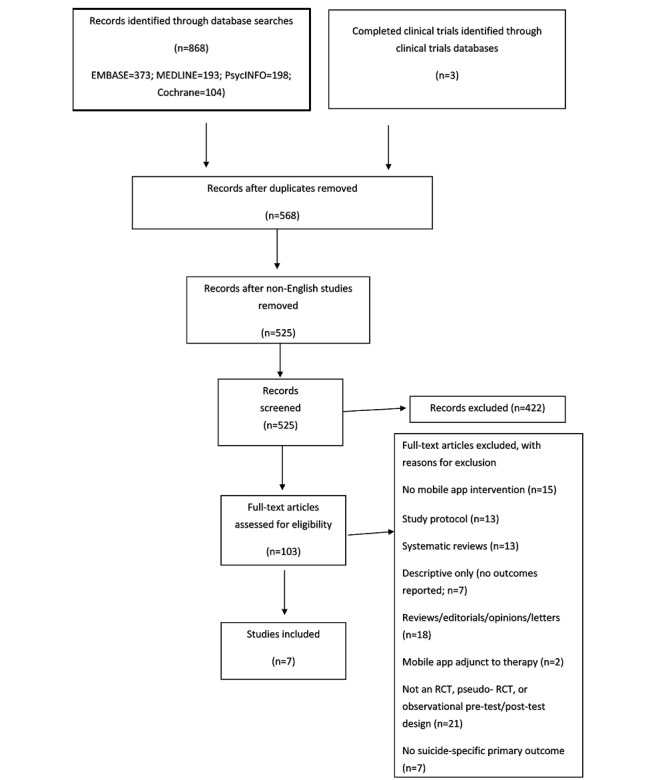
The following databases were searched: Cochrane Central Register of Controlled Trials (The Cochrane Library), MEDLINE, EMBASE, PsycINFO, and relevant sources of gray literature. All published and unpublished randomized controlled trials (RCTs), pseudo-RCTs, and pre-post observational studies that evaluated the effectiveness of mHealth technology in suicide prevention delivered via mobile computing and communication technology were included. Studies were included if they measured at least one suicide outcome variable (ie, suicidal ideation, suicidal intent, nonsuicidal self-injurious behavior, and suicidal behavior). A total of 2 review authors independently extracted data and assessed study suitability, in accordance with the Cochrane Collaboration Risk of Bias Tool, on July 31, 2018. Owing to the heterogeneity of outcomes found across studies, results were not amenable for pooled synthesis, and a meta-analysis was not performed. A narrative synthesis of the available research is presented here.
A total of 7 studies met criteria for inclusion . Four published articles that reported on the effectiveness of the following mobile phone apps were included: iBobbly, Virtual Hope Box, BlueIce, and Therapeutic Evaluative Conditioning. Results demonstrated some positive impacts for individuals at elevated risk of suicide or self-harm, including reductions in depression, psychological distress, and self-harm and increases in coping self-efficacy. None of the apps evaluated demonstrated the ability to significantly decrease suicidal ideation compared with a control condition. In addition, 3 unpublished and recently completed trials also met criteria for inclusion in the review.
Further research is needed to evaluate the efficacy of stand-alone mHealth technology-based interventions in suicide prevention. The small number of studies reported in this review tentatively indicate that such tools may have a positive impact on suicide-specific outcomes. Future mHealth intervention evaluations would benefit from addressing the following 3 main methodological limitations : (1) heterogeneity of outcomes: a lack of standardized measurement of suicide outcomes across studies; (2) ecological validity: the tendency to exclude potential participants because of the elevated suicide risk may reduce generalizability within clinical settings; and (3) app regulation and definition: the lack of a standardized classification system for mHealth intervention type points to the need for better definition of the scope of such technologies to promote safe practice.
PROSPERO CRD42017072899; https://www.crd.york.ac.uk/prospero/display_record.php?RecordID=72899.
INTERNATIONAL REGISTERED REPORT IDENTIFIER (IRRID): RR2-10.2196/resprot.8635.
数字干预措施被提议为改善自我伤害和自杀意念的有效治疗方法并提高其可扩展性的一种方法。移动设备提供了一种潜在强大的媒介,可以在需要时更具体地向个人提供循证干预措施。最近,为预防自杀而设计的公开可用的移动应用程序大量涌现,这突显了需要提供强有力的证据来促进安全实践。
本综述旨在研究当前可用的移动健康(mHealth)技术工具在减少特定于自杀的结果方面的有效性。
检索了以下数据库: Cochrane 对照试验中心注册库(Cochrane 图书馆)、MEDLINE、EMBASE、PsycINFO 和相关的灰色文献来源。纳入了评估通过移动计算和通信技术提供的 mHealth 技术在预防自杀方面有效性的所有已发表和未发表的随机对照试验(RCT)、伪 RCT 和前后观察性研究。如果研究测量了至少一个自杀结局变量(即自杀意念、自杀意图、非自杀性自伤行为和自杀行为),则将其纳入研究。共有 2 名综述作者于 2018 年 7 月 31 日按照 Cochrane 协作风险偏倚工具独立提取数据并评估研究适宜性。由于研究之间的结局存在异质性,因此结果不适于进行汇总分析,因此未进行荟萃分析。这里呈现了对现有研究的叙述性综合。
共有 7 项研究符合纳入标准。纳入了 4 篇已发表的文章,报道了以下移动电话应用程序的有效性:iBobbly、Virtual Hope Box、BlueIce 和治疗性评估性条件作用。结果表明,对于处于自杀或自伤风险较高的个体,某些应用程序具有一些积极影响,包括降低抑郁、心理困扰和自伤发生率以及提高应对自我效能感。与对照组相比,没有一种应用程序能够显著降低自杀意念。此外,还有 3 项未发表且最近完成的试验也符合纳入本综述的标准。
需要进一步研究来评估基于独立的 mHealth 技术的干预措施在预防自杀方面的疗效。本综述报告的少数研究初步表明,此类工具可能对特定于自杀的结局产生积极影响。未来的 mHealth 干预措施评估将受益于解决以下 3 个主要的方法学局限性:(1)结局的异质性:研究之间缺乏标准化的自杀结局测量;(2)生态有效性:由于自杀风险较高而排除潜在参与者的倾向可能会降低临床环境中的普遍性;(3)应用程序监管和定义:缺乏 mHealth 干预类型的标准化分类系统表明需要更好地定义此类技术的范围,以促进安全实践。
PROSPERO CRD42017072899;https://www.crd.york.ac.uk/prospero/display_record.php?RecordID=72899。
国际注册报告标识符(IRRID):RR2-10.2196/resprot.8635。
