Luan Yunpeng, Li Xiang, Luan Yunqi, Zhao Rong, Li Yanmei, Liu Lili, Hao Yizhuo, Oleg Vladimir Burakovaov, Jia Lu
Key Laboratory for Forest Resources Conservation and Utilization in the Southwest Mountains of China, Ministry of Education, Southwest Forestry University, Kunming 650224, China.
Department of Gastrointestinal, The First Affiliated Hospital of Yunnan University of Traditional Chinese Medicine, Nanjing 650021, China; Department of Immunology, School of Basic Medicine, Tongji Medical College, Huazhong University of Science and Technology, Wuhan 430030, China.
Mol Ther Nucleic Acids. 2020 Mar 6;19:790-803. doi: 10.1016/j.omtn.2019.12.009. Epub 2019 Dec 24.
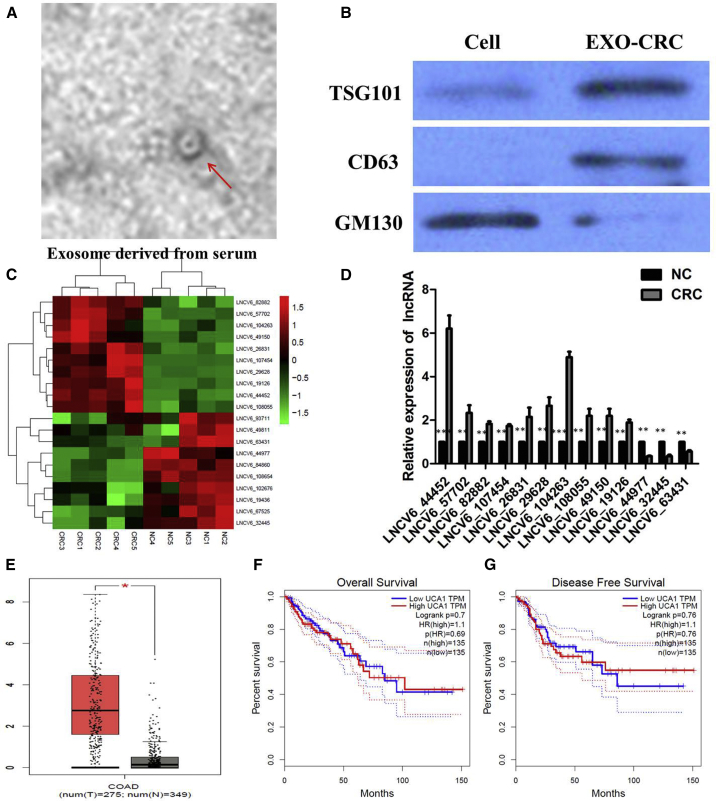
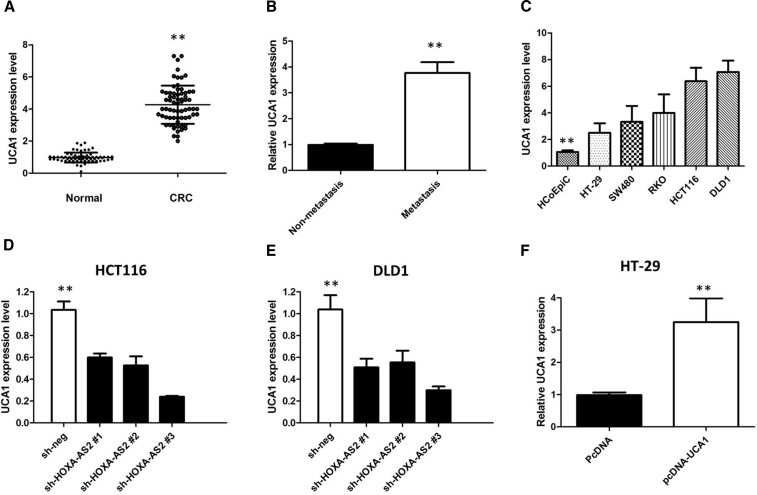
Exosomes mediate cell-cell crosstalk in cancer progression by transferring a variety of biomolecules, including long noncoding RNAs (lncRNAs). Long non-coding RNA urothelial carcinoma-associated (UCA1) is a well-known lncRNA associated with the development and progression of various cancers, including colorectal cancer (CRC). However, the presence of UCA1 in exosomes and the roles and clinical values of exosomal UCA1 in CRC remain unknown. In this study, we systematically analyzed the expression profiles of exosomal lncRNAs in CRC patients using a high-throughput microarray assay. Then, we evaluated the UCA1 expression levels in a series of CRC tissues and the serum exosomes of CRC patients using quantitative real-time PCR. The roles of UCA1 on CRC in vitro and in vivo were investigated by MTT, colony formation, Transwell, quantitative real-time PCR, flow cytometry, and western blotting. The miRNA binding sites of UCA1 were predicted using the miRcode online database, and miR-143 was validated to target UCA1 by dual-luciferase activity assay and AGO2 RNA immunoprecipitation. Finally, the role of exosome-mediated UCA1 was further investigated by co-culturing with CRC cells. This study showed that UCA1 was upregulated in CRC tissues and functioned as an oncogene in CRC. Loss-of-function investigations showed that inhibition of UCA1 suppressed CRC cell proliferation and metastasis in vivo and in vitro. Mechanistically, UCA1 was identified as a miR-143 sponge. We also found that MYO6 was a direct target of miR-1205, which functioned as an oncogene in CRC. Moreover, UCA was also upregulated in the serum exosomes of CRC patients and could transfer UCA1 to CRC cells to increase their abilities of cell proliferation and migration. In conclusion, these data suggest that UCA1 could be an oncogene for CRC and may serve as a candidate target for new therapies in human CRC.
外泌体通过传递多种生物分子(包括长链非编码RNA,即lncRNAs)介导癌症进展过程中的细胞间串扰。长链非编码RNA尿路上皮癌相关分子(UCA1)是一种与包括结直肠癌(CRC)在内的多种癌症的发生和进展相关的著名lncRNA。然而,UCA1在外泌体中的存在情况以及外泌体UCA1在CRC中的作用和临床价值仍不清楚。在本研究中,我们使用高通量微阵列分析系统地分析了CRC患者外泌体lncRNAs的表达谱。然后,我们使用定量实时PCR评估了一系列CRC组织和CRC患者血清外泌体中UCA1的表达水平。通过MTT、集落形成、Transwell、定量实时PCR、流式细胞术和蛋白质印迹法研究了UCA1在体外和体内对CRC的作用。使用miRcode在线数据库预测UCA1的miRNA结合位点,并通过双荧光素酶活性测定和AGO2 RNA免疫沉淀验证miR-143靶向UCA1。最后,通过与CRC细胞共培养进一步研究了外泌体介导的UCA1的作用。本研究表明,UCA1在CRC组织中上调,并在CRC中发挥癌基因作用。功能缺失研究表明,抑制UCA1可在体内和体外抑制CRC细胞增殖和转移。机制上,UCA1被鉴定为miR-143的海绵。我们还发现MYO6是miR-1205的直接靶标,其在CRC中发挥癌基因作用。此外,UCA在CRC患者的血清外泌体中也上调,并且可以将UCA1转移到CRC细胞中以增强其细胞增殖和迁移能力。总之,这些数据表明UCA1可能是CRC的癌基因,并可能作为人类CRC新疗法的候选靶点。