
直系同源的花瓣状TOE型基因中的突变在系统发育上距离较远的真双子叶植物中导致显性重瓣花表型。
Mutations in orthologous PETALOSA TOE-type genes cause a dominant double-flower phenotype in phylogenetically distant eudicots.
作者信息
Gattolin Stefano, Cirilli Marco, Chessa Stefania, Stella Alessandra, Bassi Daniele, Rossini Laura
机构信息
CNR-Consiglio Nazionale delle Ricerche, Istituto di Biologia e Biotecnologia Agraria (IBBA), Milano, Italy.
PTP Science Park, Lodi, Italy.
出版信息
J Exp Bot. 2020 May 9;71(9):2585-2595. doi: 10.1093/jxb/eraa032.
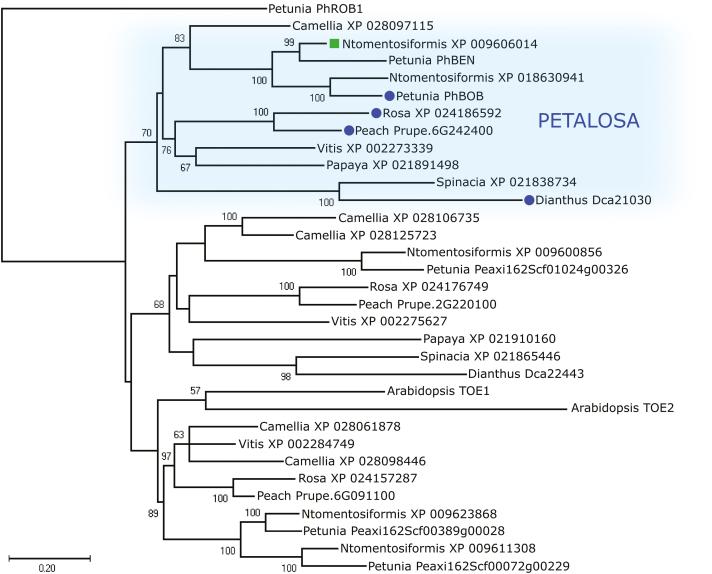
The double-flower phenotype has been selected by humans for its attractiveness in various plant species and it is of great commercial value for the ornamental market. In this study we investigated the genetic determinant of the dominant double-flower trait in carnation, petunia, and Rosa rugosa, and identified mutant alleles of TARGET OF EAT (TOE)-type genes characterized by a disruption of the miR172 target sequence and of the C-terminal portion of the encoded protein. Despite the phylogenetic distance between these eudicots, which diverged in the early Cretaceous, the orthologous genes carrying these mutations all belong to a single TOE-type subgroup, which we name as PETALOSA (PET). Homology searches allowed us to identify PET sequences in various other species. To confirm the results from naturally occurring mutations, we used CrispR-Cas9 to induce lesions within the miR172 target site of Nicotiana tabacum PET genes, and this resulted in the development of supernumerary petaloid structures. This study describes pet alleles in economically important ornamental species and provides evidence about the possibility of identifying and engineering PET genes to obtain the desirable double-flower trait in different plants.
重瓣花表型因其在多种植物物种中的吸引力而被人类选择,对观赏市场具有重要的商业价值。在本研究中,我们调查了康乃馨、矮牵牛和玫瑰中显性重瓣花性状的遗传决定因素,并鉴定了以miR172靶序列和编码蛋白C端部分破坏为特征的EAT靶标(TOE)型基因的突变等位基因。尽管这些真双子叶植物在白垩纪早期就已分化,存在系统发育距离,但携带这些突变的直系同源基因都属于一个单一的TOE型亚组,我们将其命名为PETALOSA(PET)。同源性搜索使我们能够在其他各种物种中鉴定出PET序列。为了证实自然发生突变的结果,我们使用CrispR-Cas9在烟草PET基因的miR172靶位点内诱导损伤,这导致了额外花瓣状结构的发育。本研究描述了经济上重要的观赏物种中的pet等位基因,并提供了关于识别和改造PET基因以在不同植物中获得理想重瓣花性状可能性的证据。


 Zotero 插件