Governini Laura, Semplici Bianca, Pavone Valentina, Crifasi Laura, Marrocco Camilla, De Leo Vincenzo, Arlt Elisabeth, Gudermann Thomas, Boekhoff Ingrid, Luddi Alice, Piomboni Paola
Department of Molecular and Developmental Medicine, Siena University, 53100 Siena, Italy.
Walther Straub Institute of Pharmacology and Toxicology, LMU Munich, 80336 Muenchen, Germany.
J Clin Med. 2020 Jan 18;9(1):264. doi: 10.3390/jcm9010264.
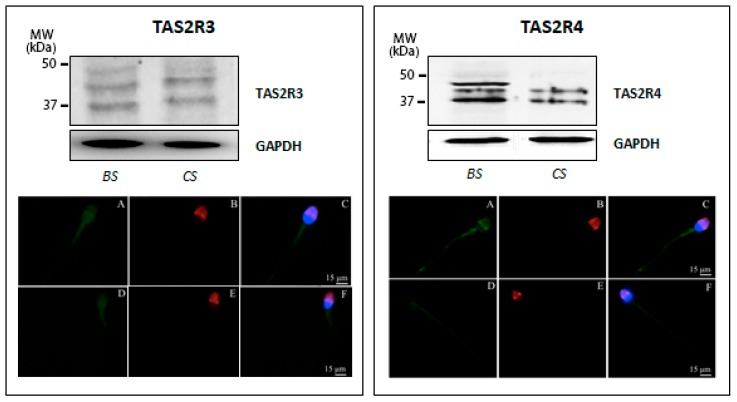
Taste receptors (TASRs) are expressed not only in the oral cavity but also throughout the body, thus suggesting that they may play different roles in organ systems beyond the tongue. Recent studies showed the expression of several TASRs in mammalian testis and sperm, indicating an involvement of these receptors in male gametogenesis and fertility. This notion is supported by an impaired reproductive phenotype of mouse carrying targeted deletion of taste receptor genes, as well as by a significant correlation between human semen parameters and specific polymorphisms of taste receptor genes. To better understand the biological and thus clinical significance of these receptors for human reproduction, we analyzed the expression of several members of the TAS2Rs family of bitter receptors in human testis and in ejaculated sperm before and after in vitro selection and capacitation. Our results provide evidence for the expression of genes, with TAS2R14 being the most expressed bitter receptor subtype in both testis tissue and sperm cells, respectively. In addition, it was observed that in vitro capacitation significantly affects both the expression and the subcellular localization of these receptors in isolated spermatozoa. Interestingly, α-gustducin and α-transducin, two Gα subunits expressed in taste buds on the tongue, are also expressed in human spermatozoa; moreover, a subcellular redistribution of both G protein α-subunits to different sub-compartments of sperm was registered upon in vitro capacitation. Finally, we shed light on the possible downstream transduction pathway initiated upon taste receptor activation in the male reproductive system. Performing ultrasensitive droplets digital PCR assays to quantify RNA copy numbers of a distinct gene, we found a significant correlation between the expression of TAS2Rs and TRPM5 ( = 0.87), the cation channel involved in bitter but also sweet and umami taste transduction in taste buds on the tongue. Even if further studies are needed to clarify the precise functional role of taste receptors for successful reproduction, the presented findings significantly extend our knowledge of the biological role of TAS2Rs for human male fertility.
味觉受体(TASRs)不仅在口腔中表达,也在全身各处表达,这表明它们可能在舌头以外的器官系统中发挥不同作用。最近的研究表明,几种TASRs在哺乳动物的睾丸和精子中表达,表明这些受体参与雄性配子发生和生育能力。携带味觉受体基因靶向缺失的小鼠的生殖表型受损,以及人类精液参数与味觉受体基因特定多态性之间的显著相关性,都支持了这一观点。为了更好地理解这些受体对人类生殖的生物学及临床意义,我们分析了苦味受体TAS2Rs家族的几个成员在人类睾丸以及体外筛选和获能前后的射出精子中的表达。我们的结果为这些基因的表达提供了证据,其中TAS2R14分别是睾丸组织和精子细胞中表达最多的苦味受体亚型。此外,观察到体外获能显著影响这些受体在分离精子中的表达和亚细胞定位。有趣的是,α - 味导素和α - 转导素这两种在舌头上的味蕾中表达的Gα亚基,也在人类精子中表达;此外,体外获能后,这两种G蛋白α亚基在精子的不同亚区室发生了亚细胞重新分布。最后,我们阐明了雄性生殖系统中味觉受体激活后可能启动的下游转导途径。通过进行超灵敏液滴数字PCR分析来定量一个特定基因的RNA拷贝数,我们发现TAS2Rs的表达与TRPM5(r = 0.87)之间存在显著相关性,TRPM5是一种阳离子通道,参与舌头上味蕾中的苦味以及甜味和鲜味味觉转导。即使需要进一步研究来阐明味觉受体对成功生殖的确切功能作用,但所呈现的研究结果显著扩展了我们对TAS2Rs在人类男性生育中的生物学作用的认识。