Vincent Flora, Bowler Chris
lnstitut de Biologie de l'ENS, Département de Biologie, École Normale Supérieure, CNRS, INSERM, Université PSL, Paris, France.
lnstitut de Biologie de l'ENS, Département de Biologie, École Normale Supérieure, CNRS, INSERM, Université PSL, Paris, France
mSystems. 2020 Jan 21;5(1):e00444-19. doi: 10.1128/mSystems.00444-19.
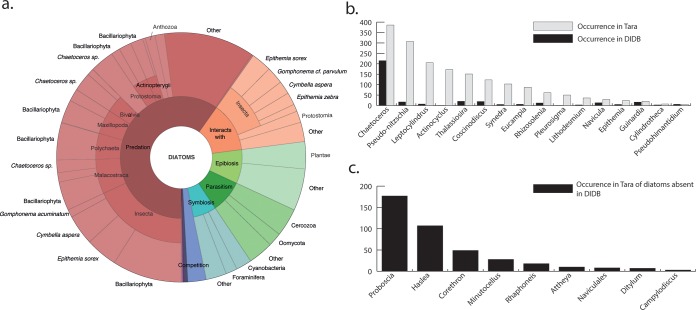
Diatoms are a major component of phytoplankton, believed to be responsible for around 20% of the annual primary production on Earth. As abundant and ubiquitous organisms, they are known to establish biotic interactions with many other members of plankton. Through analyses of cooccurrence networks derived from the Oceans expedition that take into account both biotic and abiotic factors in shaping the spatial distributions of species, we show that only 13% of diatom pairwise associations are driven by environmental conditions; the vast majority are independent of abiotic factors. In contrast to most other plankton groups, on a global scale, diatoms display a much higher proportion of negative correlations with other organisms, particularly toward potential predators and parasites, suggesting that their biogeography is constrained by top-down pressure. Genus-level analyses indicate that abundant diatoms are not necessarily the most connected and that species-specific abundance distribution patterns lead to negative associations with other organisms. In order to move forward in the biological interpretation of cooccurrence networks, an open-access extensive literature survey of diatom biotic interactions was compiled, of which 18.5% were recovered in the computed network. This result reveals the extent of what likely remains to be discovered in the field of planktonic biotic interactions, even for one of the best-known organismal groups. Diatoms are key phytoplankton in the modern ocean that are involved in numerous biotic interactions, ranging from symbiosis to predation and viral infection, which have considerable effects on global biogeochemical cycles. However, despite recent large-scale studies of plankton, we are still lacking a comprehensive picture of the diversity of diatom biotic interactions in the marine microbial community. Through the ecological interpretation of both inferred microbial association networks and available knowledge on diatom interactions compiled in an open-access database, we propose an ecosystems approach for exploring diatom interactions in the ocean.
硅藻是浮游植物的主要组成部分,据信其贡献了地球上约20%的年度初级生产力。作为丰富且分布广泛的生物,它们与许多其他浮游生物成员建立了生物相互作用。通过对“海洋”考察中得出的共现网络进行分析,该分析考虑了塑造物种空间分布的生物和非生物因素,我们发现只有13%的硅藻两两关联是由环境条件驱动的;绝大多数关联与非生物因素无关。与大多数其他浮游生物类群不同,在全球范围内,硅藻与其他生物的负相关比例要高得多,尤其是与潜在的捕食者和寄生虫,这表明它们的生物地理学受到自上而下压力的限制。属级分析表明,丰富的硅藻不一定是连接性最强的,而且物种特异性的丰度分布模式会导致与其他生物产生负相关。为了在共现网络的生物学解释方面取得进展,我们编制了一份关于硅藻生物相互作用的开放获取的广泛文献综述,其中18.5%在计算出的网络中被发现。这一结果揭示了浮游生物相互作用领域中可能仍有待发现的内容的范围,即使是对于最知名的生物类群之一也是如此。硅藻是现代海洋中的关键浮游植物,参与了从共生到捕食和病毒感染等众多生物相互作用,这些相互作用对全球生物地球化学循环有相当大的影响。然而,尽管最近对浮游生物进行了大规模研究,但我们仍然缺乏对海洋微生物群落中硅藻生物相互作用多样性的全面了解。通过对推断的微生物关联网络以及开放获取数据库中汇编的关于硅藻相互作用的现有知识进行生态学解释,我们提出了一种生态系统方法来探索海洋中的硅藻相互作用。