Institute of Microbiology, University of Greifswald, Greifswald, Germany.
Max Planck Institute for Marine Microbiology, 28359 Bremen, Germany.
FEMS Microbiol Ecol. 2024 Apr 10;100(5). doi: 10.1093/femsec/fiae037.
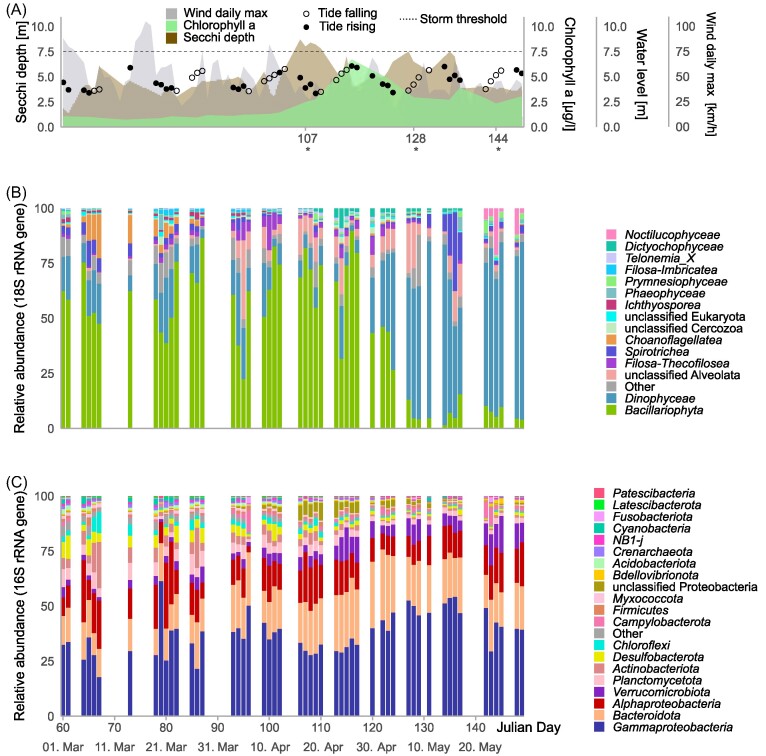
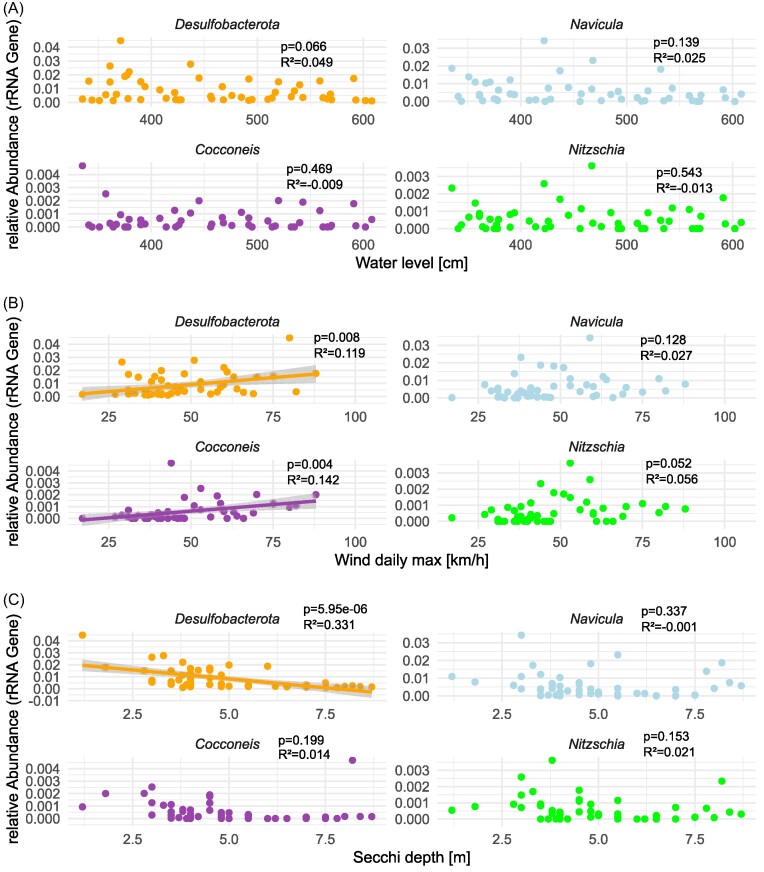
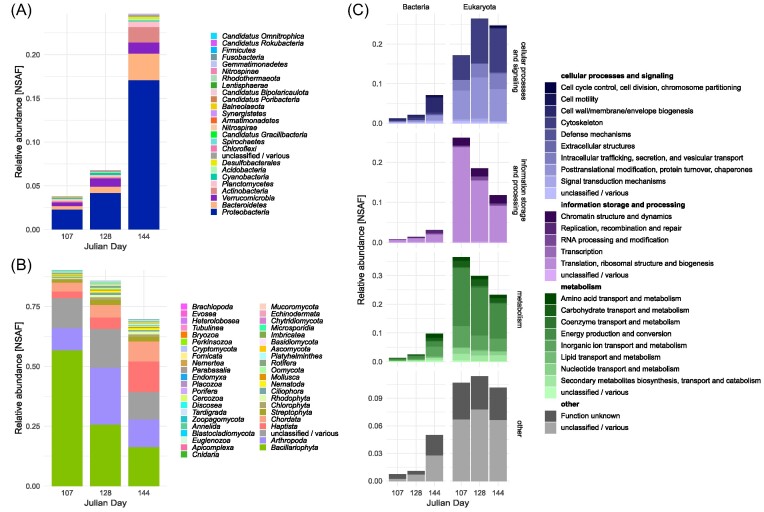
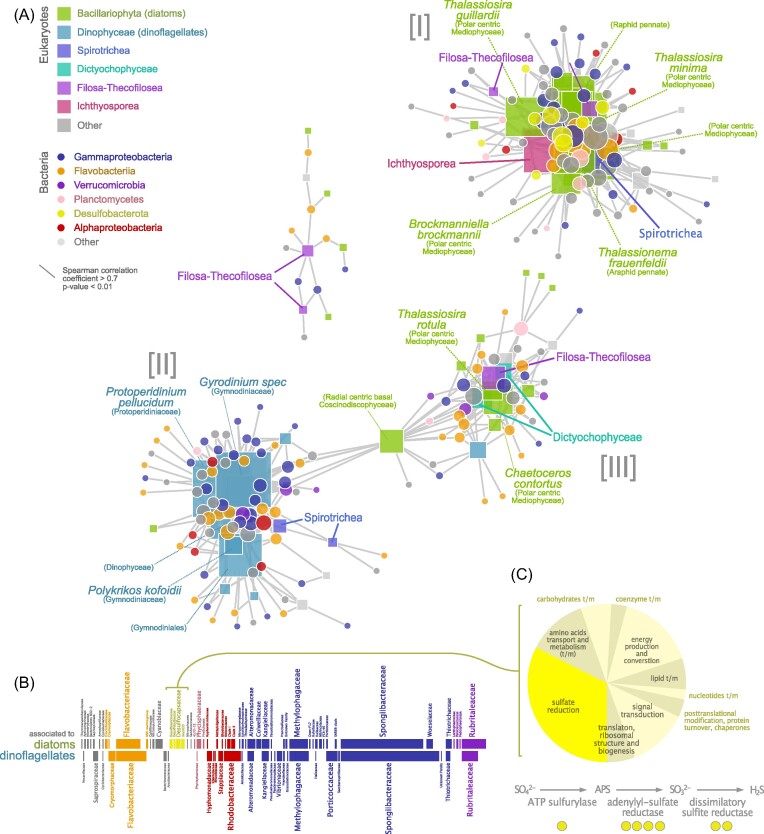
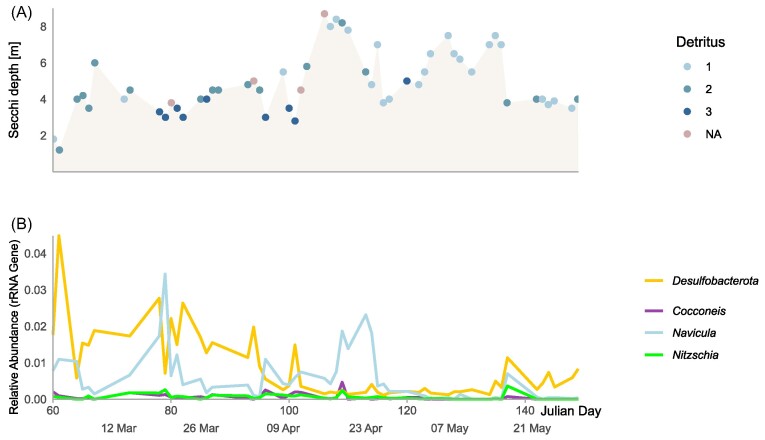
Phytoplankton blooms fuel marine food webs with labile dissolved carbon and also lead to the formation of particulate organic matter composed of living and dead algal cells. These particles contribute to carbon sequestration and are sites of intense algal-bacterial interactions, providing diverse niches for microbes to thrive. We analyzed 16S and 18S ribosomal RNA gene amplicon sequences obtained from 51 time points and metaproteomes from 3 time points during a spring phytoplankton bloom in a shallow location (6-10 m depth) in the North Sea. Particulate fractions larger than 10 µm diameter were collected at near daily intervals between early March and late May in 2018. Network analysis identified two major modules representing bacteria co-occurring with diatoms and with dinoflagellates, respectively. The diatom network module included known sulfate-reducing Desulfobacterota as well as potentially sulfur-oxidizing Ectothiorhodospiraceae. Metaproteome analyses confirmed presence of key enzymes involved in dissimilatory sulfate reduction, a process known to occur in sinking particles at greater depths and in sediments. Our results indicate the presence of sufficiently anoxic niches in the particle fraction of an active phytoplankton bloom to sustain sulfate reduction, and an important role of benthic-pelagic coupling for microbiomes in shallow environments. Our findings may have implications for the understanding of algal-bacterial interactions and carbon export during blooms in shallow-water coastal areas.
浮游植物水华通过不稳定的溶解碳为海洋食物网提供燃料,还会导致由活的和死的藻类细胞组成的颗粒有机物质的形成。这些颗粒有助于碳封存,是藻类-细菌相互作用的热点,为微生物提供了多样化的生境以茁壮成长。我们分析了从北海一个浅水区(水深 6-10 米)2018 年春季浮游植物水华的 51 个时间点获得的 16S 和 18S 核糖体 RNA 基因扩增子序列和 3 个时间点的宏蛋白质组学数据。在 2018 年 3 月初至 5 月底期间,每隔一天采集一次大于 10 µm 直径的颗粒部分。网络分析确定了两个主要模块,分别代表与硅藻和甲藻共现的细菌。硅藻网络模块包括已知的硫酸盐还原菌脱硫杆菌门以及可能的硫氧化外硫红螺菌科。宏蛋白质组学分析证实了参与异化硫酸盐还原的关键酶的存在,该过程已知在较深的下沉颗粒中和沉积物中发生。我们的研究结果表明,在活跃的浮游植物水华的颗粒部分中存在足够的缺氧小生境来维持硫酸盐还原,以及浅海环境中底栖-浮游耦合对微生物组的重要作用。我们的发现可能对理解浅水沿海地区浮游植物水华期间的藻类-细菌相互作用和碳输出具有重要意义。