Departamento de Informática, Escuela Superior de Ingeniería, Universidad de Almería, ceiA3, CIESOL, Ctra. Sacramento s/n, 04120 Almería, Spain.
Convenio Universidad de Almería, Plataforma Solar de Almería, Ctra. Senés s/n, 04200 Tabernas, Almería, Spain.
Sensors (Basel). 2020 Jan 21;20(3):596. doi: 10.3390/s20030596.
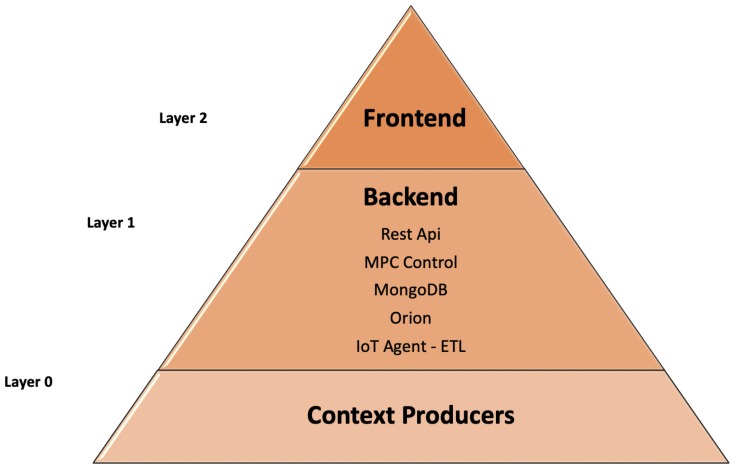
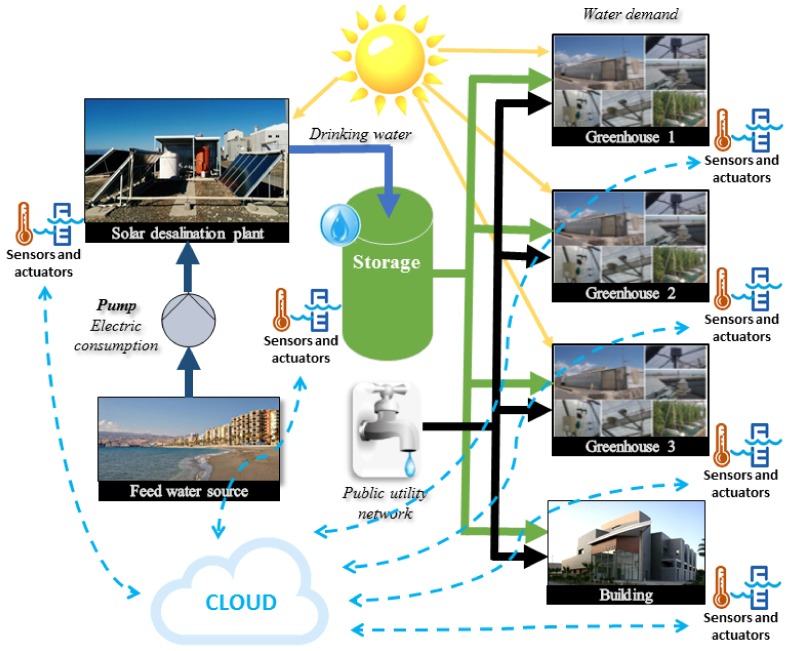
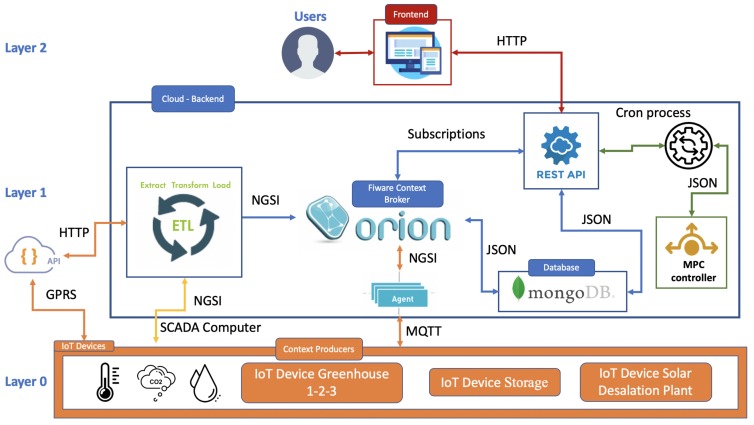
The current agricultural water panorama in many Mediterranean countries is composed by desalination facilities, wells (frequently overexploited), the water public utility network, and several consumer agents with different water needs. This distributed water network requires centralized management methods for its proper use, which are difficult to implement as the different agents are usually geographically separated. In this sense, the use of enabling technologies such as the Internet of Things can be essential to the proper operation of these agroindustrial systems. In this paper, an Internet of Things cloud architecture based on the FIWARE standard is proposed for interconnecting the several agents that make up the agroindustrial system. In addition, this architecture includes an efficient management method based on a model predictive control technique, which is aimed at minimizing operating costs. A case study inspired by three real facilities located in Almería (southeast of Spain) is used as the simulation test bed. The obtained results show how around 75% of the total operating costs can be saved with the application of the proposed approach, which could be very significant to decrease the costs of desalinated water and, therefore, to maintain the sustainability of the agricultural system.
目前,许多地中海国家的农业用水格局由海水淡化设施、水井(经常过度开采)、公共供水管网和具有不同用水需求的几个消费者组成。这个分布式的水网络需要集中管理方法来正确使用,但是由于不同的代理通常在地理上是分开的,因此很难实施。在这种情况下,使用物联网等使能技术对于这些农业产业系统的正常运行可能是必不可少的。在本文中,提出了一种基于 FIWARE 标准的物联网云架构,用于互连构成农业产业系统的几个代理。此外,该架构还包括一种基于模型预测控制技术的高效管理方法,旨在最大限度地降低运营成本。该架构以位于西班牙东南部阿尔梅里亚的三个实际设施为灵感,用作模拟测试平台。所获得的结果表明,通过应用所提出的方法可以节省约 75%的总运营成本,这对于降低淡化水的成本、从而维持农业系统的可持续性具有非常重要的意义。