Research Division, Joslin Diabetes Center, Boston, MA.
Department of Medicine, Harvard Medical School, Boston, MA.
Diabetes. 2020 Apr;69(4):771-783. doi: 10.2337/db19-0973. Epub 2020 Jan 23.
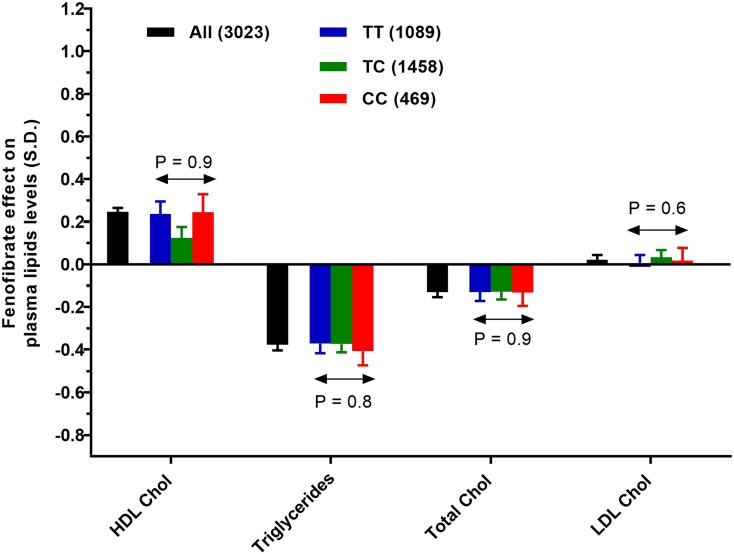
The cardiovascular benefits of fibrates have been shown to be heterogeneous and to depend on the presence of atherogenic dyslipidemia. We investigated whether genetic variability in the gene, coding for the pharmacological target of fibrates (PPAR-α), could be used to improve the selection of patients with type 2 diabetes who may derive cardiovascular benefit from addition of this treatment to statins. We identified a common variant at the locus (rs6008845, C/T) displaying a study-wide significant influence on the effect of fenofibrate on major cardiovascular events (MACE) among 3,065 self-reported white subjects treated with simvastatin and randomized to fenofibrate or placebo in the ACCORD-Lipid trial. T/T homozygotes (36% of participants) experienced a 51% MACE reduction in response to fenofibrate (hazard ratio 0.49; 95% CI 0.34-0.72), whereas no benefit was observed for other genotypes ( = 3.7 × 10). The rs6008845-by-fenofibrate interaction on MACE was replicated in African Americans from ACCORD ( = 585, = 0.02) and in external cohorts (ACCORD-BP, ORIGIN, and TRIUMPH, total = 3059, = 0.005). Remarkably, rs6008845 T/T homozygotes experienced a cardiovascular benefit from fibrate even in the absence of atherogenic dyslipidemia. Among these individuals, but not among carriers of other genotypes, fenofibrate treatment was associated with lower circulating levels of CCL11-a proinflammatory and atherogenic chemokine also known as eotaxin ( for rs6008845-by-fenofibrate interaction = 0.003). The GTEx data set revealed regulatory functions of rs6008845 on expression in many tissues. In summary, we have found a common regulatory variant that influences the cardiovascular effects of fenofibrate and that could be used to identify patients with type 2 diabetes who would derive benefit from fenofibrate treatment, in addition to those with atherogenic dyslipidemia.
贝特类药物的心血管益处具有异质性,并且取决于致动脉粥样硬化性血脂异常的存在。我们研究了 基因(编码贝特类药物的药理学靶点 PPAR-α)的遗传变异是否可用于改善 2 型糖尿病患者的选择,这些患者可能从添加这种治疗方法到他汀类药物中获益于心血管。我们在 ACCORD-Lipid 试验中鉴定了一个位于 基因座(rs6008845,C/T)的常见变异,该变异在 3065 名自报为白人的接受辛伐他汀治疗并随机分配接受非诺贝特或安慰剂的受试者中,对非诺贝特治疗对主要心血管事件(MACE)的影响具有全研究范围的显著影响。T/T 纯合子(36%的参与者)对非诺贝特的 MACE 降低了 51%(风险比 0.49;95%CI 0.34-0.72),而其他基因型则没有获益( = 3.7×10)。在 ACCORD 中的非裔美国人( = 585, = 0.02)和外部队列(ACCORD-BP、ORIGIN 和 TRIUMPH,总 = 3059, = 0.005)中复制了 rs6008845-非诺贝特对 MACE 的相互作用。值得注意的是,即使没有致动脉粥样硬化性血脂异常,rs6008845 T/T 纯合子也能从贝特类药物中获益于心血管。在这些个体中,而非在其他基因型的携带者中,非诺贝特治疗与循环 CCL11 水平降低相关,CCL11 是一种促炎和致动脉粥样硬化的趋化因子,也称为嗜酸细胞趋化因子(对于 rs6008845-非诺贝特相互作用, = 0.003)。GTEx 数据集揭示了 rs6008845 对许多组织中 表达的调节作用。总之,我们发现了一种常见的 调节变异,它影响非诺贝特的心血管作用,并且可以用于识别除了有动脉粥样硬化性血脂异常的 2 型糖尿病患者之外,还可以识别那些从非诺贝特治疗中获益的患者。