Alfatni Abrar, Riou Marianne, Charles Anne-Laure, Meyer Alain, Barnig Cindy, Andres Emmanuel, Lejay Anne, Talha Samy, Geny Bernard
Unistra, Translational Medicine Federation of Strasbourg (FMTS), Faculty of Medicine, Team 3072 "Mitochondria, Oxidative Stress and Muscle Protection", 11 rue Humann, 67000 Strasbourg, France.
University Hospital of Strasbourg, Physiology and Functional Exploration Service, 1 Place de l'Hôpital, 67091 Strasbourg CEDEX, France.
J Clin Med. 2020 Jan 22;9(2):311. doi: 10.3390/jcm9020311.
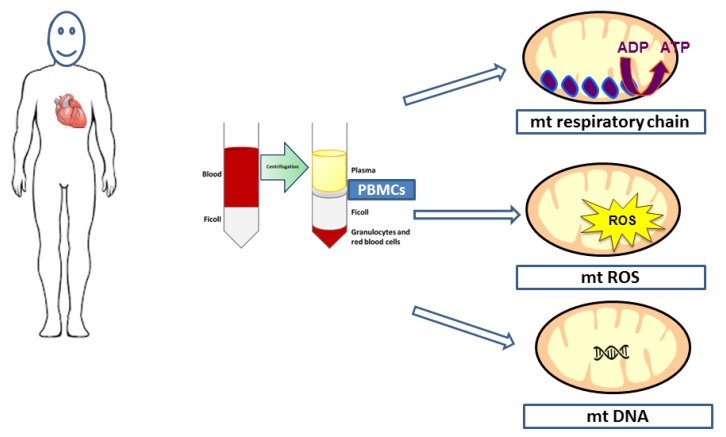
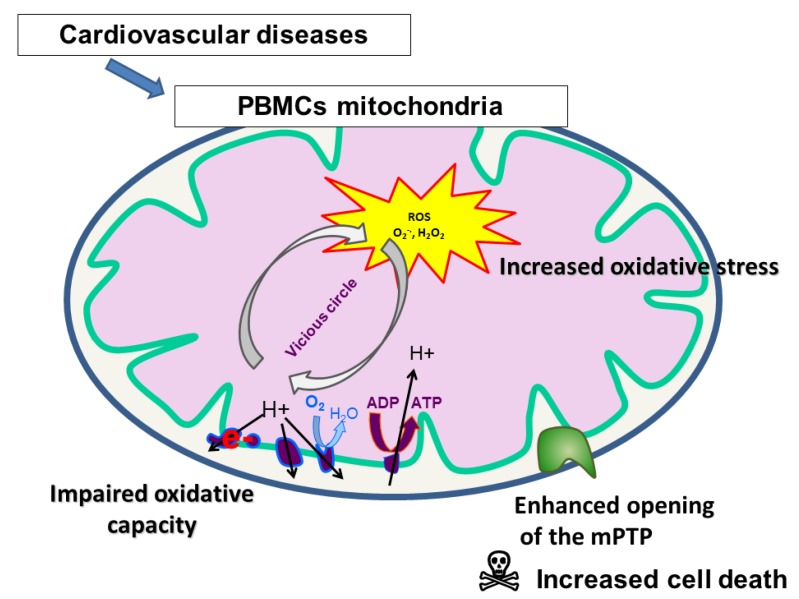
Cardiovascular diseases (CVDs) are devastating disorders and the leading cause of mortality worldwide. The pathophysiology of cardiovascular diseases is complex and multifactorial and, in the past years, mitochondrial dysfunction and excessive production of reactive oxygen species (ROS) have gained growing attention. Indeed, CVDs can be considered as a systemic alteration, and understanding the eventual implication of circulating blood cells peripheral blood mononuclear cells (PBMCs) and or platelets, and particularly their mitochondrial function, ROS production, and mitochondrial DNA (mtDNA) releases in patients with cardiac impairments, appears worthwhile. Interestingly, reports consistently demonstrate a reduced mitochondrial respiratory chain oxidative capacity related to the degree of CVD severity and to an increased ROS production by PBMCs. Further, circulating mtDNA level was generally modified in such patients. These data are critical steps in term of cardiac disease comprehension and further studies are warranted to challenge the possible adjunct of PBMCs' and platelets' mitochondrial dysfunction, oxidative stress, and circulating mtDNA as biomarkers of CVD diagnosis and prognosis. This new approach might also allow further interesting therapeutic developments.
心血管疾病(CVDs)是极具破坏性的疾病,也是全球范围内主要的死亡原因。心血管疾病的病理生理学复杂且具有多因素性,在过去几年中,线粒体功能障碍和活性氧(ROS)的过量产生受到了越来越多的关注。事实上,心血管疾病可被视为一种全身性改变,了解循环血细胞(外周血单核细胞(PBMCs)和/或血小板)的最终影响,特别是它们在心脏功能受损患者中的线粒体功能、ROS产生以及线粒体DNA(mtDNA)释放,似乎是有价值的。有趣的是,报告一致表明,线粒体呼吸链氧化能力的降低与心血管疾病的严重程度相关,且PBMCs产生的ROS增加。此外,此类患者的循环mtDNA水平通常会发生改变。就理解心脏疾病而言,这些数据是关键步骤,有必要进行进一步研究,以探究PBMCs和血小板的线粒体功能障碍、氧化应激以及循环mtDNA作为心血管疾病诊断和预后生物标志物的可能性。这种新方法也可能带来进一步有趣的治疗进展。