Coronel-Ruiz Carolina, Gutiérrez-Barbosa Hernando, Medina-Moreno Sandra, Velandia-Romero Myriam L, Chua Joel V, Castellanos Jaime E, Zapata Juan C
Grupo de Virología, Vicerrectoría de Investigaciones, Universidad El Bosque, Bogotá 110121, Colombia.
Institute of Human Virology, University of Maryland School of Medicine, Baltimore, MD 21201, USA.
Vaccines (Basel). 2020 Jan 22;8(1):39. doi: 10.3390/vaccines8010039.
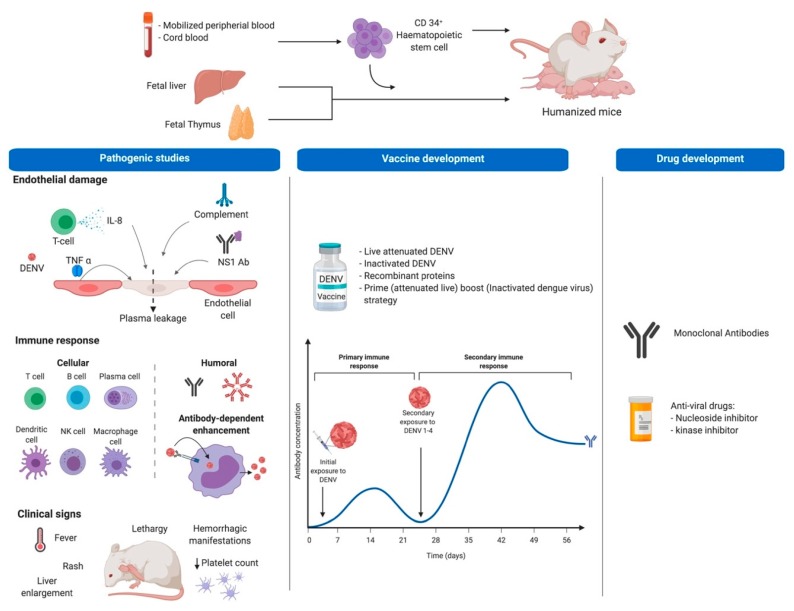
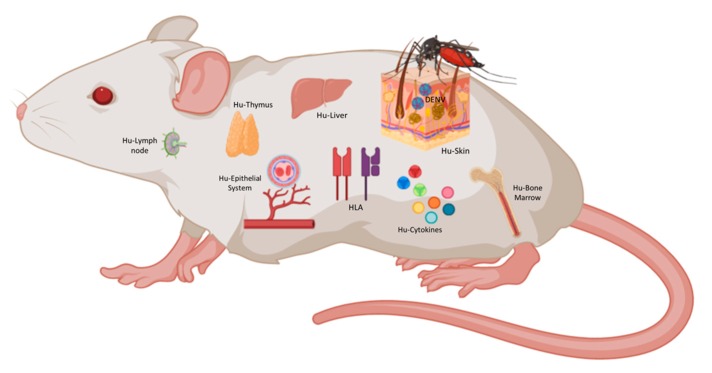
Dengue virus (DENV) is an arbovirus of the Flaviviridae family and is an enveloped virion containing a positive sense single-stranded RNA genome. DENV causes dengue fever (DF) which is characterized by an undifferentiated syndrome accompanied by fever, fatigue, dizziness, muscle aches, and in severe cases, patients can deteriorate and develop life-threatening vascular leakage, bleeding, and multi-organ failure. DF is the most prevalent mosquito-borne disease affecting more than 390 million people per year with a mortality rate close to 1% in the general population but especially high among children. There is no specific treatment and there is only one licensed vaccine with restricted application. Clinical and experimental evidence advocate the role of the humoral and T-cell responses in protection against DF, as well as a role in the disease pathogenesis. A lot of pro-inflammatory factors induced during the infectious process are involved in increased severity in dengue disease. The advances in DF research have been hampered by the lack of an animal model that recreates all the characteristics of this disease. Experiments in nonhuman primates (NHP) had failed to reproduce all clinical signs of DF disease and during the past decade, humanized mouse models have demonstrated several benefits in the study of viral diseases affecting humans. In DENV studies, some of these models recapitulate specific signs of disease that are useful to test drugs or vaccine candidates. However, there is still a need for a more complete model mimicking the full spectrum of DENV. This review focuses on describing the advances in this area of research.
登革病毒(DENV)是黄病毒科的一种虫媒病毒,是一种包膜病毒粒子,含有正链单链RNA基因组。登革病毒引起登革热(DF),其特征是一种未分化的综合征,伴有发热、疲劳、头晕、肌肉疼痛,在严重情况下,患者会病情恶化,出现危及生命的血管渗漏、出血和多器官衰竭。登革热是最常见的蚊媒疾病,每年影响超过3.9亿人,一般人群的死亡率接近1%,但在儿童中尤其高。目前没有特效治疗方法,只有一种应用受限的许可疫苗。临床和实验证据表明体液和T细胞反应在预防登革热中起作用,以及在疾病发病机制中的作用。感染过程中诱导的许多促炎因子与登革热疾病的严重程度增加有关。登革热研究的进展因缺乏能够重现该疾病所有特征的动物模型而受阻。在非人类灵长类动物(NHP)身上进行的实验未能重现登革热疾病的所有临床症状,在过去十年中,人源化小鼠模型在研究影响人类的病毒性疾病方面已显示出若干益处。在登革病毒研究中,其中一些模型概括了对测试药物或候选疫苗有用的特定疾病体征。然而,仍然需要一个更完整的模型来模拟登革病毒的全谱。本综述重点描述了该研究领域的进展。